

Creatine does not add body fat. Taken consistently and paired with resistance training, it tends to raise lean mass, can nudge body fat percentage down slightly, and often adds a few pounds of water weight early on. The scale rises, but what the scale is made of matters more than the number. This guide explains what happens, what to expect in the first 30 days, and how to measure it accurately.
TL;DR
- Randomized trials lasting from one week to two years do not support the idea that creatine increases fat mass.
- The first scale jump is mostly water. A loading phase typically adds 1 to 3 kg (about 2 to 7 lb), mostly from water held in the body.
- Paired with resistance training, creatine is linked to more lean mass and a small drop in body fat percentage.
- Standard dosing is 3 to 5 g of creatine monohydrate per day. Loading is optional.
- Scale weight can't separate water, muscle and fat. A DEXA scan can, so use it as your before-and-after measure.
Table of Contents
- What creatine actually does in your body
- Does creatine change body fat?
- Lean mass: where the real gains show up
- Water weight: why the scale jumps first
- What the first 30 days usually look like
- How much creatine to take
- If you run or train hybrid
- Why the scale and BMI can't tell you what creatine did
- Perspective
- How to track creatine's effect with DEXA
- Find a DEXA scan near you
- Common mistakes when judging creatine results
- FAQ
- Sources
What creatine actually does in your body
Creatine is not a foreign compound. It is a non-protein amino acid your body makes, mainly in the liver and kidneys, and you also get it from red meat and seafood (review of creatine supplementation protocols). Supplementing raises the stores in your muscles.
Those stores matter because they help you perform repeated, high-intensity efforts. The International Society of Sports Nutrition (ISSN) position stand notes that creatine can improve high-intensity exercise capacity, which lets athletes train harder and promotes greater muscle growth over time (ISSN position stand).
So creatine is not a fat burner and not a stimulant. It works through training quality. You get an extra rep or two, a bit more volume per week, and over months that adds up. Understanding this indirect route explains most of what you see in body composition data.
Does creatine change body fat?
The short answer: it does not increase it, and it may lower body fat percentage modestly.
A 2021 review of common creatine questions and misconceptions found that randomized controlled trials lasting from one week to two years do not validate the claim that creatine supplementation increases fat mass. The same review reports that older adults who combined creatine with resistance training had a greater reduction in body fat percentage (Journal of the International Society of Sports Nutrition, 2021).
Meta-analyses back up the direction of that finding. A 2024 analysis indicates that creatine combined with resistance training can lead to a small reduction in body fat percentage (PubMed, 2024). A 2023 analysis in adults under 50 found a small but significant reduction in body fat percentage, without a matching decrease in absolute fat mass (PubMed, 2023).
That last detail is worth understanding. Body fat percentage is fat mass divided by total body mass. If lean mass and water go up while fat stays about the same, the percentage falls even though you haven't lost a pound of fat. It is a real change in composition, but it is not the same as fat loss. Be wary of any claim that creatine melts fat.
There is also a research perspective that creatine's possible effect on fat in older adults may involve adipose tissue energy use and expenditure (PMC, 2019). It is an open area, so treat it as a hypothesis rather than a promise.

Lean mass: where the real gains show up
The most consistent finding is on the lean side. In longer studies summarized by the ISSN, people taking creatine monohydrate gained roughly 2 to 4 extra pounds of muscle mass over 4 to 12 weeks of training compared with placebo (ISSN position stand). A broader review of protocols found that creatine increased body mass and fat-free mass, with larger body composition effects in studies where it was combined with resistance training (protocol review).
Researchers think several things are at work:
- Better training output. More work done per session gives muscle more reason to grow.
- Cell swelling. Water drawn into muscle cells has been suggested as a key stimulus for growth (scoping review).
- Signaling and protein synthesis. Current evidence suggests creatine may influence muscle growth through multiple pathways, including protein synthesis and myogenesis (PubMed, 2017).
Notice the phrase "combined with resistance training" recurring in every source. Creatine amplifies a training program. It does not replace one.
Water weight: why the scale jumps first
The first change most people notice is on the bathroom scale. The 2021 review states that an initial loading phase typically increases body mass by 1 to 3 kg, mostly from net body water retention, and that evidence does not show creatine increases fat mass (2021 review).
That water sits mostly inside muscle cells, not under the skin as puffiness. For a lifter, it is part of the process. For someone in a weight class or a strict cut, it can be unwelcome, which is one reason loading is optional.
How much weight gain is normal?
For most people on a standard 3 to 5 g daily dose without loading, the rise is gradual and modest. With a loading phase, expect it to arrive within about a week. If you load, a 1 to 3 kg change (roughly 2 to 7 lb) is the range the research describes.
What if you gain 10 pounds?
If the scale is up 10 pounds after starting creatine, creatine water is unlikely to be the whole story, based on the 1 to 3 kg range above. Look at the other variables first:
- Did your calorie intake rise, for example from a mass-gain shake you added alongside creatine?
- Did you start a new training block that is adding real muscle?
- Did you change your sodium, carbohydrate or fluid intake?
- Are you comparing a morning weigh-in with an evening one?
The fix is to measure composition rather than guess. A scan separates fat, lean tissue and bone, so you can see whether the extra weight is lean, fat, or a mix. If the weight gain is large, sudden, or comes with swelling or other symptoms, talk to your doctor.
What the first 30 days usually look like
There is no single trial that defines "day 30," so here is a realistic picture built from the findings above. Individual results vary.
| Timeframe | What you may notice | What is likely going on |
|---|---|---|
| Week 1 | Scale up a few pounds if you load; little change if you don't | Muscle creatine stores filling, water drawn into muscle |
| Weeks 2 to 3 | Slightly better performance on hard sets, muscles looking fuller | Stores saturated; more training volume possible |
| Week 4 | Scale stable or creeping up; strength trending up | Water weight plateaued; early training adaptations |
| Weeks 8 to 12 | Measurable lean mass differences in studies | Cumulative training effect, not water alone |
The takeaway: judge creatine on a 8 to 12 week horizon, not on a 30-day scale reading. Our guide to DEXA scan timing explains why 8 to 12 weeks is a sensible interval for body composition changes.
How much creatine to take
Is creatine dosed by body weight? Not necessarily. The NIH Office of Dietary Supplements lists a typical creatine dose of 20 g per day for up to 7 days, followed by 3 to 5 g per day for up to 12 weeks. It also describes weight-based alternatives of about 0.3 g/kg/day for loading and 0.03 to 0.1 g/kg/day for gradual dosing (NIH ODS).
Once muscle stores are saturated, the ISSN says maintenance generally requires 3 to 5 g per day, though larger athletes may need as much as 5 to 10 g per day (ISSN position stand).
A simple approach for most people:
- Choose creatine monohydrate. NIH ODS identifies it as the most widely used and studied form and says other forms have not been proven superior for raising muscle creatine, digestibility, stability or safety (NIH ODS).
- Take 3 to 5 g daily with a meal or shake, at whatever time you will remember.
- Skip loading if you are cutting weight or dislike the idea of a quick scale jump. Stores still fill over a few weeks.
- Stay consistent. The effect comes from saturated muscle stores, not from timing tricks.
In the United States, creatine is sold as a dietary supplement and regulated by the FDA under the Dietary Supplement Health and Education Act, signed into law in 1994 (ISSN position stand). That means quality varies between brands, so choose products that carry third-party testing. If you have kidney disease, take medications, are pregnant, or are under 18, check with your doctor or pharmacist before starting.
If you run or train hybrid
Endurance and hybrid athletes often avoid creatine because they fear the extra weight. If that is you, the water weight question is a fair one, and it is worth reading about creatine for endurance training before deciding. Whatever you choose, track body composition rather than only weight. Our piece on body composition for runners shows what a scan adds to your training picture.
Why the scale and BMI can't tell you what creatine did
A scale reports one number. Creatine can push that number up while you simultaneously gain muscle, hold fat steady and lower your body fat percentage. Body mass index has the same blind spot, because it uses only height and weight. See BMI vs DEXA for why the two can disagree.
Home tools such as bioimpedance scales estimate composition from electrical resistance, which is affected by hydration. Since creatine changes where your body holds water, those readings can drift for reasons unrelated to fat or muscle. DEXA uses low-dose X-rays to report fat mass, lean mass and bone mineral content, which is why it is the reference many athletes and coaches choose. By the platform's own account, a DEXA scan measures body fat with a precision of about ±1 to 2%.

That precision matters when your expected change is small. If creatine helps you add 2 to 4 pounds of lean mass over a training block, you need a measurement with low enough noise to see it. Our guide on DEXA scans for athletes covers how to tell real muscle change from scan-to-scan noise.
Perspective
Most people ask us whether creatine will make them fatter. After looking at the research and at how people use body composition scans, we think that is the wrong question. The better question is: what is the extra weight made of?
A scale can't answer that. A DEXA scan can. It separates fat, lean tissue and bone, so you can see whether creatine is doing what the studies suggest: supporting more lean mass while fat stays flat. We built Dexascans so that anyone can find a verified clinic, compare cash prices and book without a physician referral. That access is the point. Good data should not depend on insurance paperwork.
Our advice is to scan before you start creatine, train consistently, and scan again after 8 to 12 weeks. Use the same clinic, the same time of day and similar hydration each time, so the comparison is fair. The result tells you more than any weigh-in will.
Erik
How to track creatine's effect with DEXA
To get a clean read, set up your scans like an experiment:
- Baseline scan before creatine. Book it before your first dose, or before you load.
- Standardize the conditions. Scan at a similar time of day, with similar food and fluid intake, and in similar clothing. Ask the clinic for its prep instructions.
- Re-scan at 8 to 12 weeks. That interval is long enough for training adaptations to show.
- Read the right numbers. Look at total lean mass, fat mass and body fat percentage. For muscle specifically, the lean mass index and other key metrics are more meaningful than any single headline figure. Remember that lean mass on a scan includes the water held within muscle.
- Stay with one clinic and machine where possible. Comparing across machines adds noise.
If your goal is fat loss rather than muscle gain, our guide to tracking real fat loss with DEXA explains how to separate fat change from water change. Lifters preparing for a physique goal may also like what DEXA can and can't tell you for bodybuilding. And if you are older and concerned about muscle loss, see sarcopenia and DEXA.
Find a DEXA scan near you
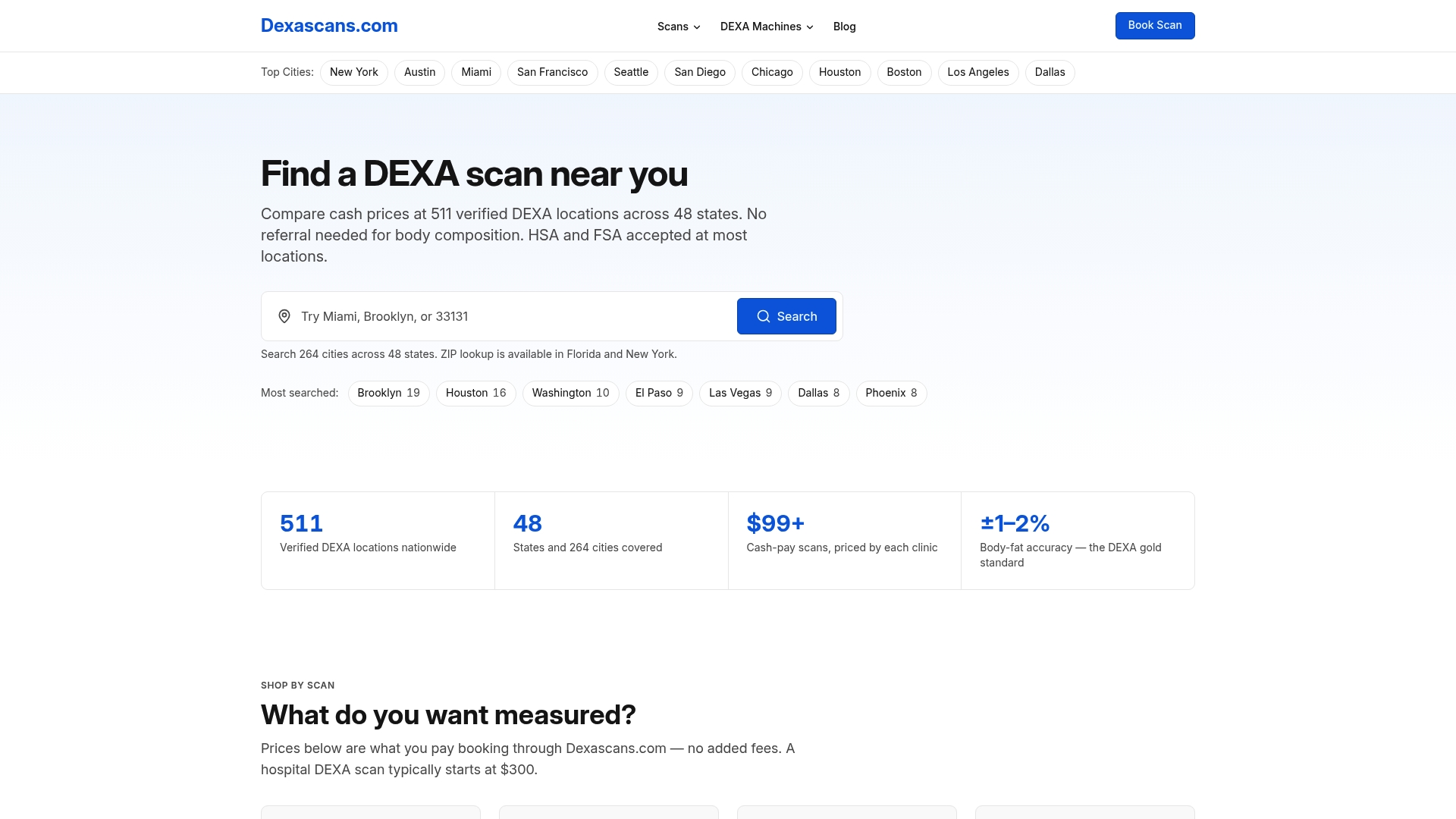
Dexascans lists 511 verified locations across 48 states where you can book a body composition scan without a referral. You can search by city or ZIP, compare cash prices, and check which scan types each clinic offers, including combined appointments and add-ons such as VO2 max and RMR. Start with our body composition scan page, or see DEXA scan costs near you to compare before you book.
A baseline scan costs you one appointment. It turns the next 12 weeks of creatine from guesswork into a measured result.
Common mistakes when judging creatine results
- Reading the first week as fat gain. The early jump is mostly water, not fat, according to the 2021 review cited above.
- Stopping because of scale weight. If your goal is performance or muscle, a few pounds of water inside muscle is usually part of the process.
- Skipping the training. The body composition benefits in the research show up mainly when creatine is paired with resistance training.
- Changing everything at once. New diet, new program and new supplement together make it impossible to know what caused what.
- Comparing different measurement methods. A home scale reading and a DEXA result are not interchangeable.
FAQ
Is creatine naturally present in the body?
Yes. Your body makes creatine, mainly in the liver and kidneys, and you also take it in from red meat and seafood. Supplements raise the amount stored in your muscles above what diet and natural production typically provide.
Does creatine make you gain fat?
No evidence supports that. Randomized trials ranging from one week to two years do not show that creatine increases fat mass. Weight gained early is mostly water, and over time creatine paired with training is linked to more lean mass.
Is creatine intake based on body weight?
It can be, but it does not have to be. Fixed doses of 3 to 5 g per day are the common standard, while weight-based protocols use about 0.03 to 0.1 g per kg per day for gradual dosing. Larger athletes may use more, as the ISSN notes.
What happens after 30 days of creatine?
Muscle stores are typically saturated, scale weight has settled after any early water gain, and you may be lifting a bit more volume. Changes in lean mass are better judged at 8 to 12 weeks, ideally with a DEXA scan.
Do I need to load creatine?
No. A 20 g per day loading phase for 5 to 7 days fills muscle stores faster, but daily maintenance doses get you to the same place over a few weeks. Skipping the load avoids the quick water weight jump.
Sources
- Common questions and misconceptions about creatine supplementation, Journal of the International Society of Sports Nutrition (2021)
- The effect of creatine supplementation on resistance training, meta-analysis (2024)
- Resistance exercise and creatine supplementation on fat mass (2023)
- Changes in fat mass following creatine supplementation (2019)
- ISSN position stand on creatine supplementation (2007)
- Creatine supplementation protocols with or without training
- Creatine supplementation for muscle growth: a scoping review
- Creatine supplementation and skeletal muscle metabolism (2017)
- NIH Office of Dietary Supplements: Exercise and Athletic Performance
- ISSN position stand on safety and efficacy of creatine
- Creatine for endurance training