

Lean mass index (LMI) equals your lean mass in kilograms divided by your height in meters squared, and it isolates muscle, organs, and bone rather than mixing them with fat like body mass index does. That distinction matters most when you care about muscle health, aging, or clinical risk, since LMI tracks the tissue that actually predicts strength and metabolic function. Getting an accurate number depends on a solid lean-mass measurement, with a DXA scan the most reliable source.
TL;DR:
- A reliable LMI depends on a precise lean-mass measurement from a DEXA scan, as estimates from scales or formulas can be inaccurate.
- DXA provides a highly accurate total lean mass, correlating closely with MRI and CT, but reference ranges vary by device and population.
- LMI declines with age after 50, and lower-than-normal values, especially alongside weakness, warrant medical consultation.
- Comparing LMI over time is more meaningful than raw numbers, especially if different measurement methods or devices are used.
- Using LMI together with functional assessments offers a better picture of muscle health than relying on a single ratio or muscle mass figure alone.
Table of Contents
- What lean mass index actually measures
- How to calculate LMI step by step
- DXA versus field methods for measuring lean mass
- Interpreting your LMI: ranges, age, and sex differences
- LMI versus BMI, ALMI, and other indices
- Tracking and improving your LMI responsibly
- Why a DEXA scan gives you the most trustworthy LMI
- A brief guide to using LMI alongside function and health goals
- Book a DXA scan and get a lean mass index you can trust
- Sources
- FAQ
What lean mass index actually measures
Lean mass isn't just muscle. It includes skeletal muscle, organs, bone, connective tissue, and body water, everything left over once you subtract fat mass from total body weight. That's a broader category than "muscle mass" alone, which is why a DEXA report and a bathroom scale can tell wildly different stories about the same body.
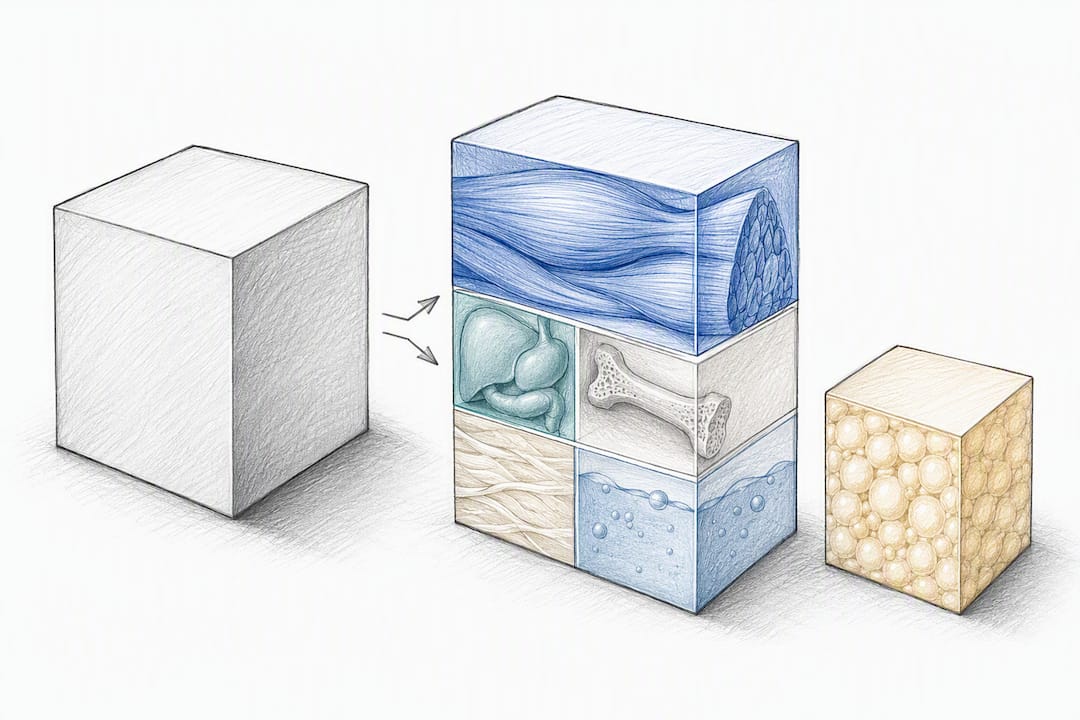
BMI can't see any of this. It takes weight and height and spits out a single number that treats a bodybuilder and someone carrying excess fat the same way if they weigh the same and stand the same height. LMI fixes that blind spot by isolating the tissue that actually drives strength, metabolic rate, and long-term health outcomes.
That's why clinicians and fitness professionals increasingly lean on it:
- It separates muscle-driven health from fat-driven health, something BMI structurally cannot do.
- It gives a stature-adjusted number, so a 5-foot-2 person and a 6-foot-4 person can be compared fairly.
- It's the metric researchers use to screen for age-related muscle loss, not just general weight status.
How to calculate LMI step by step
The formula is simple once you have a trustworthy lean-mass figure: LMI = lean mass (kg) ÷ height (m)².
- Convert your units. If your DEXA report or scale gives lean mass in pounds, divide by 2.2046 to get kilograms. If your height is in feet and inches, convert the whole thing to inches, then multiply by 0.0254 to get meters.
- Square your height in meters, then divide your lean mass in kilograms by that number.
Here's a worked example. A woman is 5 feet 6 inches tall (1.68 meters) and her DEXA scan reports 45 kg of lean mass. Height squared is 2.82 m². Divide 45 by 2.82 and you get an LMI near the typical adult female range when compared against age and sex-specific norms.
Statistic Callout: A woman with 45 kg of lean mass at 1.68 m tall has an LMI near 16.0 kg/m², a figure that sits within typical adult female reference ranges but only means something when compared against age and sex-specific norms.
The math is trivial. The hard part is the input. If your lean-mass figure comes from a shaky bioelectrical scale instead of a scan, the LMI you calculate is only as good as that estimate.
DXA versus field methods for measuring lean mass
Dual-energy X-ray absorptiometry, or DXA, remains the practical benchmark for lean mass measurement. It correlates strongly with CT and MRI (r² between 0.86 and 0.96) while costing far less and exposing patients to a fraction of the radiation, which is why it's the standard tool in body composition research and clinical use. It also isn't perfectly uniform. Reference values built on GE-Healthcare DXA systems differ from those built on Hologic machines, so switching scanners between visits can shift your numbers even if nothing about your body changed.
Field methods trade some accuracy for convenience:
- Bioelectrical impedance analysis (BIA) is fast and cheap but highly sensitive to hydration. A dehydrated morning reading and a post-meal evening reading on the same device can differ by several percentage points.
- Skinfold calipers depend heavily on the technician's skill and consistency, which makes them unreliable for tracking small changes over time.
- Air displacement plethysmography (ADP), often branded as a "Bod Pod," is more accurate than BIA but requires specialized equipment rarely found outside research labs.
- Estimation formulas like Boer, Hume, and James use weight, height, and sex to predict lean mass without any scan at all, useful in a pinch but built for population averages, not individual precision.
Pro Tip: If you've used more than one measurement method, don't compare the raw numbers across them. Compare trends within the same method over time instead.
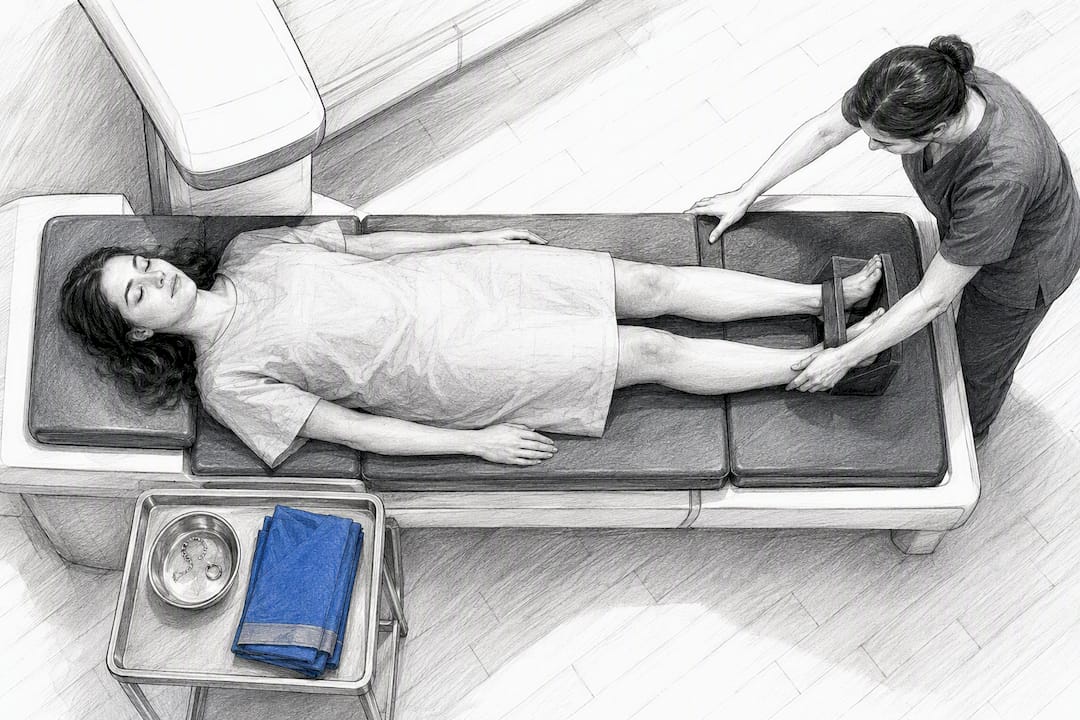
A clinic DXA appointment is worth booking when you want a number you can actually trust, whether for tracking muscle gain, screening bone density, or getting a clinical-grade baseline. Expect the scan itself to take under 15 minutes, with no fasting or special prep required beyond removing metal jewelry.
Interpreting your LMI: ranges, age, and sex differences
A single LMI number means little without context. Reference data built from GE-Healthcare DXA systems shows mean LMI is consistently higher in men than women, and both sexes see gradual decline with age as muscle mass erodes, a pattern documented in reference values for lean mass variables. That decline accelerates after roughly age 50 for most people, which is exactly why LMI gets used as a sarcopenia screening tool in older adults.
Clinical sarcopenia definitions usually don't rely on whole-body LMI at all. They lean on appendicular lean mass index (ALMI), which measures only arm and leg lean tissue divided by height squared, since limb muscle correlates more directly with strength and fall risk than trunk-inclusive lean mass. Some researchers go further and adjust ALMI for adiposity, and that adjustment noticeably improves prediction of physical performance and disability risk in older adults, according to a study of 2,846 participants.
Keep a few limitations in mind:
- There's no single universal LMI cutoff for "low" lean mass across all populations.
- Device and manufacturer differences mean your number may not compare cleanly across clinics.
- Reference ranges are population-specific, so an LMI that looks low against one dataset might look normal against another.
If your LMI sits well below age and sex norms, especially alongside weak grip strength or slow walking speed, that combination is worth a conversation with a doctor.
LMI versus BMI, ALMI, and other indices
Each index answers a different question. BMI screens general population weight status but cannot distinguish fat from muscle. LMI isolates total lean tissue relative to height, giving a cleaner read on muscle-driven health. ALMI narrows further to limb lean mass, the tissue most tied to functional strength. The ALM-to-BMI ratio adjusts appendicular lean mass for overall body size, which some researchers prefer for catching sarcopenia in people who are also overweight.
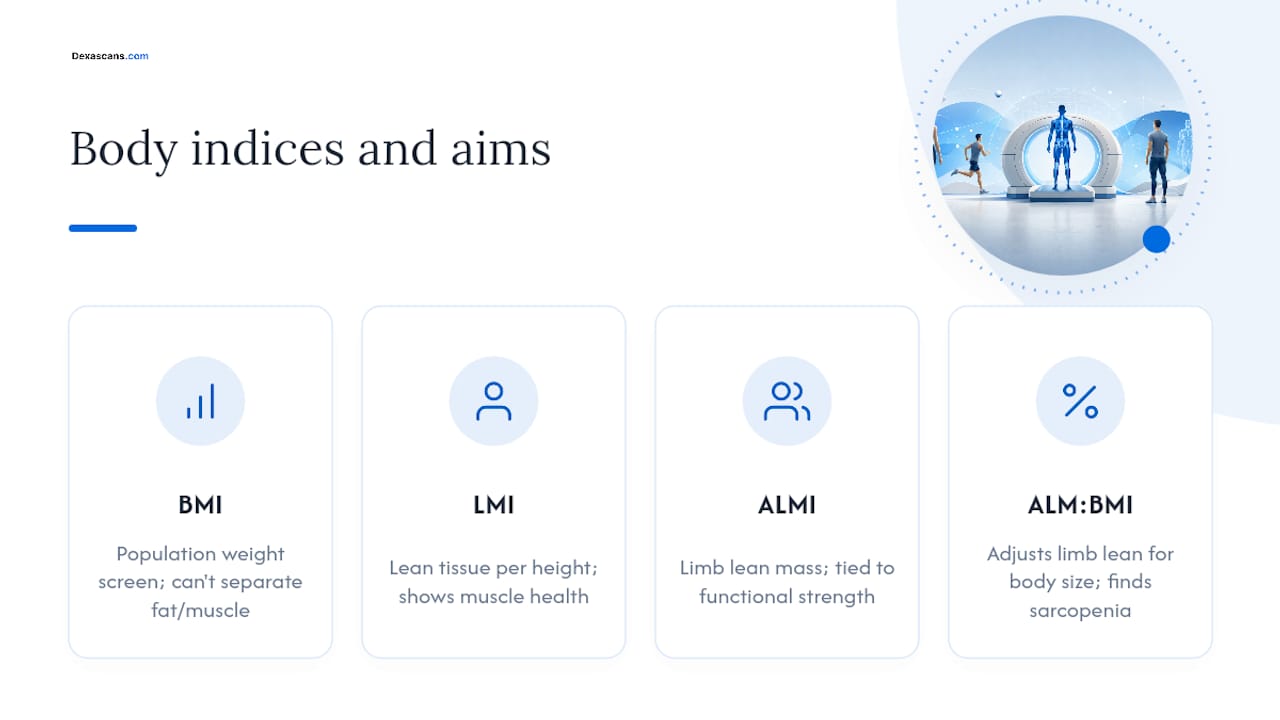
The evidence gap between BMI and LMI is real. One cohort study of older adults found LMI outperformed BMI as a predictor of all-cause mortality, and separate cross-sectional research links LMI more closely to arterial stiffness than BMI does.
The practical takeaway: use BMI for a rough population screen, LMI when muscle health is the question, and ALMI when sarcopenia or functional decline is the specific concern.
Tracking and improving your LMI responsibly
Building lean mass follows a short list of levers, not a long one.
- Train with progressive resistance. Muscle responds to load that increases over weeks and months, not to the same weight repeated indefinitely.
- Distribute protein across meals rather than loading it all at dinner, which supports muscle protein synthesis more consistently through the day.
- Prioritize recovery. Sleep and rest days are when muscle actually rebuilds, not an afterthought to training.
- Remeasure every few months, not every few weeks. DXA precision runs around ±1 to 2%, so small week-to-week shifts in LMI are often just measurement noise, not real change.
Pro Tip: Pair every LMI reading with a strength or function check, like your working weight on a squat or how many push-ups you can do. The number on the scan and the number on the bar should move together.
Don't chase a single figure in isolation. Lean mass that climbs while strength stalls is a signal to look at recovery or programming, not just the scan.
Why a DEXA scan gives you the most trustworthy LMI
Formulas and field methods get you an estimate. A DEXA scan gets you a number built on actual tissue measurement, with body fat precision around ±1 to 2%. More than 500 verified scan locations are listed across many states, bookable without a physician referral, at transparent cash prices below typical hospital billing. Pull the lean mass figure straight from your report, plug it into the LMI formula, and you have a number worth tracking.
A brief guide to using LMI alongside function and health goals
LMI is a useful number, not a verdict. Weigh it against how you actually move, lift, and recover, since strength and mobility often tell a more complete story than a single ratio. If your LMI drops sharply between scans, or sits far outside expected ranges for your age and sex, that's the moment to loop in a doctor rather than guess.
— Erik
Book a DXA scan and get a lean mass index you can trust
Estimation formulas and bathroom scales get you in the ballpark. If you want the number that actually holds up, Dexascans lists over 511 verified DEXA locations across 48 states with transparent cash pricing, so you can compare clinics near you before booking, no referral required.
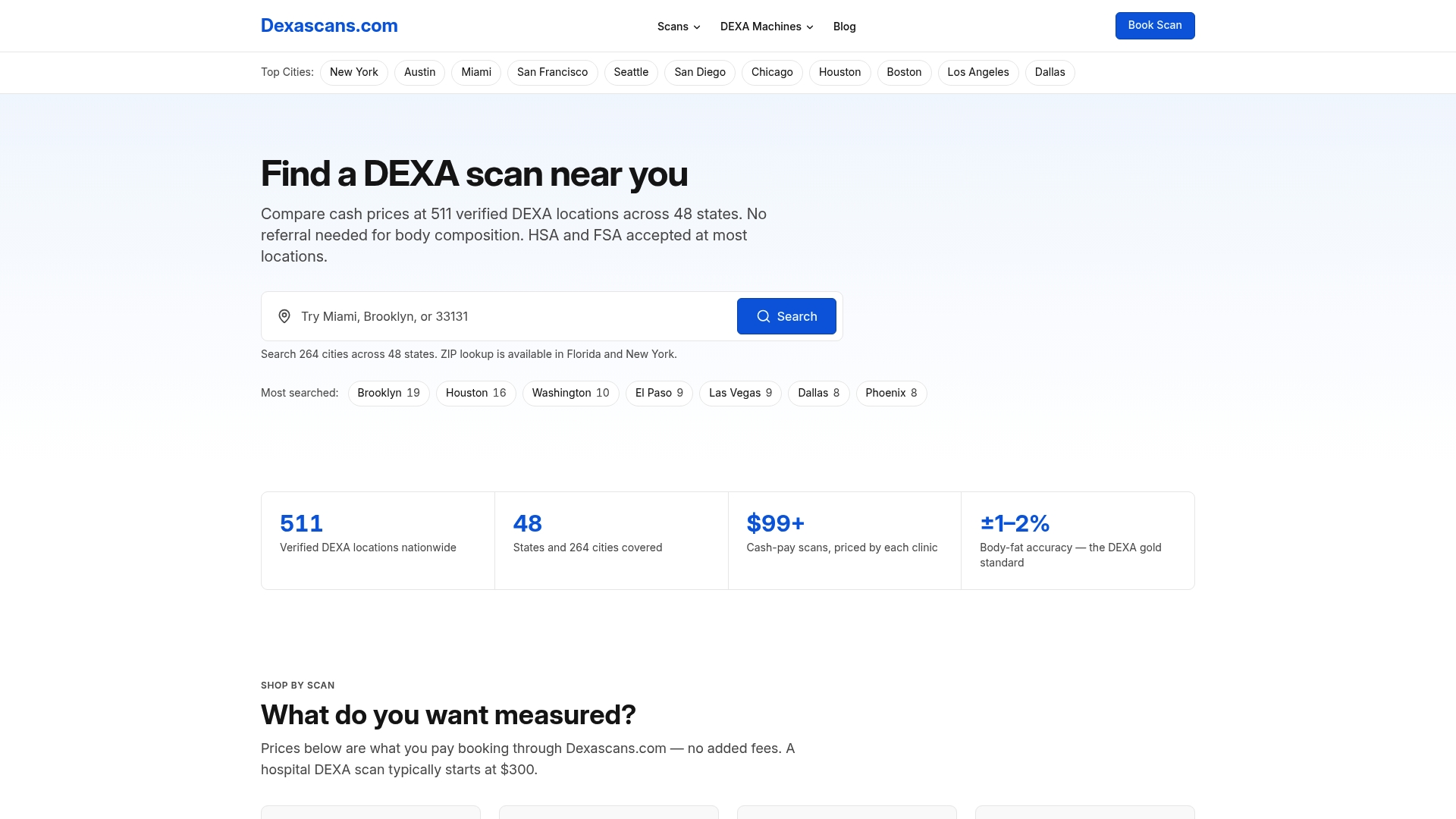
That transparency matters more than it sounds. Hospital-billed DEXA scans can vary wildly depending on your insurance and facility, while the clinics listed on Dexascans post their cash prices upfront so you know the cost before you show up. Whether you're screening for sarcopenia risk, tracking muscle gained from months of training, or getting a bone density baseline alongside your body composition results, an accurate lean mass figure starts with an accurate scan. Search DEXA scan locations near you and book the appointment that gets you a real number instead of an estimate.
This article is general information, not a substitute for advice from a qualified doctor. Consult a qualified healthcare professional about your own circumstances before acting on anything here.
Sources
- Adiposity-adjusted lean mass improves prediction of physical performance and incident disability (PMC6001879)
- Reference values for lean mass variables using GE-Healthcare DXA systems (PLOS ONE)
- Lean Mass Index: A Better Predictor of Mortality than Body Mass Index in Elderly Asians
- DXA vs CT/MRI concordance and clinical utility (NCBI PMC)
FAQ
What is a good BMI for my age?
BMI ranges don't shift by age for most adults; the standard categories for "normal weight" apply broadly across adulthood, though they don't account for muscle mass at all. That's exactly why LMI is a better companion metric for anyone with above-average muscle or concerns about age-related lean tissue loss.
Is 75% lean mass good?
A body composition reading of roughly 75% lean mass is generally solid for most adults, since it implies moderate to low body fat, but "good" depends heavily on sex, age, and how the percentage was measured. Comparing that percentage against DXA-based reference values for your own age and sex group gives a far more useful answer than the raw number alone.
Is a BMI of 22 lean?
A BMI in the normal weight range says nothing about whether that weight is muscle or fat. Someone with a normal BMI could have a high LMI and low body fat, or a low LMI and higher body fat, which is the core limitation BMI can't resolve on its own.
What does lean mass mean on a DEXA scan?
Lean mass on a DEXA report is your total body weight minus fat mass and bone mineral content, covering muscle, organs, connective tissue, and water. You can take that figure directly from your scan results and divide it by your height in meters squared to calculate your own LMI.