

For routine tracking, pick one consistent method, either a consumer bioelectrical impedance (BIA) scale or a tape measure with the Navy method, and follow the same protocol every time. Reserve a DEXA scan for an accurate baseline or when a medical or athletic decision depends on the number. Avoid switching devices or technicians midway, control hydration before each check, and log more than one metric. Dexascans makes finding a DEXA provider straightforward when precision actually matters.
TL;DR:
- Using a consistent BIA scale or tape measure weekly, coupled with controlled hydration and timing, provides reliable trend tracking in body fat percentage.
- DEXA scans offer the highest precision at roughly ±1 to 2 percent but should be reserved for baseline or significant health decisions, not frequent checks.
- Operator skill and measurement consistency are critical for skinfold and tape methods, while hydration and timing significantly influence BIA and DXA results.
- Tracking multiple indicators, such as waist circumference and strength, alongside body fat helps differentiate real progress from measurement noise.
- A single body fat percentage number varies in meaning depending on age, sex, and ethnicity, making it a useful but relative health and fitness insight.
Table of Contents
- Which Body Fat Measurement Method Should You Use?
- How Do You Measure Body Fat Accurately at Home or in a Clinic?
- How Do You Track Fat Loss Without Chasing Noise?
- What Does Your Body Fat Percentage Actually Mean?
- Where DEXA Fits Into a Practical Tracking Plan
- How Age, Sex, and Ethnicity Change What a Body Fat Number Means
- What Actually Matters When You Track Body Fat
- Ready to Get an Accurate Baseline?
- Sources
- FAQ
Which Body Fat Measurement Method Should You Use?
No single tool wins outright. The right choice depends on how much accuracy you need versus how often you want to check.
DEXA (dual-energy X-ray absorptiometry) scans your entire body with low-dose X-rays and separates fat, lean tissue, and bone mineral with real precision. It's the method clinicians reach for when regional or whole-body fat and lean mass measurements matter, and it requires controlled conditions (fasting status, hydration, positioning) to deliver its best numbers. The tradeoff is cost and access. You typically need to book an appointment at a clinic rather than check daily at home.
BIA, the tech inside most smart scales and handheld analyzers, sends a small electrical current through your body and estimates fat based on resistance. It's cheap, instant, and great for spotting trends over weeks. It is also sensitive to hydration, food intake, and even the time of day, which is why the same scale can bounce by several percentage points depending on when you step on it.
Skinfold calipers pinch a fold of skin and fat at specific sites (triceps, suprailiac, thigh, and others) and plug the millimeter readings into a formula. In the hands of a trained tester, skinfolds correlate reasonably well with whole-body measures and are minimally affected by day-to-day fluctuations compared to some lab methods. The catch is operator skill. A different person pinching the same spot can produce a meaningfully different number.
Circumference measurements (the Navy method) and BMI-based calculators are the most accessible options. You need a tape measure, a calculator, and a few landmarks. They're not precise measures of fat mass. The CDC is explicit that BMI screens for weight relative to height, not body fat directly, and it can misclassify muscular people as overweight. Still, for free, repeatable trend tracking, tape and BMI are hard to beat.
Newer tools like 3D body scanners and handheld ultrasound devices are showing up in some gyms and clinics, but they remain a niche option rather than a mainstream one, and cost or availability still limits them for most people.
Quick comparison:
- DEXA: highest precision, clinical-grade, $$ to $$$, occasional use
- BIA (consumer): low cost, instant, hydration-sensitive, good for frequent trend checks
- Skinfold calipers: low cost, operator-dependent, best with a trained tester
- Tape/Navy method: free, accessible, lower accuracy, useful as a screening tool
- BMI calculators: free, fast, doesn't measure fat directly
DEXA's edge comes down to one number: it measures body fat with roughly ±1 to 2% precision when scan conditions are standardized, a level consumer devices generally can't match.
How Do You Measure Body Fat Accurately at Home or in a Clinic?
Getting a usable number is less about which tool you buy and more about doing the same thing the same way every time.
- Consumer BIA: Weigh in the morning, after using the bathroom and before eating or drinking. Use minimal clothing, stand on the same scale, on the same flat surface, and skip intense exercise or alcohol the night before. Check weekly rather than daily. Day-to-day swings are mostly water, not fat.
- Tape measure (Navy method): Measure your waist at the navel, your neck just below the larynx, and (for women) your hips at the widest point. Keep the tape snug but not compressing skin, stand relaxed with normal posture, and take each measurement twice to confirm. Log the raw numbers, not just the calculated percentage, so you can recheck your math later.
- Skinfold calipers: Take three readings per site and average them, since a single pinch can be off by a few millimeters. If you want results you can actually trust over months, find a tester with ISAK training or at least use the same person every time.
- DEXA prep: Skip heavy exercise for 24 hours before your scan, follow any fasting instructions your clinic gives, and wear light clothing with no metal. Ask the technician whether they can copy your prior scan's region-of-interest (ROI) settings. That single request meaningfully improves repeatability between visits.
Pro Tip: Electrode placement is one of the biggest hidden sources of error in BIA readings. If you use a handheld device, keep your hands and feet on the exact same contact points every time; even a slightly different grip can shift the impedance signal enough to fake a trend that isn't real.
A realistic weekly routine looks like this: a BIA check every Monday morning, a tape measurement once a month, and a DEXA scan every six to twelve months if you want a precise anchor point to correct against.
How Do You Track Fat Loss Without Chasing Noise?
The hardest part of tracking body fat isn't taking a measurement. It's knowing whether a change is real or just noise.
Standardize everything you can control:
- Measure at the same time of day, ideally first thing in the morning
- Keep hydration and fasting status consistent (don't measure after a big meal one week and an empty stomach the next)
- Use the same device or the same technician every time
- Wear the same type of clothing and stand the same way
This matters because passive hydration shifts of even half a percent of body mass can alter DXA-derived lean mass readings, and BIA is even more sensitive to water changes. That's the difference between precision (can the method repeat itself) and accuracy (is the number actually correct). What you want when tracking progress is precision. The concept researchers use here is least significant change, or LSC: the smallest shift that's bigger than normal measurement noise. A well-controlled DEXA scan can have an LSC in the low single digits for body fat percentage, while a home BIA scale's day-to-day noise can eat up several points on its own.
Log more than one number. Fitness professionals generally recommend tracking waist circumference, strength numbers, clothing fit, and energy levels alongside body fat percentage, because a single figure can mislead you on its own. If your waist is shrinking and your strength is climbing but your BIA scale says otherwise for two weeks straight, trust the trend, not the outlier. Consider a DEXA re-scan when you're making a real decision: adjusting a training block, confirming progress before a competition, or checking in with a doctor about a health goal.

What Does Your Body Fat Percentage Actually Mean?
Percentage ranges give you context, not a verdict. These ranges shift with age and differ by sex, since women naturally carry more essential fat than men.
A few things worth knowing:
- Two people at the same body fat percentage can look completely different depending on height, muscle distribution, and where fat is stored.
- BMI and body fat percentage don't always agree. A muscular person can have a "high" BMI and a low body fat percentage at the same time, which is exactly the kind of misclassification the CDC warns about.
- Visible abs generally show up somewhere in the low double digits for men and slightly higher for women, though genetics and fat distribution shift that line for everyone.
- Extremely low single-digit body fat is rare and typically limited to competitive bodybuilders in contest prep or elite endurance athletes, and it's not a sustainable everyday target.
- On the higher end, body fat percentages that push into the obese range are worth discussing with a doctor, since health risk climbs well before a number looks alarming on a bathroom scale.
Where DEXA Fits Into a Practical Tracking Plan
There are platforms that list hundreds of verified DEXA locations across many states, with real-time availability and transparent cash pricing so you can compare providers before booking anything. The core appeal is precision: DEXA measures body fat with roughly ±1 to 2% accuracy, and you don't need a physician's referral to get scanned.
A few things worth asking any clinic before you book:
- Whether they can use the same scanner and copy your prior scan's ROI settings for a repeat visit
- What their pre-scan prep instructions are (fasting, hydration, clothing)
- Whether morning appointments are available, since that's when hydration and stomach contents are most consistent
Booking through a platform that verifies pricing and location details removes a lot of the guesswork that comes with calling around to hospitals and imaging centers one by one.
How Age, Sex, and Ethnicity Change What a Body Fat Number Means
The same body fat percentage can mean different things for different people, and that's not a flaw in the measurement. It's biology.
Women carry more essential fat than men at every fitness level, largely tied to reproductive function, so a healthy percentage for a woman sits several points higher than the equivalent for a man. Comparing your number against a partner's or a training buddy's of the opposite sex is rarely useful.
Age matters too. Body fat tends to climb gradually through adulthood even when weight holds steady, partly because lean mass naturally declines over the decades unless you actively train against it. A 50 year old and a 25 year old at the same weight and height often carry noticeably different amounts of fat, which is one reason DEXA and other body composition tools are more useful than a bathroom scale for tracking real change over the years.
Ethnicity adds another layer that most calculators ignore entirely. Research on population differences in fat distribution and the relationship between BMI and body fat has found that some groups carry more visceral fat at a given BMI than others, which is part of why health organizations increasingly treat BMI as a rough screening tool rather than a diagnostic one. None of this means the numbers are useless. It means a single percentage should be read as one data point about you specifically, not measured against a generic chart built for an average that may not reflect your background at all.

What Actually Matters When You Track Body Fat
Most tracking advice focuses on which device to buy. That's the wrong question. The bigger failure point is consistency: people switch scales, change testers, or measure at random times, then panic when the number moves. That swing is usually the tool, not your body.
The conventional wisdom oversells precision and undersells repeatability. A $30 BIA scale used the same way every Monday morning will tell you more useful information over three months than three different high-end tools used once each. Precision matters most when a real decision hinges on the number: a medical evaluation, a competition prep check, or a long-term health screening. For everyday tracking, boring consistency beats fancy equipment every time.
If there's one thing worth prioritizing first, it's picking a single method and sticking with it for at least eight to twelve weeks before judging any trend. DEXA earns its place as an occasional gut check, not a weekly habit, precisely because its value comes from precision under controlled conditions, not convenience.
— Erik
Ready to Get an Accurate Baseline?
Once you've been tracking with a scale or tape for a few months, a DEXA scan gives you the precise checkpoint to see how close your estimates actually were. Dexascans lets you search by city or ZIP, compare cash prices across verified clinics, and book without a physician's referral, so you skip the runaround of calling hospitals for quotes.
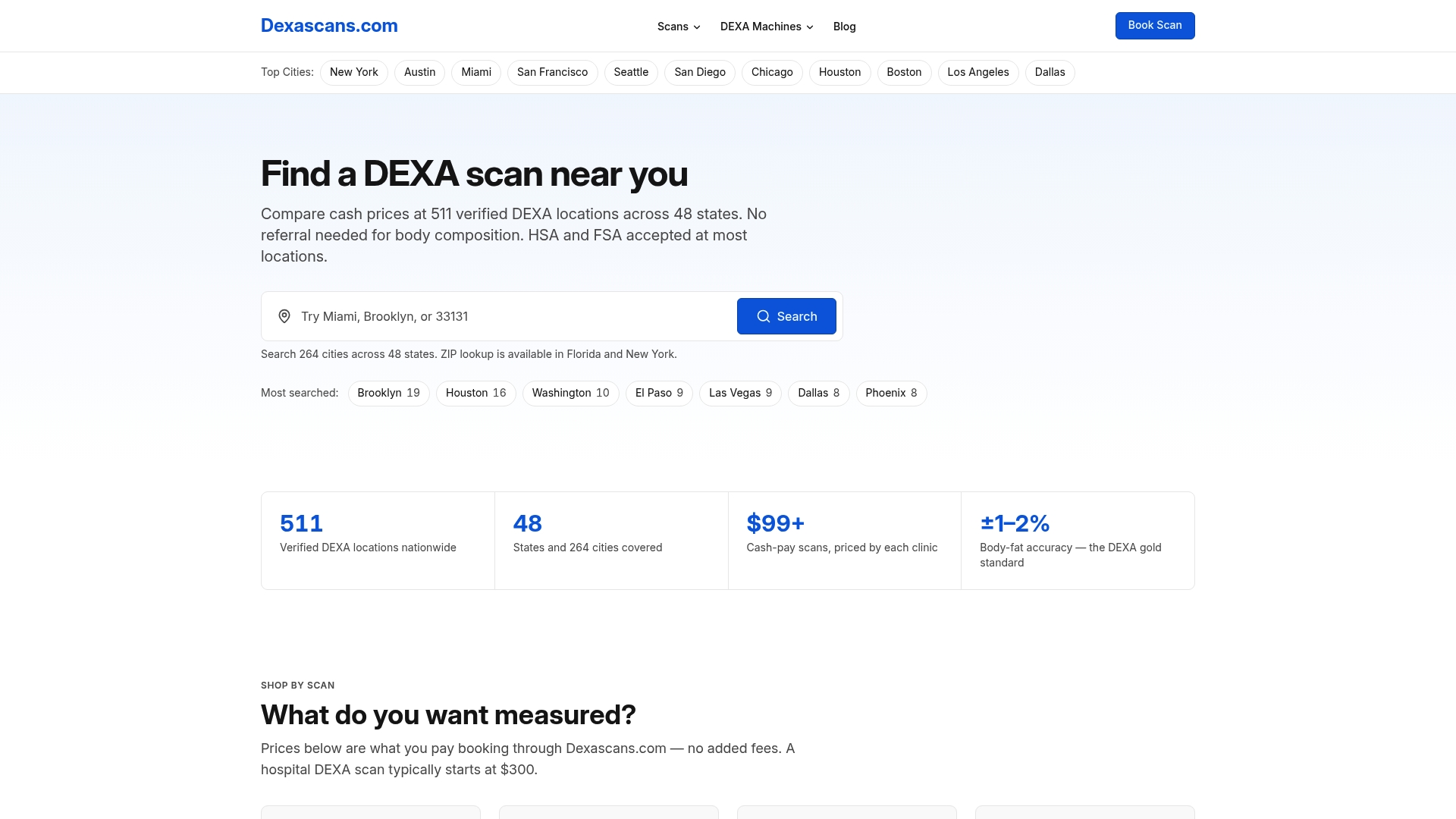
Before your appointment, standardize the same conditions you'd use for any other measurement: avoid hard workouts for 24 hours, follow the clinic's fasting instructions, and wear light clothing without metal or thick fabric. It's also worth asking the technician whether they can match your positioning to a prior scan, since that single step improves how comparable your results will be over time. Find a DEXA location near you and get a number you can actually trust.
Sources
- Dual-Energy X-Ray Absorptiometry
- Review of body composition assessment methods
- Anthropometric measurements: When to use this assessment (ACE)
- About adult BMI
FAQ
Is 30% Body Fat Considered High?
For most women, 30% body fat sits above the typical "average" range and moves toward levels associated with greater health risk, while for men it's well into that higher category. Context matters. Age, activity level, and where fat is stored all affect how much that number should concern you, so it's worth combining it with a waist measurement and a conversation with a doctor rather than judging it in isolation.
Is 20% Body Fat Still Considered Fat?
For men, 20% body fat generally falls in the average to slightly above-average range and isn't unhealthy on its own.
How Rare Is 10% Body Fat?
Ten percent body fat is rare and typically limited to competitive athletes or bodybuilders during contest prep, since maintaining it long term is difficult for most people's health and lifestyle. It's not a realistic year-round target for the average person, and chasing it without professional guidance can backfire on energy, hormones, and training performance.
Will My Abs Show at 15% Body Fat?
For women, visible ab definition typically requires a lower percentage than the general "athletic" range, closer to the leaner end of that category.
How Often Should I Check My Body Fat Percentage?
Weekly checks with a consistent method like BIA or tape measurements are enough to spot real trends without overreacting to daily noise. A DEXA scan every six to twelve months, booked through a verified clinic, gives you a precise checkpoint to correct your at-home estimates against.