
A DEXA scan typically takes 3 to 10 minutes on the table, with the full visit running 15 to 30 minutes once check-in and positioning are included. For bone density, most people should wait 2 years or longer between scans unless a clinician flags a risk that calls for sooner. For body composition, 8 to 12 weeks between scans gives real change time to outpace measurement noise.
TL;DR:
- Guidance generally starts screening at 65 for women and 70 for men, earlier for prior fractures, low body weight, or long term steroid use.
- During osteoporosis treatment, clinicians commonly repeat scans after 1 to 2 years, then extend intervals to 3 to 5 years once results stabilize.
- For comparable body composition readings, use the same machine, scan time, clothing, hydration, and fasting conditions; food, alcohol, and hard exercise can skew results.
- Additional imaging, repositioning for limited mobility, or bundled services can lengthen appointments, so confirm what the clinic includes before booking.
- Some clinics provide an immediate screen review, but formal reports often take days; ask whether a verbal walkthrough is included.
Table of Contents
- Why DEXA scan timing varies
- What to expect during the appointment and when results arrive
- Preparation rules that affect timing and accuracy
- Recommended timing and intervals for bone density DEXA
- Recommended timing for body-composition DEXA tracking
- Technical limits and best practices for serial monitoring
- Finding and booking appropriately timed scans
- FAQ
- Sources
- Rules of thumb for choosing your own scan schedule
Why DEXA scan timing varies
The number on the appointment card rarely matches reality exactly, and that gap comes down to a few predictable factors. A scan limited to the hip and spine moves faster than one that also covers the forearm or adds a full-body composition read, since each region requires its own positioning and imaging pass.
Mobility issues, pain, or trouble holding still can also add time, because a technologist may need to reposition a patient or repeat part of the scan to get a usable image. Combined appointments, such as a bone density scan paired with body composition or optional add-ons like VO2 max testing, naturally extend the visit beyond the baseline scan time.
A few things routinely stretch or shrink a visit:
- Scanning multiple sites (hip, spine, forearm) instead of one region adds several minutes per area.
- Limited mobility or difficulty staying still can require repositioning or a repeat pass.
- Bundled services, like combining bone density with full-body composition, extend the appointment.
- Check-in paperwork, consent forms, and a review of recent imaging history add administrative time before the scan starts.
None of this makes the appointment unpredictable in a meaningful way. It just means the 15 to 30 minute window is an average, not a guarantee, and asking the clinic in advance what's included in your specific appointment helps you plan your day.
What to expect during the appointment and when results arrive
A typical visit follows a predictable sequence. You arrive and check in, change into a gown or scan-friendly clothing if needed, and get positioned on the table by a technologist. The imaging itself takes roughly 10 to 30 minutes, depending on how many regions are scanned, and the step-by-step process involves very little beyond lying still while the machine passes over you.
Many clinics offer a brief on-screen review right after the scan, so you may walk out with a general sense of your numbers. That's different from a formal report: a radiologist's written interpretation or your clinician's full read of the results often takes a few days to arrive.
When booking, it helps to ask the clinic directly whether same-day numbers are available, how long the formal report typically takes, and whether the appointment includes time for a verbal walkthrough. That one question can save you from assuming you'll leave with a complete answer.
Preparation rules that affect timing and accuracy
What you do in the hours before a scan has a direct effect on both how smoothly the appointment runs and how trustworthy the results are. Many labs prefer morning, fasted scans for body composition specifically because eating and drinking can shift fluid balance enough to distort fat and lean mass readings.
A few preparation steps matter most:
- Avoid eating or drinking anything beyond water for several hours before a body-composition scan, and skip intense exercise the day before.
- Limit alcohol the night before, since it can affect hydration and tissue measurements.
- Wear clothing without metal zippers, buttons, or underwire, and remove jewelry, since metal can create imaging artifacts.
- Mention any recent contrast imaging, barium studies, or nuclear medicine scans, since residual contrast can interfere with results.
Pro Tip: If you're tracking changes over time, scan at the same time of day, in the same type of clothing, and under the same fasting conditions every time, so the only thing that's actually changing is your body.
Skipping these steps doesn't usually ruin a scan, but it can introduce enough variability that a follow-up looks like it changed when it didn't, or vice versa.
Recommended timing and intervals for bone density DEXA
Clinical guidance generally recommends a baseline central DEXA scan for women starting at age 65 and men at age 70, with earlier screening for those who have specific risk factors like prior fracture, low body weight, or long-term steroid use. For most people with normal or borderline results, routine monitoring every 2 years or longer is standard.
Once someone starts osteoporosis therapy, the monitoring rhythm often tightens for a while. A 1 to 2 year follow-up interval is common in the first phase of treatment, since clinicians want to confirm the medication is working before stretching the gap between scans. After results stabilize, many patients move back to longer intervals, sometimes 3 to 5 years, depending on risk.

Certain situations justify shorter intervals regardless of baseline results. Long-term glucocorticoid therapy, a recent fragility fracture, or signs of rapid bone loss are all reasons a clinician might order a scan sooner than the standard cadence. Outside of those scenarios, repeating a bone density scan more often than once a year is generally discouraged, since bone remodels slowly and short-interval scans mostly capture measurement noise rather than real change. MedlinePlus guidance similarly notes that recommended intervals range from 2 to 5 years for most people, narrowing only for those at elevated risk. A deeper breakdown of DEXA frequency by risk category can help you map your own situation to a specific interval.
Recommended timing for body-composition DEXA tracking
Body composition DEXA is remarkably precise, but it still has a margin of error, and that margin matters a lot when you're trying to detect real change. Typical precision for fat mass sits in a narrow range, and day-to-day biological variability (hydration shifts, recent meals, bowel contents) adds its own layer of noise on top of that.
That combination is why 8 to 12 weeks between scans is the commonly recommended minimum for tracking fat or lean mass change. Scan again sooner than that and you risk mistaking normal fluctuation for progress or setbacks. Athletes or people in structured research protocols sometimes scan more frequently, but only when every other variable, timing, hydration, clothing, exercise history, is tightly standardized to isolate the signal from the noise.
A short checklist keeps serial comparisons meaningful:
- Scan at the same time of day, ideally morning, before eating.
- Maintain similar hydration status each time rather than over- or under-hydrating.
- Wear the same type of clothing and remove the same items (jewelry, belts) consistently.
- Use the same machine for every follow-up scan whenever possible.
Readers tracking fat loss over time can find a practical overview of how body-composition scans support weight-loss tracking alongside where to book one.
Technical limits and best practices for serial monitoring
Interpreting a series of scans correctly depends on more than just waiting the right number of weeks. Using the same DEXA machine and software version for every follow-up matters because different manufacturers calibrate differently, and switching machines can make a stable patient look like they gained or lost bone when nothing actually changed, a point bone health specialists emphasize when discussing monitoring cadence.
For bone density specifically, clinicians generally prefer comparing absolute BMD values in g/cm² and calculating the least significant change rather than relying only on shifts in T-score, since T-scores can mask small but real differences. Degenerative spine changes, old fractures, or surgical hardware can also distort readings at certain sites, which is sometimes a reason to request a different measurement site or a repeat scan. When results look inconsistent with expectations or symptoms, that's the point to loop in the ordering clinician for interpretation rather than trying to read the trend yourself.
Finding and booking appropriately timed scans
Finding a clinic that fits your preferred timing, morning slots, fasted appointments, or a combined bone-and-body-composition visit, is where Dexascans comes in. We list more than 511 verified scan locations across 48 states, which makes it straightforward to search by city or ZIP and compare cash prices instead of guessing at hospital billing.
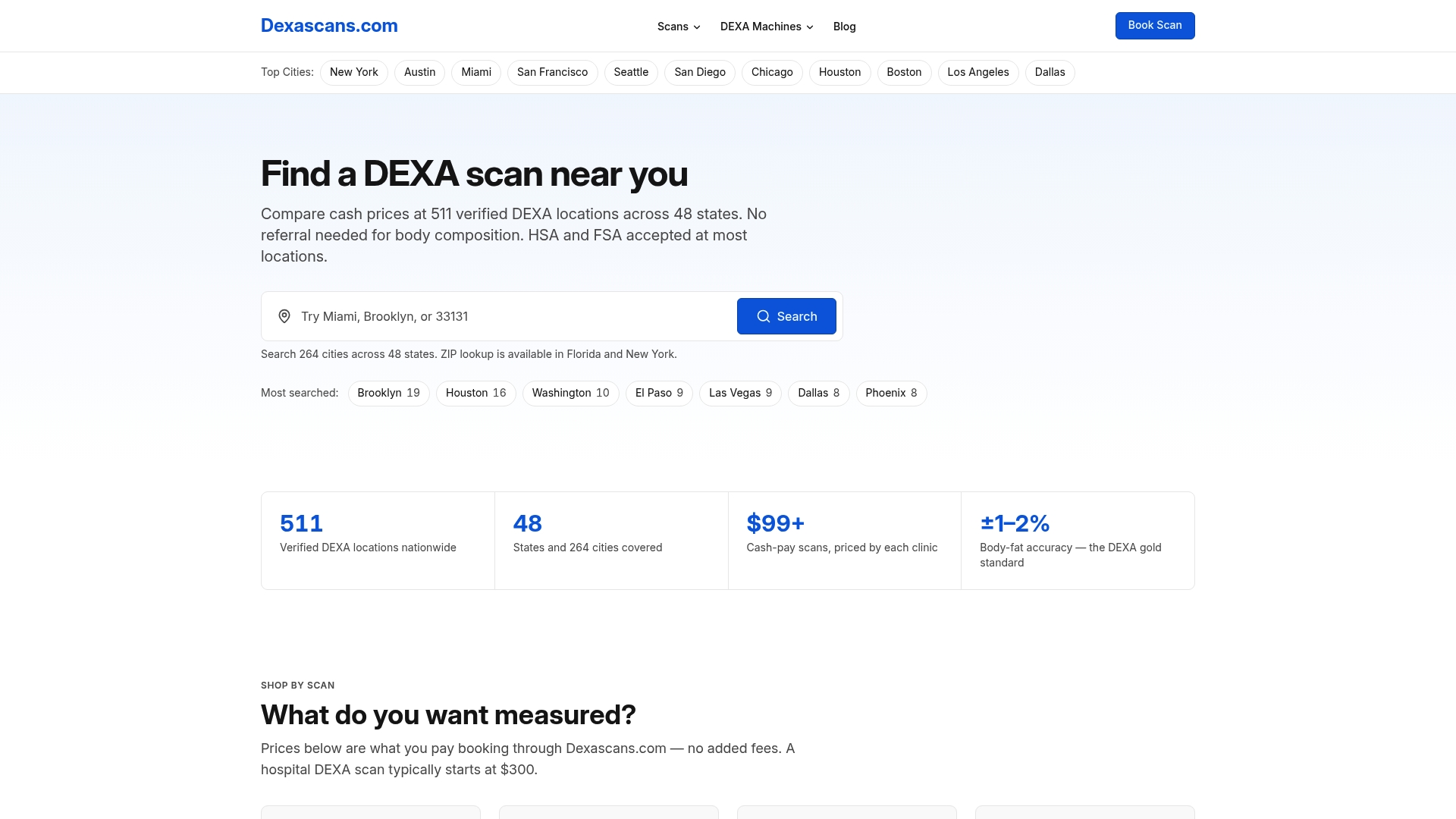
Because pricing is transparent upfront, there's no surprise bill that complicates the decision to book a follow-up scan on schedule. For anyone planning serial monitoring, booking the same clinic (and ideally the same machine) every time matters more than almost anything else for keeping results comparable.
A few ways to put this into practice:
- Search verified clinics near you and filter for morning or fasted-slot availability.
- Compare cash prices and confirm whether a clinic offers bone density, body composition, or combined scans.
- Note the clinic and machine you use for your baseline scan so you can book the same one for every follow-up.
| Scan type | Recommended interval | Why |
|---|---|---|
| Bone density screening | 2 years or longer | Bone remodels slowly; shorter intervals mostly capture noise |
| Bone density on therapy | 1 to 2 years initially | Confirms treatment response before spacing out |
| Body composition tracking | 8 to 12 weeks minimum | Allows real change to exceed measurement error |
This article is general information, not a substitute for advice from a qualified doctor. Consult a qualified healthcare professional about your own circumstances before acting on anything here.
FAQ
What should you never do before getting a DEXA bone scan?
Avoid recent contrast imaging, barium studies, or nuclear medicine scans close to your appointment, since residual contrast material can interfere with results. Also skip wearing clothing with metal zippers, buttons, or underwire, and remove jewelry before the scan.
Why no caffeine before DEXA scan?
Caffeine and other fluids can shift hydration status, which matters more for body-composition scans than for bone density imaging. Many clinics ask patients to stick to water only before a fasted body-composition appointment to keep hydration-related variability out of the result.
What can throw off a DEXA scan?
Metal objects, recent contrast imaging, inconsistent hydration, and switching machines between follow-up scans are the most common sources of distorted results. Degenerative spine changes or surgical hardware at a scan site can also affect bone density readings.
How frequently should a DEXA scan be done?
For bone density, most people should wait 2 years or longer between screening scans, with 1 to 2 year intervals common for those actively on therapy. For body composition tracking, 8 to 12 weeks between scans is the practical minimum for detecting real change.
Sources
- Clinician’s guidance / related guideline evidence (PubMed citation)
- Impact of food and fluid intake on body composition assessment (PubMed 2017)
- Cleveland Clinic: DEXA (bone density) scan overview
- MedlinePlus: Bone density (DEXA) scan
Rules of thumb for choosing your own scan schedule
The guideline cadence exists for a reason: bone remodels on a timeline measured in years, not weeks, and scanning more often than that mostly just adds cost without adding information. If you're on therapy, the first year or two of closer monitoring is about confirming the treatment is working, not about chasing month-to-month numbers.
Body composition is the opposite case. The technology is precise enough that short-interval scanning feels tempting, but biological noise means anything under 8 weeks is unreliable for tracking real change. The habit worth building isn't frequent scanning, it's consistent scanning: same machine, same prep, same time of day, every time.
If you're uncertain where to start, book a single baseline scan and commit to one follow-up at a sensible interval rather than stacking several scans close together out of impatience. That single decision will tell you more than a handful of rushed, inconsistent ones ever could.
— Erik