
For most athletes, a DEXA scan is the most informative single test for tracking regional lean mass, body-fat distribution, visceral fat, and bone density. It works when you keep the protocol standardized: same fasting window, same hydration, same machine. Done right, it turns vague fitness questions into hard numbers you can act on.
TL;DR:
- Consistent pre-scan protocol, including fasting and hydration, is essential to ensure reliable tracking of body composition changes over time.
- Regional body measurements, especially limb lean mass and visceral fat, provide critical insights into strength imbalances and metabolic health beyond simple body-fat percentage.
- Repeating scans on the same machine and technician minimizes measurement noise, as differences in equipment or setup can cause significant result fluctuations within error margins.
- Use multiple data points over a season to accurately interpret changes, relying on trends rather than single measurements, particularly for bone density and lean mass.
- Affordable and accessible DEXA locations that emphasize consistency help athletes and teams improve long-term monitoring and training decisions.
Table of Contents
- What Does a DEXA Scan for Athletes Actually Measure?
- How Does a DEXA Scan Work, and What Happens During the Test?
- What's the Best Pre-Scan Protocol for Reliable Results?
- How Do You Interpret DEXA Results as an Athlete?
- What Limits DEXA Accuracy, and What Confounds Results?
- How Should Teams Use DEXA Data in Training and Rehab?
- Checklist and Common Mistakes I See With Athlete DEXA Use
- Finding Consistent, Affordable DEXA Testing Near You
- Sources
What Does a DEXA Scan for Athletes Actually Measure?
A single body-fat percentage tells you almost nothing about where an athlete is strong, weak, or at risk. A DEXA (dual-energy X-ray absorptiometry) report breaks the body into regions and tissue types, which is why it's become standard in serious athletic programs rather than just clinical settings.
The report isolates lean mass in each arm, each leg, and the trunk separately. That regional breakdown flags a strength or muscle imbalance between limbs long before it shows up as a performance problem. It's also the reason DEXA has become central to rehab tracking. A scoping review found losses of up to 7% in bone mineral density in the surgical limb after ACL reconstruction, a change no scale or tape measure would ever catch.
Beyond limb data, DEXA estimates visceral adipose tissue, the fat packed around internal organs that skinfolds and most home scales can't touch. VAT matters for endurance athletes managing metabolic health as much as it does for anyone else.
A few things a full DEXA report gives you that a body-fat percentage alone never will:
- Limb-by-limb lean mass to catch strength asymmetry
- Visceral fat estimates tied to metabolic and endurance outcomes
- Site-specific bone mineral density (BMD) for stress-fracture risk
- A trend line across a season, not a single snapshot
Sports medicine bodies treat DEXA as the investigation of choice for measuring bone mineral density, which is exactly why programs use it for return-to-play decisions, not just off-season check-ins.
How Does a DEXA Scan Work, and What Happens During the Test?
DEXA sends two low-energy X-ray beams through the body at different intensities. Bone, lean tissue, and fat absorb each beam differently, and the machine calculates composition from that difference.
The test itself is almost uneventful. You lie flat on a padded table while a scanning arm passes slowly overhead, and the whole acquisition takes roughly six to ten minutes. No enclosed tube, no contrast dye, nothing to swallow.
What you get afterward is a multi-page report, not a single number:
- Whole-body and regional lean mass (arms, legs, trunk)
- Total and regional fat mass, plus a VAT estimate
- Bone mineral density with both T-scores and Z-scores
- A percentile comparison against reference populations
Radiation exposure is a common worry, and it shouldn't be. A whole-body scan delivers roughly 0.01 mSv, about the equivalent of a few days of ordinary background radiation. Athletes who scan two or three times a year have nothing meaningful to weigh against that.
What's the Best Pre-Scan Protocol for Reliable Results?
The scan is only as good as the prep behind it. Skip the protocol and you're comparing apples to oranges every time you retest, which defeats the entire point of tracking change over a season.
Follow these steps before every scan, every time, without exception:
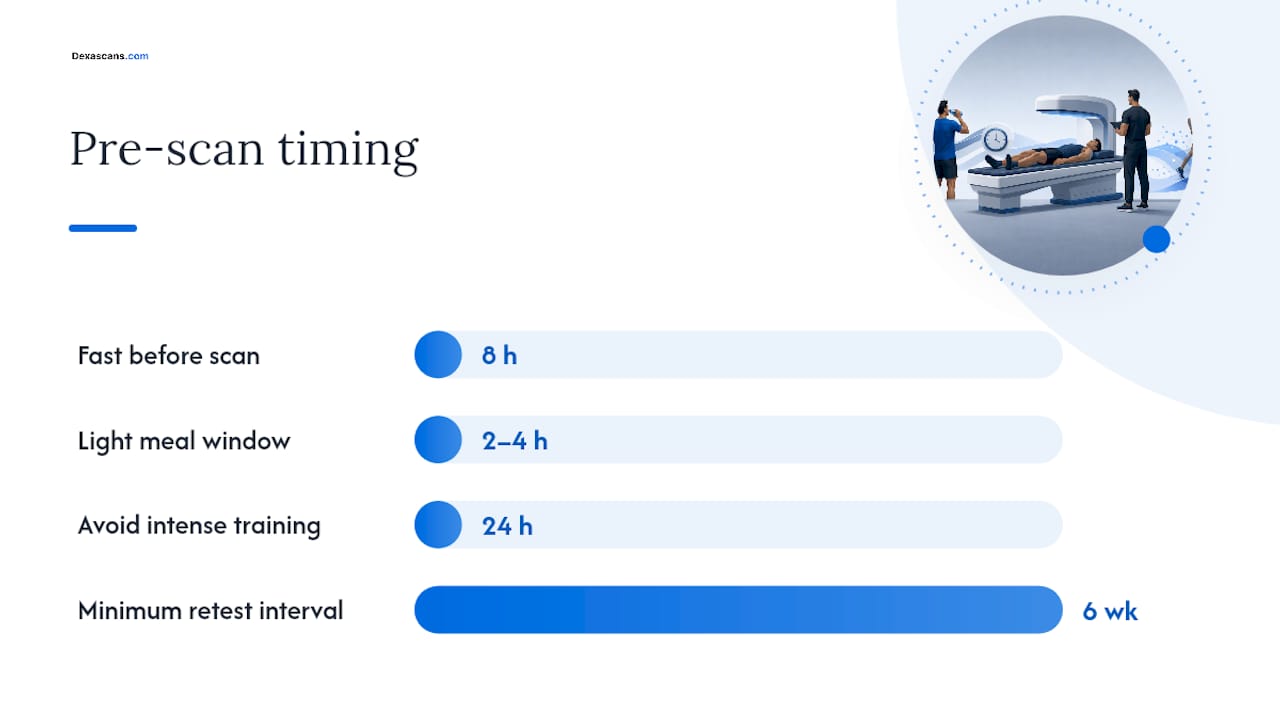
- Fast for at least 8 hours, or stick to a light meal 2 to 4 hours before if your provider allows it.
- Maintain normal hydration in the days leading up to the scan. Don't cut water to "lean out" for the test.
- Avoid intense training in the 24 hours before scanning.
- Empty your bladder immediately before you get on the table.
- Remove metal jewelry, zippers, and anything with underwire.
Consistency here isn't a nice-to-have. Dehydration, glycogen depletion, and acute inflammation from a hard training session can all distort the reading, and best-practice protocols point to a minimum six-week interval between scans to detect a real change rather than noise.
Pro Tip: Keep a short log every time you scan: last meal, hydration status, training load from the prior 48 hours, and menstrual phase if relevant. That context is what turns a confusing number into a useful one six months later.
How Do You Interpret DEXA Results as an Athlete?
Raw numbers on a DEXA report mean nothing without knowing the margin of error behind them. Precision for body-fat measurement typically runs around 1 to 2%, and lean-mass precision can be even tighter under controlled conditions, but individual scan-to-scan error can still run a few percentage points depending on positioning and prep.
A 2% shift in body fat between two scans could be a real change, or it could be entirely within the machine's normal measurement error. The only way to know is comparing against your own established baseline on the same equipment.
Read your regional numbers with a specific question in mind: is one limb lagging behind the other by more than a few percent in lean mass? That asymmetry is often the first hard evidence a rehab program is working, or isn't.
For bone, the athlete's age matters. Under 50, Z-scores compare you to age and sex-matched peers, and that's the number that actually matters for a competitive athlete, not the T-score built for postmenopausal fracture risk. Because bone remodels slowly, annual BMD checks are usually sufficient unless there's a specific clinical reason to test sooner.
A few habits separate useful interpretation from guesswork:
- Report both absolute change (pounds or kilograms) and relative change (percent)
- Compare every new scan against the same machine's prior baseline, never a different clinic's numbers
- Treat any change smaller than the known error margin as noise, not progress or regression
What Limits DEXA Accuracy, and What Confounds Results?
DEXA is precise, but it's not immune to being fooled. A few variables consistently trip up athletes who don't know to control for them.
Glycogen and creatine loading can inflate apparent lean mass by roughly 1 to 2%, which looks like real muscle gain on paper but isn't. Scanning glycogen-depleted after a hard training block creates the opposite problem, making lean mass look like it dropped when nothing structural changed.
Machine and software differences matter more than most athletes realize:
- Switching scanner brands or software versions between scans can shift results independent of any real body change
- Technician segmentation, meaning exactly where the software draws the line between arm and torso, varies slightly between operators and can skew regional numbers
- Very tall or very large athletes may exceed some scanner tables, forcing a partial scan that gets stitched together with added error
- Repeat scans should be spaced out sensibly since there's no clinical reason to add unnecessary radiation exposure for marginal extra data
None of this makes DEXA unreliable. It just means the reading is only as trustworthy as the consistency of the setup behind it.
How Should Teams Use DEXA Data in Training and Rehab?
A DEXA report is only valuable once someone acts on it. The best programs treat each scan as a checkpoint tied to a specific training phase, not an isolated data pull.
Follow a simple operational sequence:
- Set a concrete target in both kg and percent, such as gaining 1.5 kg of lean mass in the off-season without a corresponding rise in fat mass.
- Schedule scans around training macrocycles, typically a preseason baseline and periodic follow-ups during active phases, based on monitoring practices used in some programs.
- Cross-reference DEXA data against strength and power testing before changing a program. A lean-mass gain that doesn't show up in force output is worth investigating.
- Use regional BMD or lean-mass gaps to prioritize interventions, whether that's unilateral loading, targeted nutrition, or blood flow restriction training for an injured limb.
- Loop in a coach, a sports dietitian, and a sports physician together when a scan reveals something unexpected. No single role should interpret a DEXA report alone.
Pro Tip: Bring the actual multi-page report to your next team meeting, not just a summary percentage. Coaches and physicians read regional and BMD data very differently, and both perspectives usually change the plan.
Checklist and Common Mistakes I See With Athlete DEXA Use
Most bad DEXA data isn't a machine problem. It's a protocol problem. Athletes scan fasted one time and post-meal the next, switch clinics mid-season, or panic over a 2% swing that's just measurement noise.
Build a short checklist and stick to it: same fasting window, same hydration status, no hard training in the prior 24 hours, and ideally the same machine and technician every time. Log training load and menstrual phase alongside the results. The single biggest mistake is treating one scan as a verdict instead of a data point in a trend line, especially with bone density, where meaningful change takes months, not weeks.
A booking platform that lets you find and stick with the same facility, same equipment, and same technician removes most of the variability that ruins longitudinal tracking in the first place.
— Erik
Finding Consistent, Affordable DEXA Testing Near You
Consistency is the whole game with DEXA, and that's exactly where Dexascans earns its keep. You can find facilities across many locations to book the same clinic, same machine, and ideally the same technician every time you retest, which is the single biggest factor in getting a trend line you can trust.
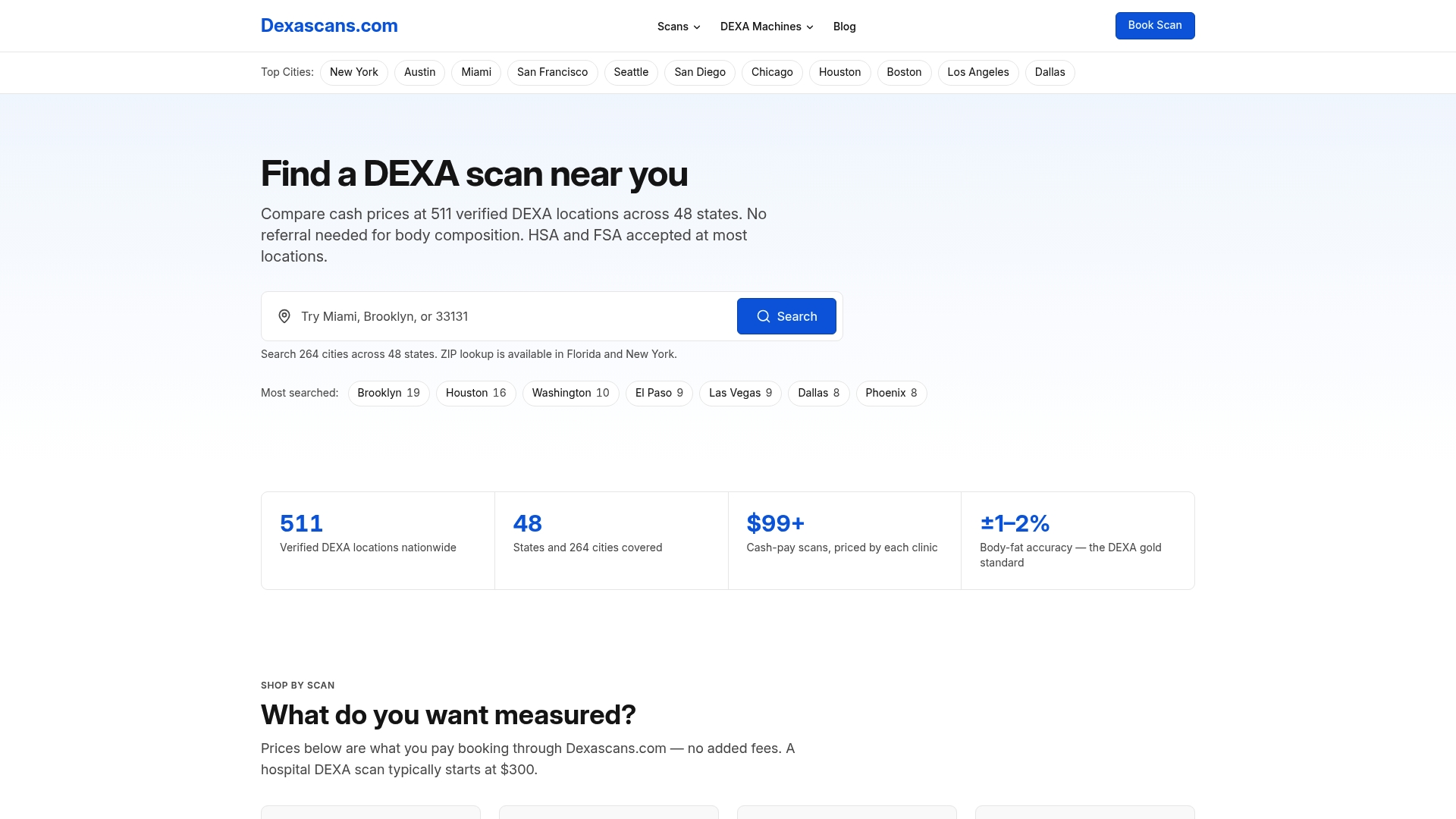
Cash pricing on the platform is listed upfront, so you can compare scan costs and accuracy details before you book instead of getting a surprise bill at a hospital-based imaging center. You can also filter by scan type, whether you need a standard body composition scan, a dedicated bone density test, or a combined appointment with VO2 max or RMR add-ons. Search DEXA scan locations near you and lock in the same provider for your next scan.
Sources
- The Use of DEXA in Evaluating Recovery After Musculoskeletal Injuries — PMC
- DEXA Scans — Science for Sport
- FSEM — DEXA use in Sport and Exercise Medicine