
Yes. A DEXA scan gives you clinically precise body-composition data, fat mass, lean mass, and visceral fat, that a scale or BMI chart simply cannot produce. With precision around ±1–2% for body fat and clinical backing from the ISCD, it's one of the most reliable tools available for tracking whether weight loss is actually fat loss. The catch: it only works if you stay consistent about where and how often you scan, and platforms like Dexascans exist specifically to help with that consistency.
TL;DR:
- Using the same clinic and machine for follow-up scans ensures comparability, as different manufacturers use proprietary algorithms that produce slightly different results.
- Repeat scans every three to six months are optimal for tracking meaningful changes in body composition, while annual scans suffice for bone density monitoring.
- Hydration status and recent contrast imaging can distort DEXA results, so scheduling scans after contrast clears and maintaining consistent pre-scan conditions is essential.
- Comparing absolute fat mass and regional visceral fat trends provides more actionable insights than focusing on percentage body fat alone.
- Consistent preparation, using the same machine, and recording both percentage and absolute mass improve the reliability of DEXA as a weight-loss monitoring tool.
Table of Contents
- What a DEXA Scan for Weight Loss Actually Measures
- How DEXA Sharpens Weight-Loss Monitoring
- How Often Should You Repeat a DEXA Scan?
- What Happens During a DEXA Appointment
- Where DEXA Results Can Mislead You
- Turning DEXA Numbers Into Weight-Loss Decisions
- Why Consistency Matters More Than the Scan Itself
- Find a DEXA Clinic and Book a Consistent Follow-Up
- Sources
What a DEXA Scan for Weight Loss Actually Measures
A DEXA scan reads your body in layers. It reports total fat mass, percent body fat, lean mass (muscle plus organs and fluid), bone mineral content, and an estimate of visceral adipose tissue, the fat packed around your organs that drives metabolic risk more than subcutaneous fat does.
Precision claims for DEXA body fat measurement typically land around ±1–2%, which is tighter than what BMI or a bathroom scale can offer since neither distinguishes fat from muscle. CT and MRI can match or exceed DEXA for visceral fat detail, but they cost more and expose you to far higher radiation. DEXA's visceral fat estimates correlate strongly with CT-based measurements, which is why it's become the practical middle ground.
One detail that trips people up: different manufacturers (Hologic, GE, Norland) use slightly different algorithms to calculate lean and fat mass. A scan from one machine won't match another machine's output exactly, even on the same body. That's why sticking with the same clinic and machine for repeat scans matters more than most people realize.
How DEXA Sharpens Weight-Loss Monitoring
A scale tells you total pounds lost. It says nothing about whether those pounds came from fat or muscle, and that distinction changes everything about whether your plan is working. Because BMI often misclassifies people with normal weight but excess body fat, DEXA catches cases that a routine checkup would miss entirely.
Clinically, DEXA shows up in a few recurring scenarios: tracking diet and resistance-training programs, following patients after bariatric surgery, and monitoring body composition changes during GLP-1 medication therapy, where rapid weight loss often includes meaningful lean mass loss. Athletes use it to fine-tune cutting phases without sacrificing muscle.
The regional data matters too. If a scan shows your visceral fat dropping while your arms and legs hold steady on lean mass, that's a signal your protein intake and training are working. If lean mass is sliding along with fat, that's a cue to add resistance training or adjust caloric deficit before you lose the muscle you need for metabolic health.
How Often Should You Repeat a DEXA Scan?
For body composition tracking, every 3 to 6 months is the standard window. That gap gives your body enough time to produce a change large enough to separate from normal measurement noise. Scanning monthly wastes money chasing fluctuations that don't reflect real progress.
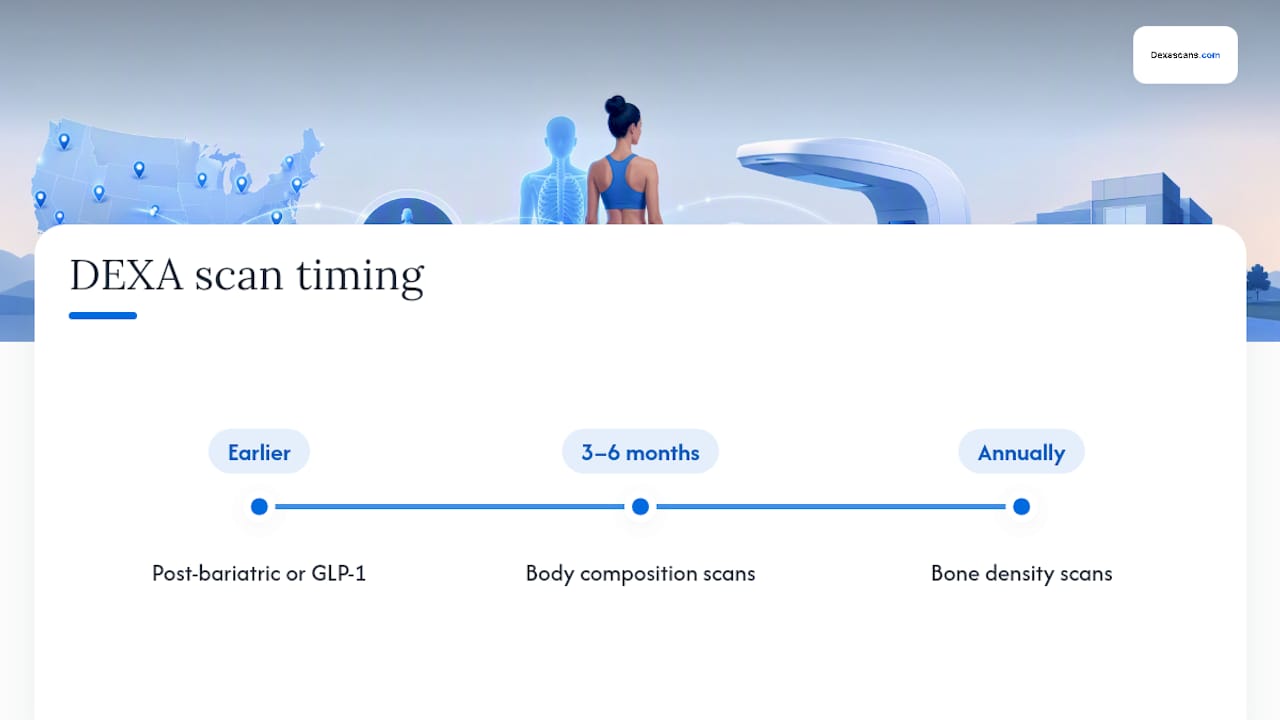
Bone density follows a slower clock: annual scans are typically sufficient, since bone remodels far more slowly than fat or muscle tissue.
Exceptions exist. Someone in the first few months after bariatric surgery, or starting a GLP-1 medication, might benefit from an earlier recheck given how fast composition shifts in those windows. Radiation exposure from DEXA is very low, low enough that frequency concerns come down to cost and clinic access rather than safety.
What Happens During a DEXA Appointment
Expect a simple process: check in, remove metal objects and jewelry, lie flat on the table, and stay still while a scanning arm passes over your body. The scan itself typically takes 3 to 12 minutes, depending on your size and the machine model.
A few practical notes matter. Pregnancy is a contraindication. If you've recently had a contrast-enhanced imaging study (like a CT with dye), schedule your DEXA scan after the contrast has cleared your system, since residual contrast can skew the reading. Machines also have weight and width limits, and technicians sometimes use reconstruction techniques for larger bodies, which can slightly reduce precision on regional numbers.
Most imaging centers hand you results the same day, often within minutes of finishing the scan.
Where DEXA Results Can Mislead You
The biggest trap is comparing scans from different machines and treating the discrepancy as real physiological change. It usually isn't. Different DEXA vendors calculate composition using proprietary algorithms, so a jump in body fat percentage between two clinics might just be a calibration difference, not fat gained.
Hydration status and recent contrast imaging can also distort a reading. And it helps to understand what "lean mass" actually includes: it's not just muscle. It aggregates skeletal muscle, organs, and body fluid. Appendicular lean mass, the reading from your arms and legs, is used as a proxy for muscle specifically, but researchers pair it with strength testing when screening for sarcopenia rather than relying on the number alone.
For very large bodies, technicians may need to reposition or "mirror" part of the scan to fit within the table's width, which introduces a small precision trade-off worth noting when comparing scans over time.
Turning DEXA Numbers Into Weight-Loss Decisions
Don't fixate on percent body fat alone. Track absolute fat mass change alongside the percentage, because percentages can shift even when total fat barely moves, especially if lean mass changes too.
Watch the regional breakdown and visceral fat trend specifically. Visceral fat reductions carry outsized value for cardiometabolic health, even when the number on the scale barely budges. If a follow-up scan shows lean mass declining alongside fat, that's your signal to add protein and resistance training before the next check-in, not after.
The ISCD's official guidance specifically supports using whole-body DEXA to monitor weight loss exceeding roughly 10% of body weight, precisely because composition shifts that large need objective tracking, not guesswork from a scale.
For documentation that actually holds up over months, keep three things constant: same machine, similar prep (hydration, timing relative to meals), and record both the percentage and the absolute mass every time. That's the difference between data you can trust and numbers you have to second-guess.
Why Consistency Matters More Than the Scan Itself
Most of the skepticism around DEXA for weight tracking isn't really about the technology. It's about how people use it. A single scan tells you almost nothing useful; the value shows up in the second, third, and fourth scan, compared against each other under the same conditions. That's the part people skip, and it's why so many folks come away thinking DEXA "didn't work" when the actual problem was inconsistent measurement, not a flaw in the method.
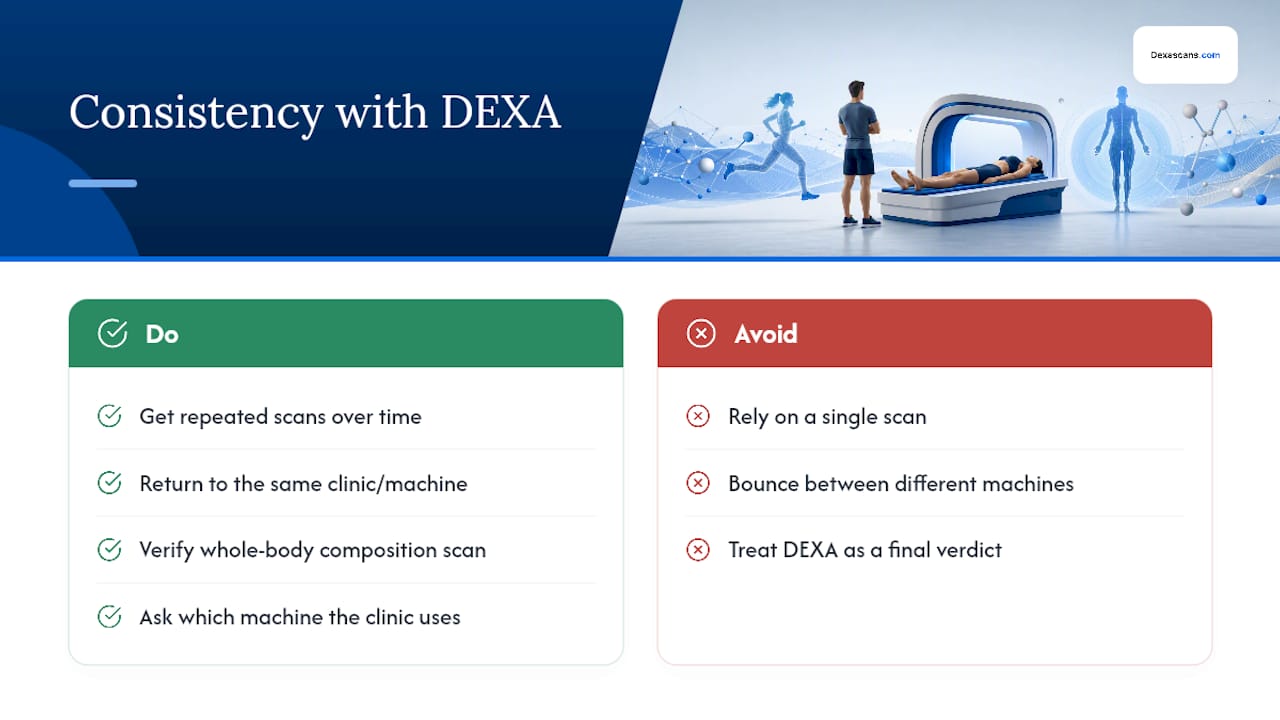
The other underrated point: DEXA is a decision-making tool, not a verdict. A single number doesn't tell you if your diet is failing. A trend across three scans, paired with how you're actually training and eating, tells you that. Treat it the way an athlete treats a lab test, one data point in an ongoing conversation with your own body, not a report card.
If there's a real recommendation buried in all this, it's to verify you're getting a whole-body composition scan (not just bone density), ask what machine the clinic runs, and plan to return to that same location for your follow-up. Dexascans.com lists over 511 verified locations across 48 states with transparent cash pricing specifically so readers can find and stick with one clinic instead of bouncing between machines that don't agree with each other.
— Erik
Find a DEXA Clinic and Book a Consistent Follow-Up
Some platforms solve the problem that undermines most people's tracking: they let you find a clinic near you, confirm the scan type before you book, and compare transparent cash prices instead of guessing what a hospital will bill.
Before booking, run through a short checklist:
- Confirm the machine vendor (Hologic, GE, or another) so your follow-up scans stay comparable.
- Verify the clinic offers whole-body composition scanning, not just a bone-density test.
- Ask about table weight and width limits if that's relevant to you.
- Schedule your next scan at the same clinic, ideally the same time of day.
Pro Tip: Book your follow-up appointment before you leave the first one. Clinics get booked out, and returning to the same machine matters more for accuracy than almost anything else you'll do between scans.
Search DEXA scan locations near you to compare cash pricing and confirm scan availability, or browse the body composition scan guide to see what a typical report includes before your first visit.
This article is general information, not a substitute for advice from a qualified doctor. Consult a qualified healthcare professional about your own circumstances before acting on anything here.
Sources
- DXA/DEXA beats BMI: Using an X-ray Exam to Measure Body Composition & Fat Loss | Radiology
- DXA Body Composition Analysis | UC Davis Health
- Body composition by DXA (PMC review)
- The Official Positions of the International Society for Clinical Densitometry: Indications of Use and Reporting of DXA for Body Composition
- Effect of contrast media on bone densitometry (PubMed entry)