
The scan itself usually takes 3 to 10 minutes on modern equipment, though you should plan for 30 minutes total at the clinic once check-in and positioning are factored in. Some clinical sources report scan windows up to about 30 minutes depending on the machine and how many body regions get imaged. There's no needle, no downtime, and no waiting around afterward. You walk in, lie still for a few minutes, and walk out.
TL;DR:
- Modern DEXA scans typically take 3 to 6 minutes on fan-beam machines, but full appointments, including check-in and preparation, can last 30 minutes.
- Repositioning, scanning multiple regions, or movement during the scan may extend the overall appointment time without affecting radiation exposure or safety.
- Preparation steps like avoiding metal, skipping recent contrast dye, and wearing simple clothing help prevent delays and ensure accurate results.
- Full clinic visits are usually 10 to 15 minutes early, with results delivered within days or immediately at some locations, depending on the facility.
- Speed differences between central and peripheral scans are significant, with central scans offering more clinical precision at the cost of slightly longer duration.
Table of Contents
- What's the Real Dexa Scan Duration: Scan Time vs. Appointment Time?
- What Happens During a DEXA Appointment?
- How Should You Prepare for a DEXA Scan?
- What's the Full Clinic Timeline From Arrival to Results?
- Do Different DEXA Scan Types Take Different Amounts of Time?
- How Often Should You Repeat a DEXA Scan?
- What Do Patients Actually Notice About DEXA Scan Timing?
- Where Can You Find and Book a DEXA Scan Near You?
- Where Can You Read More About DEXA Scan Timing and Prep?
- Sources
What's the Real Dexa Scan Duration: Scan Time vs. Appointment Time?
The confusion around dexa scan duration almost always comes down to mixing up two different clocks. One is the scan itself, the part where the machine's arm passes over your body. The other is the full appointment, which includes everything from signing in to walking back out the door.
Modern fan-beam scanners, the type most clinics use, can finish the actual scan in 3 to 6 minutes. Older pencil-beam systems move more slowly, tracing a narrower beam back and forth across the body, and can take 6 to 10 minutes or longer for the same regions. UPMC puts the scan at roughly 5 to 10 minutes at many centers, while broader clinical guidance from Mayo Clinic and MedlinePlus cites a wider range for the overall procedure.
What stretches the clock past the baseline? Scanning multiple regions (spine, hip, and total body instead of just one), repositioning between passes, and any repeat pass triggered by movement during the scan. None of these add serious time. They just explain why one person's 10 minute visit becomes someone else's 20.
What Happens During a DEXA Appointment?
Here's the actual sequence, start to finish, so nothing catches you off guard:
- Check-in. You'll verify your ID, fill out a short health history form, and confirm you followed any prep instructions.
- Change if needed. Some clinics ask you to remove clothing with metal zippers, buttons, or underwire and swap into a gown.
- Positioning. A technologist lays you flat on a padded table and aligns your hip, spine, or whole body under the scanning arm, sometimes using foam supports to keep you still.
- The scan. The arm glides slowly overhead. You'll feel nothing. No noise, no heat, no pinch.
- Wrap-up. You get dressed and leave. That's it.
The stillness part matters more than people expect. Even small shifts, like a sneeze or a shifted hip, can blur the image enough to require a repeat pass, which is the single most common reason a "10 minute" scan stretches longer.
Radiation exposure is minimal, well below a standard chest X-ray, and there's no recovery period. You can drive yourself, go back to work, or head straight to the gym.
Pro Tip: Wear clothing with no metal snaps, zippers, or underwire so you can skip the gown change entirely and shave a few minutes off your visit.

How Should You Prepare for a DEXA Scan?
A little prep prevents delays and keeps your results accurate. Handle these before you walk in:
- Skip calcium supplements for 24 to 48 hours before the appointment if your clinic asks you to.
- Leave jewelry, belts, and anything with metal at home or in the car.
- Wear simple clothing without zippers, snaps, or underwire.
- Tell staff if you've had a CT scan, barium study, or any contrast dye recently. Clinics often require a 10 to 14 day wait after contrast imaging since residual dye can throw off bone-density readings.
- Mention pregnancy, metal implants, or a recent fracture in the area being scanned. Any of these can change how the technologist proceeds.
None of this adds real time to the appointment, but skipping it can. Forgetting about a recent contrast scan, for instance, might mean rescheduling the whole visit.
What's the Full Clinic Timeline From Arrival to Results?
Plan to arrive 10 to 15 minutes early. Paperwork and check-in typically eat up another 5 to 10 minutes, especially if it's your first visit to that clinic. The scan itself runs anywhere from 3 to 30 minutes depending on the equipment and how many regions get imaged.
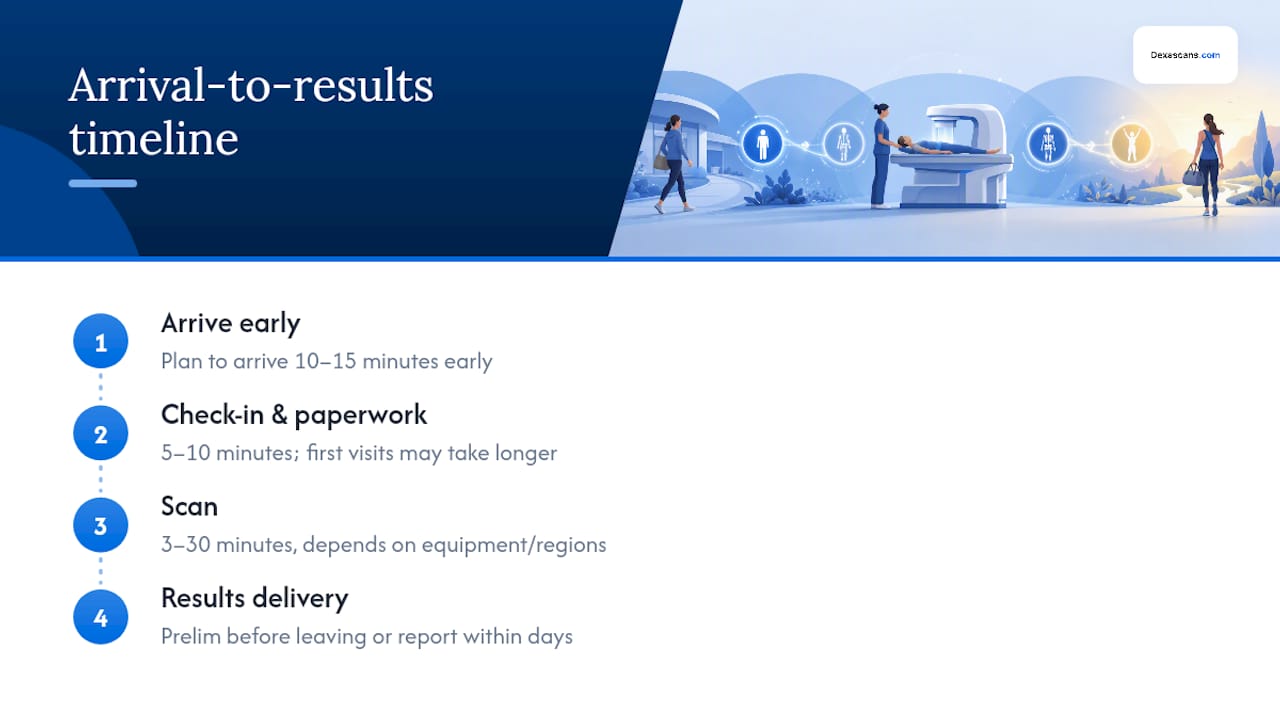
Results delivery varies by clinic. Some hand you a preliminary summary before you leave. Others send a full radiology report to your doctor within a few business days, particularly when a physician needs to interpret bone density scores. If you're booking through a clinic listed on the DEXA scan locations page, ask upfront how that specific location handles reporting so you know what to expect.
Do Different DEXA Scan Types Take Different Amounts of Time?
Central DEXA, which scans the hip and spine, is the clinical standard for diagnosing osteoporosis, and it typically takes longer than a peripheral scan because it images more tissue with more precision. Mayo Clinic treats central scans as the reference standard for fracture-risk decisions, which is why doctors lean on them even though they take a few extra minutes.
Peripheral scans, sometimes done at health fairs or pharmacies on the wrist or heel, finish faster but don't carry the same clinical weight for diagnosing bone loss.
Hardware plays a role too. Fan-beam scanners, now standard in most clinics, cut scan time dramatically compared to older pencil-beam machines without sacrificing image quality. If you're curious about the technology driving these differences, the DEXA scan machines guide breaks down how manufacturers approach speed versus resolution.
How Often Should You Repeat a DEXA Scan?
Repeat intervals depend entirely on your risk profile, not a fixed calendar. MedlinePlus notes high-risk patients often repeat testing every 2 years, moderate-risk individuals every 3 to 5 years, and low-risk people less frequently than that.
A new fracture, a change in medication, or a diagnosis affecting bone metabolism can shorten that window regardless of your last score. It's worth separating this from fitness-oriented body composition scans, which people often repeat every few months to track muscle and fat changes, a completely different rhythm than clinical bone-density monitoring.
What Do Patients Actually Notice About DEXA Scan Timing?
Most people walk out surprised at how fast the actual scan was. It's the check-in and paperwork that tend to eat more of the clock than the scan itself. If you're pressed for time, have your ID, insurance details, and any recent imaging history ready before you arrive, and skip the belt and jewelry that morning.
— Erik
Where Can You Find and Book a DEXA Scan Near You?
Once you know what to expect timing-wise, the harder part is usually finding a clinic with transparent pricing and no runaround. Dexascans lists over 511 verified locations across 48 states, each with cash pricing shown upfront instead of buried behind a phone call, and most locations offer body composition scans, bone density testing, or combined appointments without needing a physician referral.
If you want to compare clinics near you, check estimated appointment lengths, and see cash prices side by side before you commit, the DEXA scan locations directory is the fastest way to do it. Search by city or ZIP, pick a clinic that fits your schedule, and book directly. No referral, no guesswork on price, no surprise wait times once you get there.
Where Can You Read More About DEXA Scan Timing and Prep?
For deeper reading on scan timing, preparation rules, and the technology behind modern DEXA equipment, the Mayo Clinic bone density test overview covers clinical purpose and timing, RadiologyInfo details prep and contrast-wait guidance, and MedlinePlus explains repeat-interval guidelines by risk level.
Sources
That gap between a 5 minute scan and a 30 minute visit isn't inconsistency. It's the difference between two separate measurements. UC Davis Health and UPMC both describe fast scan windows alongside longer total visit estimates, and NHS guidance lands in a similar 10 to 20 minute clinical range. The technical driver behind faster scans is fan-beam technology, which images a wider area per pass than older pencil-beam systems. Movement sensitivity explains most of the rest. A repeat pass because of a stray shift adds a few minutes, but it doesn't change the radiation dose or require any recovery time.
- DEXA scan — UC Davis Health Radiology patient exam guide
- DXA Scan: What to Expect Before, During, and After — UPMC
- Bone Density Scan (DEXA) — RadiologyInfo
- Bone density scan: MedlinePlus