
A DEXA scan is a quick, noninvasive X-ray test that measures bone mineral density to screen for osteoporosis and fracture risk. Technicians scan the hip and spine in most cases, and the entire appointment usually runs about 10 to 20 minutes. Preparation is minimal: skip calcium supplements for 24 hours if your facility asks; remove metal, and tell staff if you might be pregnant.
TL;DR:
- The primary preparation involves skipping calcium supplements for 24 hours if instructed and removing metal clothing or jewelry to avoid artifacts.
- The scan takes 10 to 20 minutes, requiring you to lie still and sometimes hold your breath to ensure measurement accuracy.
- The radiation dose from a DEXA scan is very low, typically less than a standard chest X-ray, and is generally safe except for pregnant patients.
- Accurate results depend on proper calibration using height and weight, with alternative forearm scans available when hips or spine cannot be scanned.
- Finding the right provider involves verifying referral requirements, confirming scan site focus, and comparing upfront prices, especially at independent clinics or verified online directories.
Table of Contents
- What Happens During the DEXA Scan Procedure, Step by Step
- How to Prepare for a DEXA Scan
- Is DEXA Scan Radiation Safe?
- Reading Your DEXA Scan Results: T-Score and Z-Score Explained
- Where DEXA Scans Happen and What They Can't Tell You
- A Marketplace View on Choosing the Right Appointment
- What Most People Get Wrong About This Test
- Finding and Booking a DEXA Scan That Fits Your Needs
- Sources
- FAQ
What Happens During the DEXA Scan Procedure, Step by Step
Walking into a DEXA appointment for the first time feels less clinical than most imaging visits. There's no IV, no contrast dye, no changing into three layers of gowns. Here's the actual sequence.
- Check-in and a short health screening. Staff ask about recent imaging, current supplements, and whether pregnancy is possible. This isn't a formality. It affects whether the scan proceeds that day.
- Height and weight measurement. The scanner's software uses these numbers to calibrate the imaging mode, which directly affects the accuracy of your bone mineral density readout.
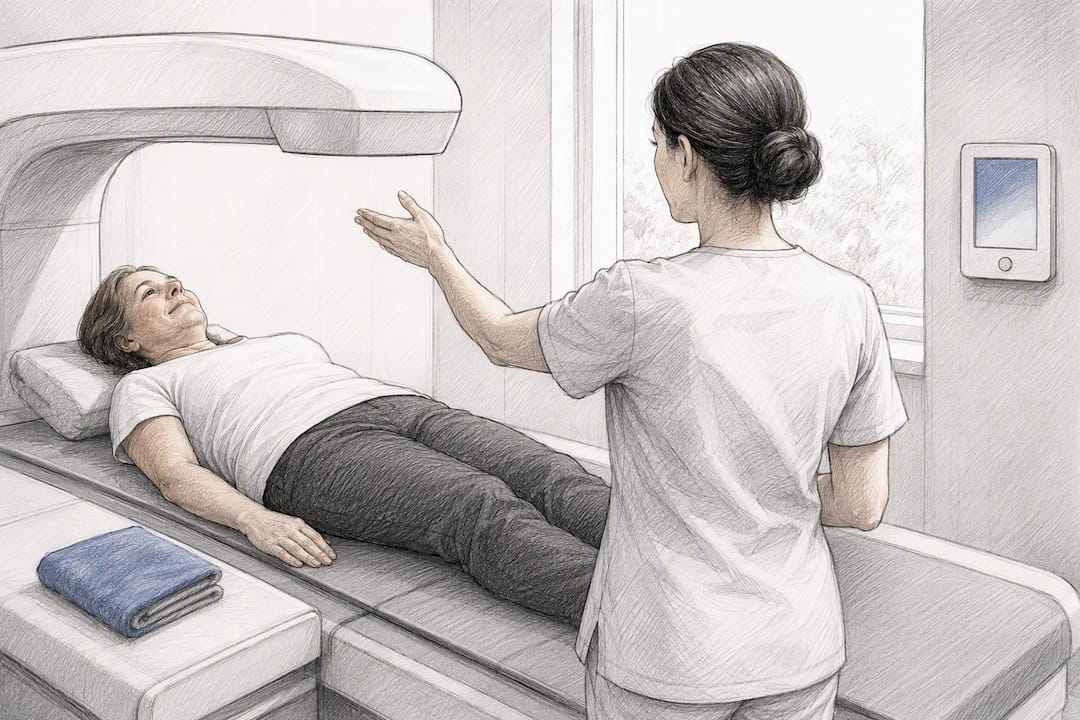
- Positioning on the table. You lie on your back. For a hip scan, the technologist rotates your leg slightly inward and may use a foot wedge to hold that angle. For a spine scan, a foam block or leg support goes under your knees to flatten the lower back's natural curve.
- The scanning arm passes overhead. A mechanical arm moves slowly over the hip and spine, emitting two X-ray beams at different energy levels. This dual-energy method is what lets the software distinguish bone from soft tissue with unusual precision.
- You stay still. Motion is the biggest threat to an accurate reading. The technologist typically remains in the room, watching a monitor, and will ask you to hold your breath briefly if needed.
- Forearm alternative. If a hip or spine can't be scanned, or if a condition like hyperparathyroidism is being evaluated, a forearm scan is a faster substitute, sometimes done seated.
- Wrap-up. No recovery time is needed. You get dressed, and the images transmit electronically for a radiologist or bone specialist to review.
Each site takes just a few minutes to scan, and the full appointment is generally 10 to 20 minutes once you're on the table, though total visit time including check-in often stretches longer.
Pro Tip: If you're claustrophobic or anxious about imaging, ask the technologist to describe the scanning arm before it starts moving. It never encloses you the way an MRI does, but knowing that in advance helps most people relax into the position.
How to Prepare for a DEXA Scan
Preparation for a bone density test procedure is lighter than for almost any other imaging exam, but a few details genuinely change your results.
- Skip clothing with metal zippers, buttons, or underwire. These create artifacts that distort the bone density reading, and you may be asked to change into a gown if your outfit has too much hardware.
- Take your regular medications as usual. No special diet or fasting is required on exam day.
- Hold off on calcium supplements for about a day before the scan if your facility specifically requests it.
- Mention any recent CT scan with contrast, barium study, or nuclear medicine exam. Facilities often want 10 to 14 days between contrast imaging and a DEXA scan to avoid skewed results.
- Tell staff if you're pregnant or think you might be. Most centers will postpone the test.
- Check whether your visit needs a physician referral. Diagnostic scans ordered for medical necessity often require one, while elective body-composition scans frequently allow direct booking.
Is DEXA Scan Radiation Safe?
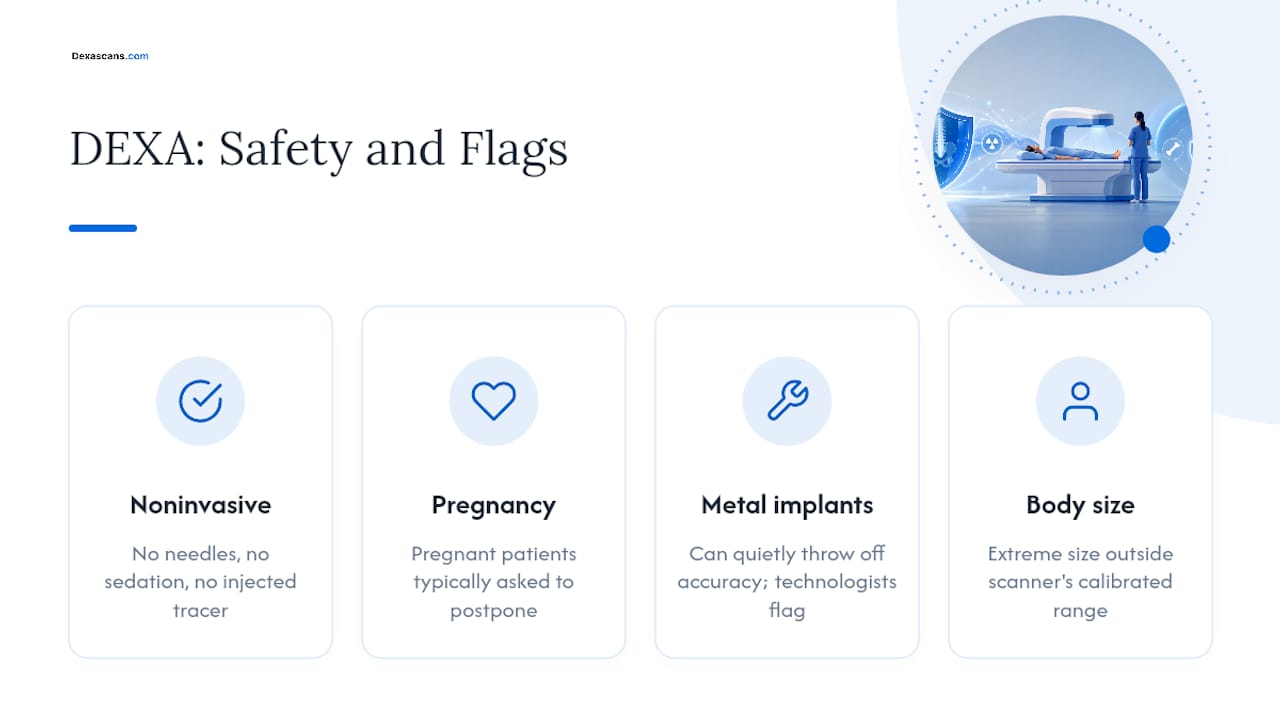
The radiation dose from a DEXA scan is genuinely small. Clinical commentary on imaging radiation notes that a DEXA scan's dose is often lower than a standard chest X-ray, which puts it near the low end of routine diagnostic imaging.
The exam itself is entirely noninvasive. No needles, no sedation, no injected tracer. That said, the exposure isn't zero, which is why pregnant patients are typically asked to postpone. Beyond pregnancy, a few things can quietly throw off accuracy: metal implants, extreme body size that falls outside the scanner's calibrated range, and recent contrast material still in the digestive tract. Technologists are trained to flag these issues before they read the images.
Reading Your DEXA Scan Results: T-Score and Z-Score Explained
Your report will list two numbers, and they answer different questions.
- T-score compares your bone density to that of a healthy 30-year-old adult of the same sex. A T-score above -1 is considered normal, -1 to -2.5 indicates osteopenia (low bone mass), and below -2.5 signals osteoporosis.
- Z-score compares your density to others your own age, sex, and body size. It's more useful for younger patients or for spotting bone loss caused by something other than aging.
A radiologist or metabolic bone specialist interprets the scan and generates both scores, and turnaround for a formal report is often just a few days, though it varies by facility's workflow. Your provider then weighs the T-score against clinical risk factors, family history, prior fractures, and medication use, to decide whether treatment, monitoring, or further testing makes sense. If a hip or spine can't be reliably imaged, a forearm scan often steps in as the alternate site. For a deeper breakdown of what these numbers mean for treatment decisions, the bone density test guide covers T-score thresholds in more detail.
Where DEXA Scans Happen and What They Can't Tell You
DEXA scans run in hospitals, outpatient imaging centers, and dedicated bone density clinics. Policies differ enough between them that it's worth a quick call before booking.
- Diagnostic scans ordered for medical reasons commonly need a physician referral; elective body-composition scans often don't.
- Hospital pricing tends to run higher than independent imaging centers or cash-pay clinics, so confirm exactly what's included before you book.
- A DEXA scan measures density. It doesn't detect infection, active fracture, or cancer the way a nuclear medicine bone scan does, which uses an injected tracer instead of dual X-ray beams.
A Marketplace View on Choosing the Right Appointment
Booking a bone density test procedure isn't just about finding the nearest scanner. Confirm the facility scans for bone density specifically, not just body composition, and ask whether you'll receive a written T-score report. Check referral requirements and pregnancy screening policies up front. If you're comparing cash prices, verify what's actually included, since "DEXA scan" sometimes means different things at different clinics.
What Most People Get Wrong About This Test
The biggest misconception about DEXA scans isn't medical. It's logistical. People assume the hard part is the scan itself, when the scan is genuinely the easy part: you lie down, hold still, and you're done in minutes. The friction that actually delays care is administrative: figuring out whether you need a referral, whether your insurance covers a diagnostic scan versus an elective one, and whether the price quoted over the phone matches what shows up on the bill.
Conventional advice tends to over-explain the mechanics of dual-energy X-ray absorptiometry and under-explain the marketing and referral-building advice for imaging centers that can help navigate the booking maze. That's backwards for most readers. If you already know your T-score threshold matters, what you actually need is a straight path to a facility that will scan the right sites, hand you a real report, and charge you a price you agreed to in advance.
Prioritize that path first. The clinical side of this test is remarkably standardized across providers. The buying experience is not, and that's where readers lose time and money.
— Erik
Finding and Booking a DEXA Scan That Fits Your Needs
Comparing DEXA providers by phone, one call at a time, is a slow way to find a straight answer on price and scan type. Dexascans lists verified locations across 48 states, lets you filter for bone density scans specifically, and shows cash pricing up front instead of burying it behind a quote request.
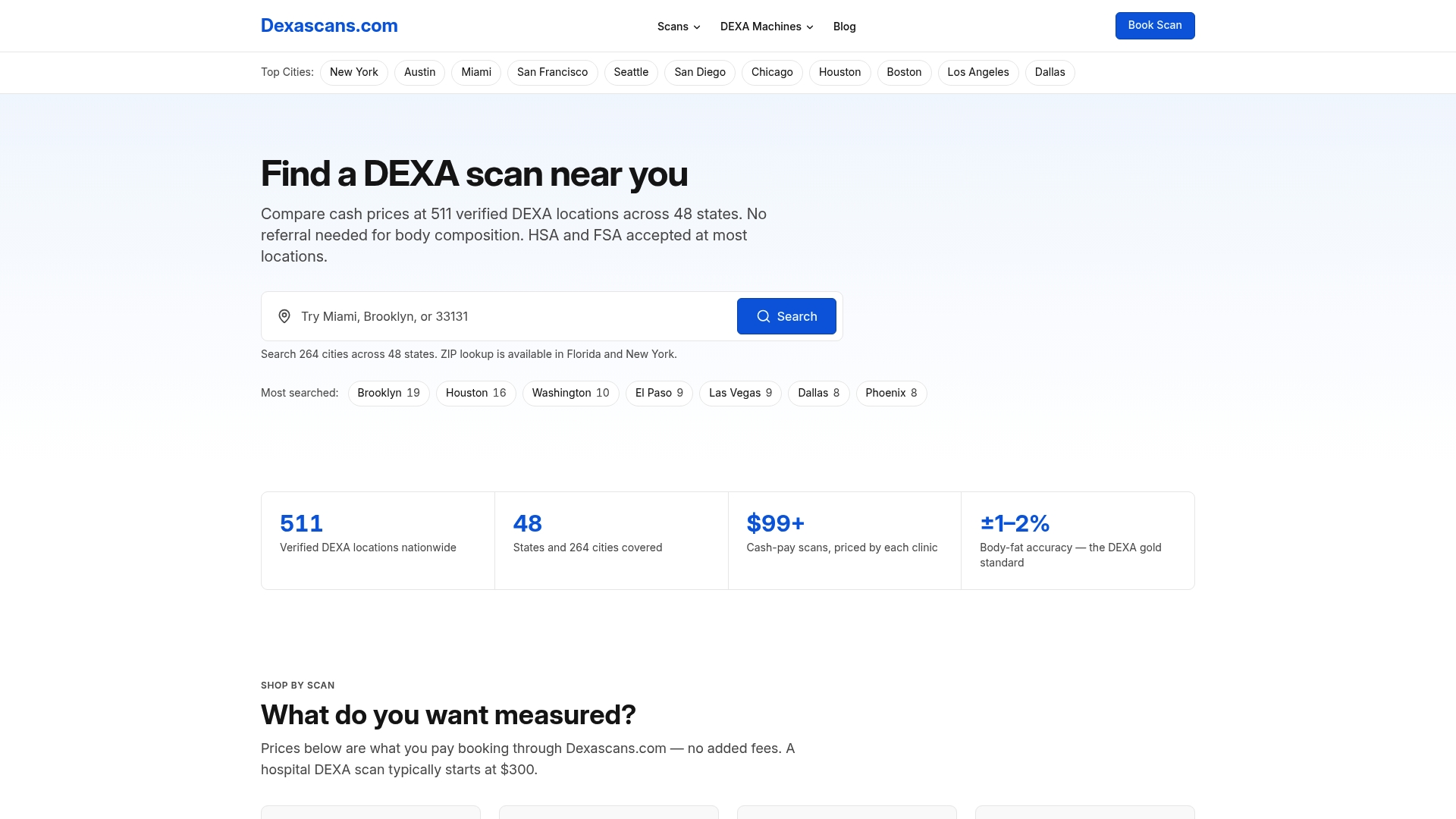
Search by ZIP code or city to pull up nearby clinics, filter for the exact scan type you need (bone density, body composition, or a combined appointment), and compare what each visit actually includes before you call. Once you find a location, confirm referral requirements and pregnancy screening directly with that facility. Interpretation of your results and any treatment decisions still belong to your clinician. Start by browsing DEXA scan locations near you to see verified pricing and availability in your area.
Sources
- Facts About Bone Density (DEXA Scan) — CDC
- DXA Scan (Bone Density Test) — Cleveland Clinic
- Radiologyinfo
This article is general information, not a substitute for advice from a qualified doctor. Consult a qualified healthcare professional about your own circumstances before acting on anything here.
FAQ
Can you wear a bra for a bone density test?
Only if it has no underwire or metal clasps. Metal fasteners can create artifacts on the scan, so many facilities ask patients to change into a gown if their clothing includes hardware.
What are the disadvantages of a DEXA scan?
DEXA can't detect infection, active fracture, or cancer the way a nuclear medicine bone scan can, and accuracy can be thrown off by metal implants, recent contrast imaging, or extreme body size.
How long does a DEXA scan take?
The scan itself typically takes about 10 to 20 minutes, though your total visit including check-in and positioning may run closer to half an hour.
What should you never do before getting a DEXA bone scan?
Avoid taking calcium supplements for 24 hours beforehand if your facility instructs you to, and disclose any recent CT scan with contrast or barium study, since these can interfere with results for 10 to 14 days.