

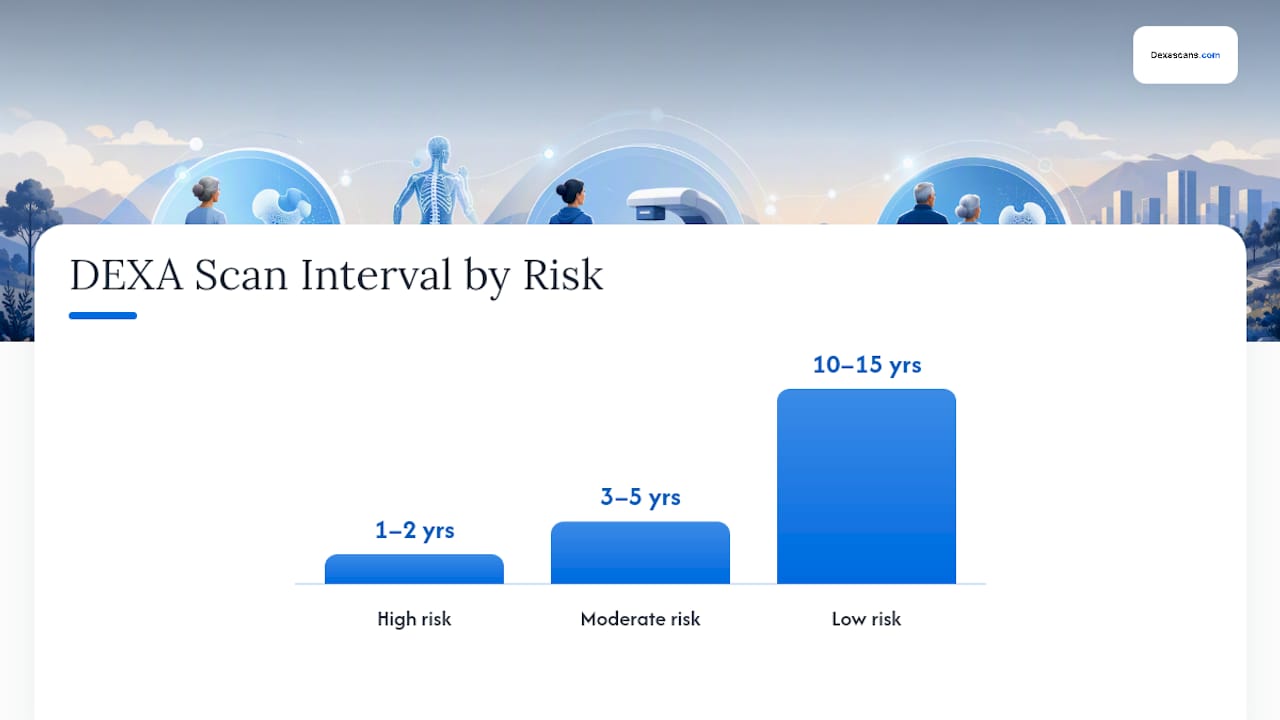
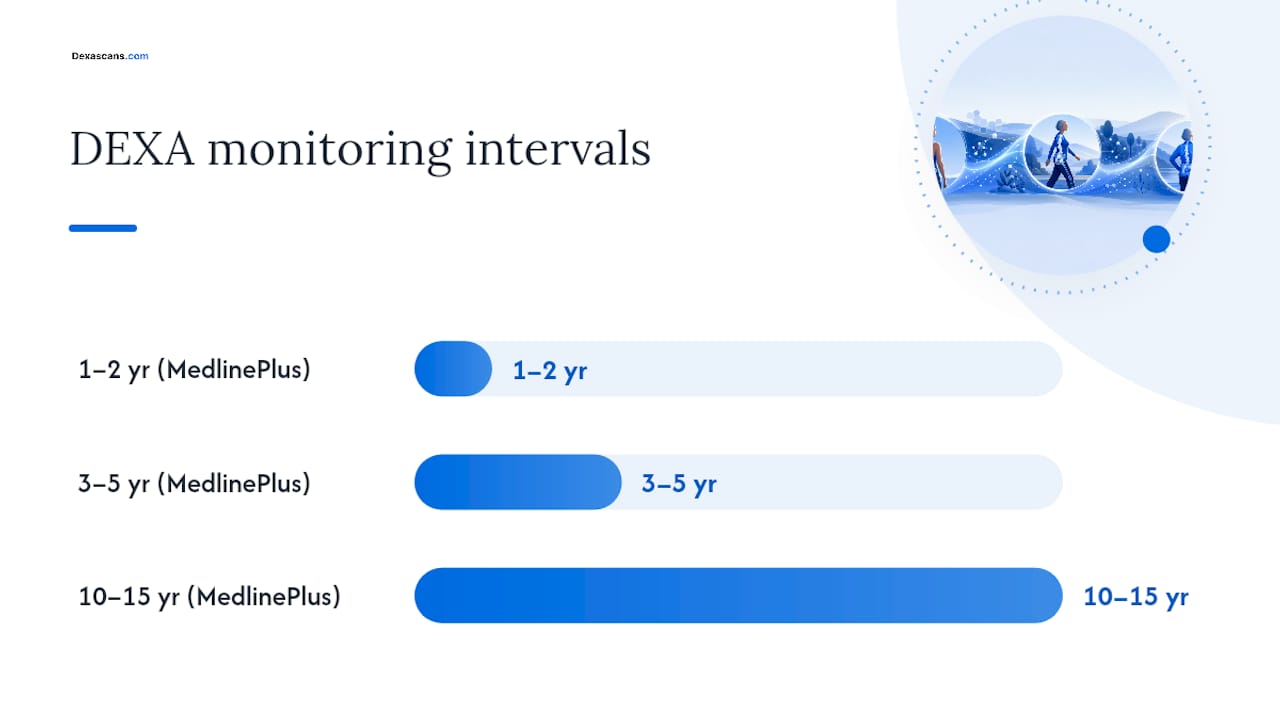
Most people need a DEXA scan every 1 to 2 years if they're high risk, every 3 to 5 years if they're moderate risk, and as infrequently as every 10 to 15 years if they're low risk, according to MedlinePlus. Screening baselines start at 65 for most women. Rescan sooner than your scheduled interval if you start a new osteoporosis medication, break a bone unexpectedly, or lose noticeable height. Everything else is a clinician's judgment call.
TL;DR:
- High-risk individuals are advised to repeat DEXA scans every 1 to 2 years to monitor rapid bone density changes and treatment response.
- Repeat scans for moderate-risk patients are typically scheduled every 3 to 5 years, unless specific clinical changes justify earlier assessment.
- Low-risk individuals can often safely wait 10 to 15 years between scans, as bone loss in this group tends to be very slow and less likely to influence treatment.
- Scans conducted before 2 years may not detect significant changes due to the margin of measurement error inherent in DEXA machines.
- Medicare generally covers bone density testing once every 24 months, with allowed earlier scans if clinical conditions like fractures or medication changes warrant it.
Table of Contents
- What Determines Dexa Scan Frequency by Risk Category
- What Do USPSTF and Other Guidelines Say About Screening Ages?
- When Should You Get a Bone Density Scan Sooner Than Scheduled?
- Why More Frequent Scans Don't Always Mean Better Data
- Does Medicare Cover DEXA Scans Every Year?
- How to Prepare for a DEXA Scan and Avoid Skewed Results
- Getting the Timing Right Without Overcomplicating It
- Skip the Referral Wait and Book a Scan Directly
- Sources
- FAQ
What Determines Dexa Scan Frequency by Risk Category
The single biggest factor in dexa scan frequency isn't your age. It's how likely your bone density is to change in a way that would actually alter your treatment plan. A stable 72-year-old on long-term therapy with unchanging scores doesn't need the same schedule as someone who just started a new drug or broke a wrist falling off a curb.
MedlinePlus breaks the recommended intervals into three tiers, and they're worth memorizing if you're managing your own bone health or a parent's.
- High risk: roughly every 1 to 2 years. This covers people actively being treated for osteoporosis, anyone with a recent fragility fracture, or those with a very low baseline bone mineral density (BMD) score.
- Moderate risk: roughly every 3 to 5 years. This is the zone for osteopenia (a T-score between negative 1.0 and negative 2.5) plus one or two risk factors like family history, low body weight, or a history of smoking.
- Low risk: up to every 10 to 15 years. Normal BMD, no major risk factors, stable overall health.
Quick reference: High risk lands at 1 to 2 years, moderate risk at 3 to 5 years, and low risk can stretch to 10 to 15 years between scans, per MedlinePlus guidance.
Two quick vignettes make this concrete. A 68-year-old woman with a T-score of negative 2.6 at the lumbar spine, who just started an oral bisphosphonate, falls squarely into the high-risk bucket. Her clinician will likely want a follow-up scan around the 1 to 2 year mark to confirm the drug is working before deciding whether to continue, switch therapies, or add something else.
Compare that to a 55-year-old with mild osteopenia (T-score negative 1.3), no fracture history, normal weight, and no family history of hip fracture. That patient sits in the moderate category. A repeat scan in 3 to 5 years is reasonable, and pushing for anything sooner usually just adds cost without adding information.
Here's a fact that surprises a lot of people: bone loss in low-risk individuals can be remarkably slow. Cohort data referenced by the U.S. Preventive Services Task Force suggest that transition times to osteoporosis vary, with those having normal baseline BMD taking many years to reach osteoporosis, while those with lower baseline BMD cross that threshold faster. That's the biological logic behind the wide gap between the 1 to 2 year high-risk window and the 10 to 15 year low-risk one. It isn't arbitrary. It's a reflection of how differently bone density erodes depending on where you start.
None of these numbers are prescriptions you fill yourself. They're starting points a clinician adjusts based on your specific labs, medications, and history. If your doctor tells you 4 years instead of 5, or 18 months instead of 2 years, that's not a guideline violation. That's medicine responding to your actual chart instead of a chart average.
What Do USPSTF and Other Guidelines Say About Screening Ages?
Screening and monitoring aren't the same conversation, and mixing them up is where a lot of confusion starts. Screening asks: should this person get a first baseline scan at all? Monitoring asks: given an existing diagnosis or risk profile, how often should we rescan?
The 2025 USPSTF recommendation gives a Grade B recommendation for screening all women 65 and older with DXA bone mineral density testing. That's a strong, actionable recommendation, meaning there's high certainty the benefit is moderate to substantial. Younger postmenopausal women with elevated fracture risk (low body weight, smoking history, parental hip fracture, certain medications) also qualify for earlier screening under the same guidance.
Men get a very different answer. The USPSTF issues an "I statement" for routine screening in men, meaning the current evidence isn't sufficient to weigh benefits against harms. That doesn't mean men never need a DEXA. It means there's no blanket rule saying every man over a certain age should get one automatically the way there is for women 65 and up. Men with specific risk factors, such as long-term corticosteroid use, low testosterone, or a prior fragility fracture, still warrant individualized screening decisions with their physician.
Other organizations largely echo the USPSTF framework but add nuance:
- The National Osteoporosis Foundation and similar clinical bodies generally support screening at 65 for women and suggest earlier testing for postmenopausal women under 65 with risk factors, aligning closely with USPSTF.
- The International Society for Clinical Densitometry focuses less on who to screen and more on how to interpret and repeat scans once someone is already in the system.
- Clinical commentary in outlets like the peer-reviewed PMC literature has actually pushed back on over-testing, arguing that a meaningful share of DEXA scans get ordered more often than the evidence supports, particularly in low-risk patients whose results wouldn't change how they're managed anyway.
That last point matters more than it might seem at first glance. A repeat scan only has clinical value if the result could plausibly change what your doctor does next. If you're stable, low risk, and not on any bone-affecting medication, rescanning at 2 years instead of 10 doesn't give your doctor new decision-making power. It mostly just adds a bill and a slightly earlier data point.
The practical takeaway: screening guidelines set the "should this person get tested at all" threshold. Monitoring intervals, the 1 to 2, 3 to 5, and 10 to 15 year windows from MedlinePlus, kick in once you already have a baseline and a risk category assigned. Confusing the two leads to either unnecessary anxiety about "overdue" scans or unnecessary scans that don't move the needle on your care.
When Should You Get a Bone Density Scan Sooner Than Scheduled?
Routine intervals are the default, not the ceiling. Several situations override the standard schedule and justify moving up your next scan regardless of what risk category you're in.
- Starting or switching osteoporosis medication. Clinicians commonly order a follow-up DEXA around 1 to 2 years after beginning a new therapy, whether that's a bisphosphonate, denosumab, or an anabolic agent, to confirm the drug is producing a measurable response before committing to years of treatment.
- Long-term systemic corticosteroid use. Glucocorticoids taken for conditions like rheumatoid arthritis or severe asthma accelerate bone loss faster than almost any other common medication class. Anyone on sustained oral steroids should expect more frequent monitoring than their age alone would suggest.
- Androgen-deprivation therapy (ADT) for prostate cancer. ADT suppresses testosterone, which speeds up bone resorption. Men on ADT are one of the clearest exceptions to the "insufficient evidence for routine male screening" rule. This is a scenario where earlier, more frequent scanning is well justified.
- A new fragility fracture. Breaking a bone from a low-impact event, a fall from standing height, a minor stumble, is itself a diagnostic red flag. It often triggers an immediate scan regardless of when the last one happened.
- Unexplained height loss. Losing more than an inch or two without an obvious cause can signal vertebral compression fractures, which sometimes go unnoticed until a scan or an X-ray catches them. Both NIAMS and clinical practice flag this as a trigger for earlier imaging.
Pro Tip: If you're starting a new bone medication, ask your prescribing doctor upfront when they plan to order the follow-up scan. Getting that date on the calendar now, instead of waiting for a reminder, keeps you from accidentally drifting past the window where the scan would actually inform a treatment decision.
These triggers aren't mutually exclusive, either. Someone on long-term steroids who then breaks a bone has two independent reasons to move up their next appointment, not one diluted reason. When in doubt, the safest move is a direct conversation with the ordering physician rather than guessing based on a generic timeline you found online, including this one.
Why More Frequent Scans Don't Always Mean Better Data
Here's the part almost nobody explains clearly, and it's the reason blindly scanning every year "just to be safe" can actually backfire: DEXA machines have a built-in margin of error, and that margin sets a floor on how often rescanning is even useful.
Every DEXA scanner has what's called precision error, the natural variation you'd see if you scanned the same person, on the same machine, multiple times in a row with zero real change in their bones. According to ISCD guidance, typical facility-level precision for an individual technologist runs around 1.8% to 1.9% at common measurement sites like the lumbar spine and total hip.
From that precision number, facilities calculate something called the least significant change, or LSC. LSC is the minimum amount your BMD has to shift between two scans before that change can be considered statistically real rather than machine noise.
The number that matters: if your bone density changes by less than your facility's LSC, roughly 5% at many sites per ISCD standards, your clinician can't confidently say anything actually happened. It could be real bone loss, or it could just be the machine's built-in wobble.
That has a direct, practical consequence for dexa scan frequency: scanning too soon after a baseline test often produces a result that falls entirely inside the margin of error. You've spent the time and money, and your doctor still can't tell if your bones changed. That's part of why the 1 to 2 year minimum shows up so consistently across guidance for even high-risk patients. It's roughly the shortest interval where real biological change has a decent chance of exceeding the noise floor.
There's a second wrinkle that catches people off guard: not all DEXA machines are interchangeable. ISCD positions note that switching between different manufacturers' scanners, or even different models from the same manufacturer, without cross-calibration can make serial comparisons meaningless. A T-score from Machine A at one imaging center and a T-score from Machine B at a different clinic two years later aren't guaranteed to be measuring on the same scale. This is a big reason serial monitoring works best when you can stick with the same facility and ideally the same equipment.
Put these two pieces together and the practical takeaway is straightforward. For most people monitoring bone density over time, waiting at least about 2 years between scans gives real biological change a fighting chance of clearing the measurement error floor, unless one of the clinical triggers covered above justifies moving sooner. Chasing more frequent data than that mostly buys you noise dressed up as information.
Does Medicare Cover DEXA Scans Every Year?
Medicare generally covers a bone density test once every 24 months when it's medically necessary, and that 2-year cadence lines up almost perfectly with the precision and LSC math covered above, and with the high-risk end of the MedlinePlus interval range. It's not a coincidence. The coverage rule reflects the same underlying reality: rescanning more often than that rarely produces a clinically meaningful result for most beneficiaries.
That said, "every 24 months" isn't an absolute ceiling. Medicare and most private insurers allow more frequent scanning when there's documented medical necessity, and that documentation is the part people underestimate.
- Confirm your plan's specific rule. Medicare Part B typically covers bone density testing every 2 years, but supplemental plans and Medicare Advantage plans can layer on their own prior authorization requirements.
- Ask your doctor to code the visit correctly. Coverage for earlier-than-standard rescans usually hinges on the diagnosis codes attached to the order, things like a documented fracture, a new prescription for an osteoporosis medication, or a condition like long-term steroid use that's known to accelerate bone loss.
- Request prior authorization proactively. If your clinician wants to scan sooner than 2 years for a legitimate reason, having them submit documentation ahead of the appointment, rather than after a denial, saves weeks of back-and-forth.
- Know that cash-pay options exist outside the insurance clock entirely. If you want a scan sooner than your coverage allows and it's not strictly medically necessary by insurer standards, paying out of pocket at a transparently priced facility sidesteps the wait without a coding fight.
The honest version of this rule: insurance frequency limits are built around the same evidence that shapes the clinical guidelines. They're not usually the obstacle people expect. The bigger friction point is almost always getting the documentation lined up correctly when a genuine exception applies.
How to Prepare for a DEXA Scan and Avoid Skewed Results
A central DEXA scan is refreshingly low effort compared to most medical imaging. According to Mayo Clinic, the whole appointment typically runs 10 to 30 minutes, you stay fully clothed in most cases, and it's completely painless. Radiation exposure is very low, well below what you'd get from a standard chest X-ray, so it's not something to lose sleep over even with repeat testing every couple of years.
A few small missteps can throw off your results enough to matter, though, especially if you're tracking change over time.
- Skip metal on the day of your scan. Zippers, belt buckles, underwire bras, and jewelry near the scan area can all interfere with the imaging. Most facilities provide a gown, but wearing simple clothing without metal fasteners speeds things along.
- Hold off on calcium supplements for 24 hours beforehand. MedlinePlus advises skipping calcium supplements the day before your test, since undigested calcium in your gastrointestinal tract can theoretically interfere with the reading.
- Mention any recent imaging with contrast dye or barium. These can linger in your system and distort results if your scan is scheduled too soon afterward. Tell the technologist if you've had a CT scan or barium study in the past week or two.
- Book at the same facility for follow-up scans whenever possible. Since cross-machine comparisons carry real uncertainty, sticking with the same scanner and ideally the same technologist keeps your serial results genuinely comparable.
Pro Tip: If you're monitoring a treatment response closely, ask the facility for its precision and LSC figures before your first scan. A clinic that can hand you those numbers, rather than a shrug, is signaling it takes serial monitoring seriously, and that's worth knowing before you commit to a multi-year monitoring relationship with them.
Getting the Timing Right Without Overcomplicating It
The instinct to scan often feels responsible. It isn't always. The evidence points toward a more disciplined idea: a scan is only useful if the result could plausibly change what happens next, whether that's starting a medication, adjusting a dose, or simply confirming that watchful waiting remains the right call.
What gets underestimated is how much the measurement error itself, not caution or bureaucracy, sets the real floor on how often rescanning makes sense. A 2-year minimum for many patients isn't a guideline being conservative for the sake of it. It's roughly the shortest window where a real change in bone density has decent odds of standing out from the machine's own noise. Scan too soon and you're not getting extra safety. You're mostly getting a number that can't tell you anything new.
Where access genuinely matters is making sure people who do need more frequent monitoring, someone newly diagnosed, someone on androgen-deprivation therapy, someone who just fractured a wrist, aren't stuck waiting months for an appointment or facing opaque pricing that makes them skip a scan they actually need. Removing friction from the scheduling side doesn't change the clinical math, but it does mean fewer people fall off the interval their risk profile calls for simply because booking was a hassle.
— Erik
Skip the Referral Wait and Book a Scan Directly
Once you know your recommended interval, the next hurdle is usually logistics: finding a facility, getting a referral, and figuring out what it'll actually cost. There are platforms available that list numerous verified DEXA locations across many states where you can book a bone density or body composition scan directly, often without a physician referral, and with transparent cash pricing shown upfront instead of a surprise bill after the fact.
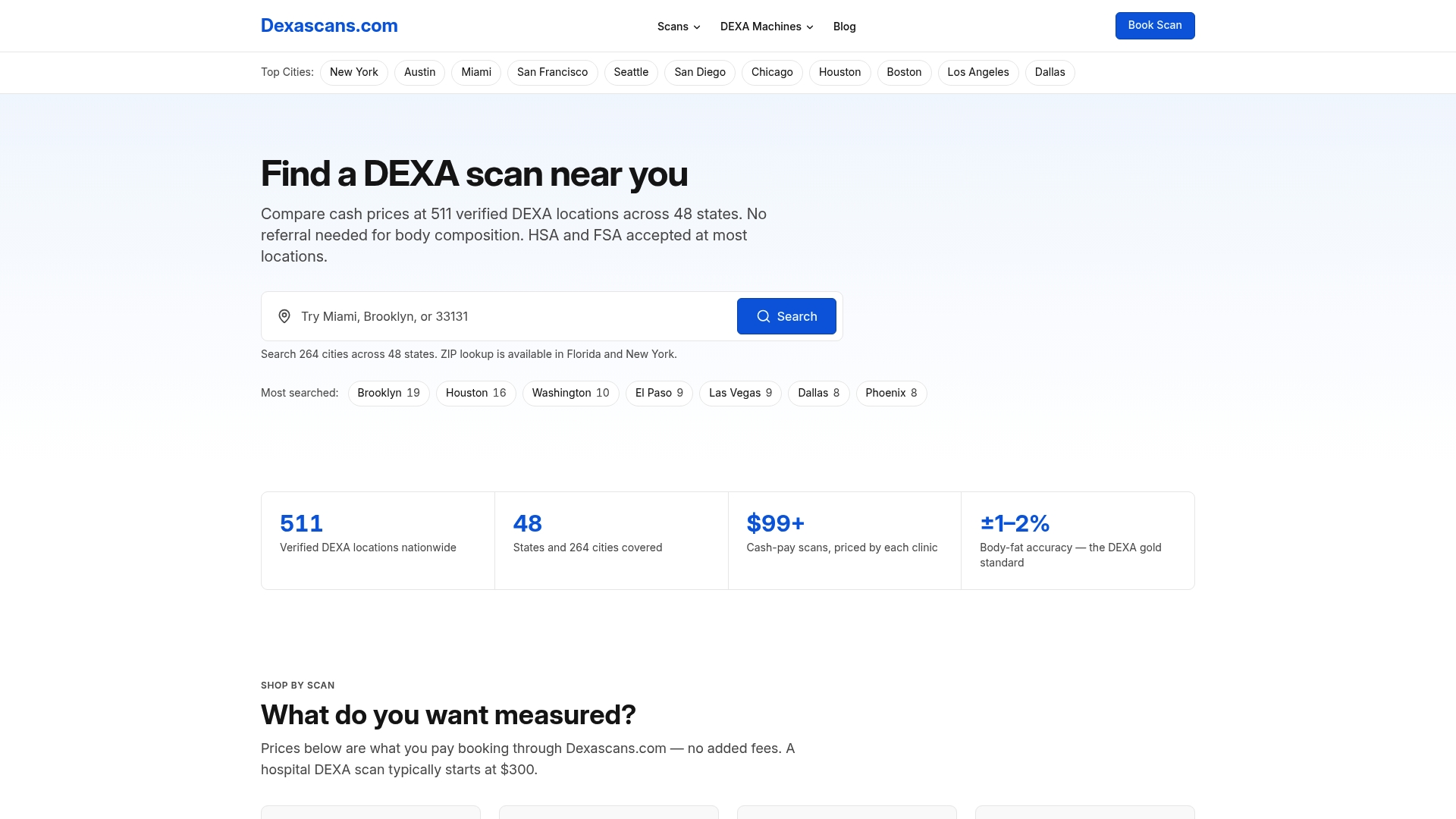
That transparency matters most for anyone whose insurance limits coverage to once every 24 months but whose clinician wants a check sooner for a documented reason, or for anyone who'd simply rather pay a known cash price than navigate a prior authorization process. Because DEXA measures body fat with a precision of about plus or minus 1% to 2%, it also gives fitness-focused users and osteoporosis-conscious patients alike a level of accuracy that's hard to match with home scales or bioelectrical impedance devices.
If you're due for a scan under any of the risk-based windows covered above, search DEXA scan locations near you to compare nearby clinics and pricing, or read the full DEXA scan overview to see exactly what your appointment will involve before you book.
Sources
For anyone who wants to read the original guidance rather than take a summary at face value: the USPSTF screening recommendation covers age thresholds, MedlinePlus lays out risk-based intervals in plain language, and ISCD's official positions explain the precision and LSC methodology behind minimum monitoring windows.
This article is general information, not a substitute for advice from a qualified doctor. Consult a qualified healthcare professional about your own circumstances before acting on anything here.
- Bone Density Scan: MedlinePlus Medical Test
- Osteoporosis to Prevent Fractures: Screening | USPSTF
- ISCD official positions (2023)
- Bone density test (DEXA) — Mayo Clinic
FAQ
How long do you have to wait between DEXA scans?
Most guidance points to at least 1 to 2 years for high-risk patients, since that's roughly the shortest window where a real bone density change can be distinguished from normal machine measurement error, according to ISCD precision standards. Lower-risk patients can often safely wait 3 to 5 years or longer, per MedlinePlus.
How often can you get a DEXA scan with Medicare?
Medicare typically covers a bone density test once every 24 months when medically necessary. More frequent scans can be covered with proper documentation, such as a new osteoporosis diagnosis, a recent fracture, or a medication known to accelerate bone loss.
What should you never do before getting a DEXA bone scan?
Avoid taking calcium supplements within 24 hours of your appointment, since MedlinePlus notes undigested calcium can interfere with results, and skip wearing clothing with zippers, metal buttons, or underwire that could show up on the scan.
Should a 70-year-old get a bone density test?
Yes. The USPSTF gives a Grade B recommendation for screening women 65 and older, and women without a recent scan would generally fall well within that recommendation. For men, the decision depends more on individual risk factors like steroid use or prior fractures, since routine screening evidence in men remains insufficient.