

Your T-score tells you where your bone density falls compared to a healthy young adult, and it's the number that matters if you're a postmenopausal woman or a man 50 or older. A T-score of -1.0 or higher is normal, -1.0 to -2.5 signals low bone mass, and -2.5 or below meets the threshold for osteoporosis. None of that is a diagnosis on its own. Bring the report to the clinician who ordered it, along with any fracture history, before drawing conclusions.
TL;DR:
- T-scores are most reliable for postmenopausal women and men over 50, with scores below -2.5 indicating osteoporosis and above -1.0 being normal.
- Hip and spine measurements provide different insights, with hip scans best predicting fractures and spine scans more responsive to treatment changes.
- Factors like spinal osteophytes, hardware, and obesity can distort DEXA results, making clinical context and prior reports crucial for accurate interpretation.
- A single score is not a diagnosis; fracture history and risk assessments like FRAX are essential for treatment decisions.
- Consistency in measurement sites and machine type is vital when tracking bone density changes over time.
Table of Contents
- Understanding Dexa Results: T-Scores vs. Z-Scores
- Which Bones Get Measured, and Why It Matters
- What Can Skew or Mislead Your DEXA Result
- How Clinicians Read DEXA Alongside the Rest of Your Health Picture
- How to Read Your DEXA Report: A Quick Checklist
- When to Repeat a Scan and What Counts as Real Change
- How Dexascans Helps You Compare and Book DEXA Scans
- Treat Your Results as a Conversation, Not a Verdict
- Ready to Compare DEXA Options?
- Where to Read More
- Sources
- FAQ
Understanding Dexa Results: T-Scores vs. Z-Scores
DEXA reports show two different scores, and mixing them up is the single most common source of confusion in dexa scan results.
A T-score measures how your bone mineral density compares to a healthy 30-year-old of the same sex, the age at which peak bone mass is typically reached. It's the score clinicians rely on for postmenopausal women and men 50 and older, because that's the population where the diagnostic categories were built and validated. A Z-score, by contrast, compares your density to other people your own age and sex. It's the more useful number for premenopausal women, men under 50, and children, since comparing a 30-year-old to a 70-year-old peak isn't clinically meaningful.
- T-score ≥ -1.0: normal bone density
- T-score -1.0 to -2.5: low bone mass (osteopenia)
- T-score ≤ -2.5: osteoporosis
- Z-score ≤ -2.0: below the expected range for age, which prompts a search for secondary causes
Every score is a standard deviation. Negative numbers mean less bone than the reference point; a positive score means more. A -2.0 isn't "twice as bad" as a -1.0 in a linear sense, but each step down the scale reflects a real, measurable drop in density and a corresponding rise in fracture risk.
Which Bones Get Measured, and Why It Matters
DEXA machines typically scan the lumbar spine, the hip (both femoral neck and total hip), and sometimes the forearm. Each site tells a slightly different story.
- Total hip and femoral neck: the best predictors of hip fracture, and the standard sites for diagnosing osteoporosis.
- Lumbar spine: more sensitive to change, which makes it the preferred site for tracking how well a treatment is working over time.
- Forearm (33% radius): used when hip or spine can't be read reliably, or in cases of very high body weight or hyperparathyroidism.
When both hips are scanned, the ISCD recommends using whichever hip reads lowest for diagnosis, but the average of both hips for tracking change on future scans. Hip BMD is the strongest predictor of hip fracture specifically, while the spine works better for monitoring because it responds faster to bone-building medications.
What Can Skew or Mislead Your DEXA Result
A single misleading number can send you down the wrong path, and DEXA has known blind spots. Spinal osteophytes, vertebral compression fractures, and calcified aortic plaque all inflate spine density readings, sometimes masking real bone loss underneath. Metal implants, surgical hardware, and severe scoliosis distort the scan geometry entirely.
- Osteoarthritis and bone spurs in the spine (falsely raises spine T-score)
- Metal implants, pacemakers, or prior spinal surgery hardware
- Obesity, which can affect positioning and soft-tissue attenuation
- Osteomalacia, which mimics osteoporosis on imaging but has a different cause
- Inconsistent positioning or scans run on different machines over time
Pro Tip: Bring your prior DEXA reports to every new appointment, and ask the technologist what machine model performed the scan and what the facility's least significant change value is. Comparing scans from two different machines without that context can make a stable spine look like it's falling apart.
How Clinicians Read DEXA Alongside the Rest of Your Health Picture
A T-score is one input, not a verdict. Someone with a T-score of -1.8 and a prior wrist fracture may face a higher real-world fracture risk than someone with a -2.3 and no fracture history, no falls, and no other risk factors. NIH guidance is explicit that clinicians need to weigh fracture history, age, medications like long-term steroids, and other conditions before deciding what a number means for you personally.
That's where fracture-risk tools come in. For patients sitting in the osteopenia range, many clinicians run the numbers through FRAX, a calculator that estimates 10-year probability of hip and major osteoporotic fracture using T-score plus factors like age, weight, smoking, and family history. A T-score alone might not clear the treatment threshold; a FRAX score that accounts for a parent's hip fracture or long-term steroid use might.
- Prior fragility fracture can justify treatment even with a T-score above -2.5
- FRAX helps decide whether osteopenia needs medication or just monitoring
- Unusually low Z-scores in younger patients often trigger lab work for thyroid, vitamin D, or hormonal causes
- Suspected vertebral fractures may prompt a dedicated imaging follow-up
How to Read Your DEXA Report: A Quick Checklist
Pull out your report and work through it in this order.
- Find the measured sites. Confirm whether both hips were scanned, and check that the spine image doesn't flag excluded vertebrae.
- Identify which score applies to you. Postmenopausal or 50-plus, use the T-score. Premenopausal, under 50, or a child, use the Z-score.
- Read the impression line, not just the numbers. The radiologist's summary states which site drove the diagnosis and notes any artifacts that were excluded from the calculation.
- Check for a precision or least significant change value. If you're comparing this scan to a past one, ask whether the facility reported this figure.
The bone density test guide on Dexascans walks through sample reports if you want to see what a full readout looks like before your appointment.
When to Repeat a Scan and What Counts as Real Change
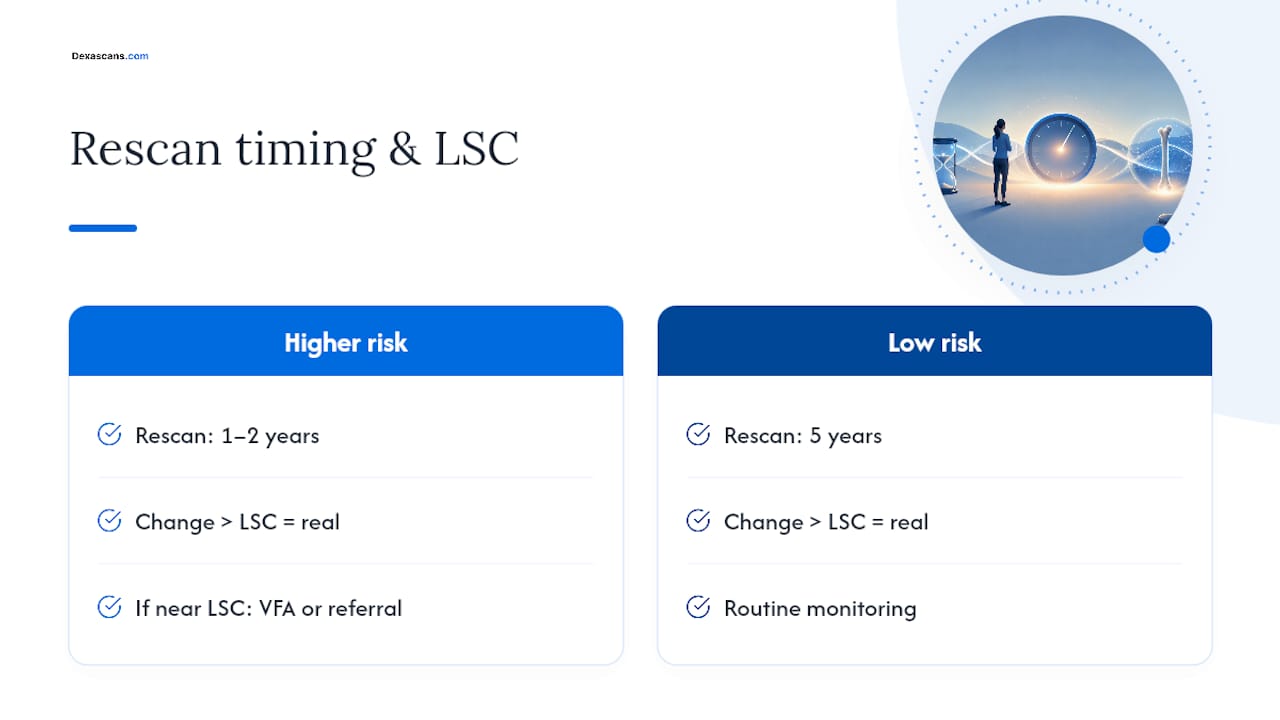
Monitoring intervals aren't fixed. Someone on osteoporosis medication might get rescanned in one to two years, while someone with normal density and low risk might wait five or longer. What matters more than timing is precision. Each facility calculates its own least significant change, the smallest difference in BMD that exceeds normal machine and positioning variability. A change smaller than that number could just be noise, not real bone loss or gain. If a report shows a change close to that threshold, or if there's clinical suspicion of a new vertebral fracture, ask about a vertebral fracture assessment or a referral to an endocrinologist or rheumatologist.
How Dexascans Helps You Compare and Book DEXA Scans
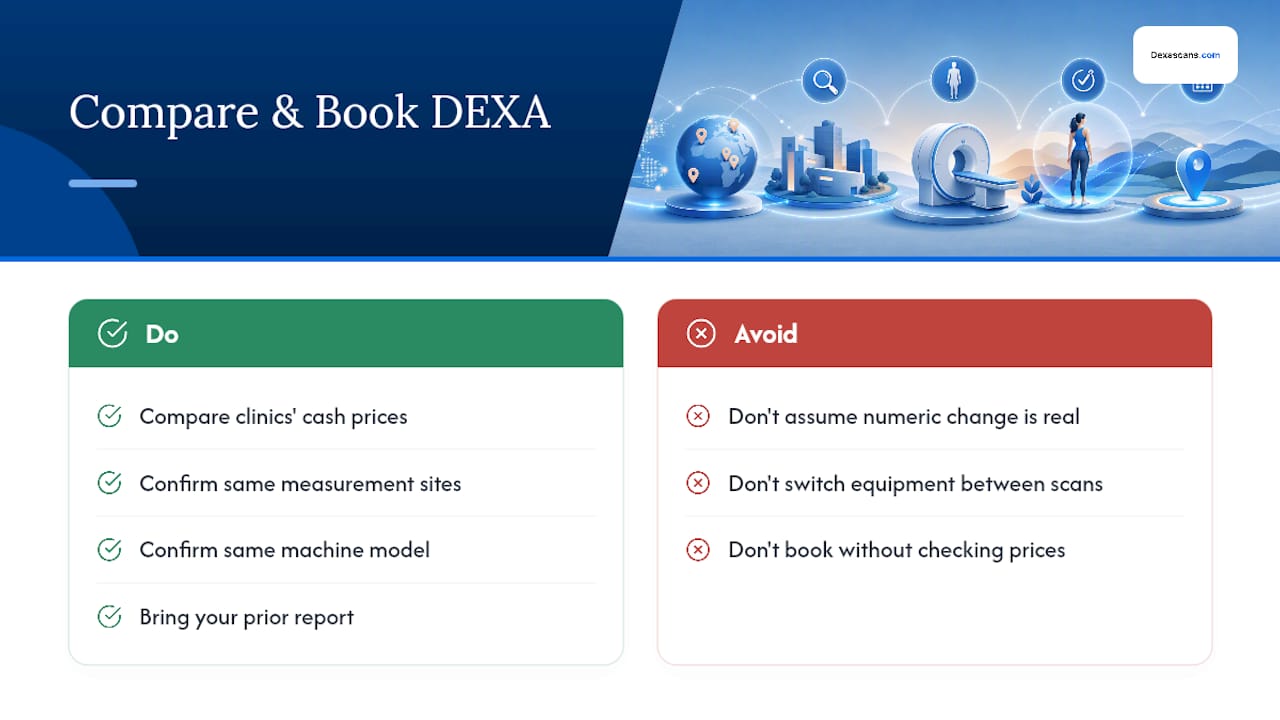
Dexascans lists verified DEXA locations nationwide with transparent cash pricing, so you can compare clinics before booking a repeat or second-opinion scan. When scheduling a follow-up, confirm the same sites will be measured and, ideally, the same machine model, since switching equipment can introduce variability that mimics real bone change. Bring your prior report and ask the ordering clinician about the facility's least significant change value before assuming any shift in your numbers is meaningful.
Treat Your Results as a Conversation, Not a Verdict
A number on a page doesn't capture your fall risk, your diet, or your family history. If your report doesn't clearly state which hip or vertebra drove the impression, ask. Fall prevention, strength training, and medication decisions all depend on the fuller picture your clinician has that the printout doesn't.
— Erik
Ready to Compare DEXA Options?
Booking a DEXA scan usually means picking between a hospital referral with a long wait or an imaging center with murky pricing. Dexascans is the more direct route: it lists verified DEXA clinics with upfront cash pricing, so you know the cost before you show up and can compare locations by ZIP code in minutes.
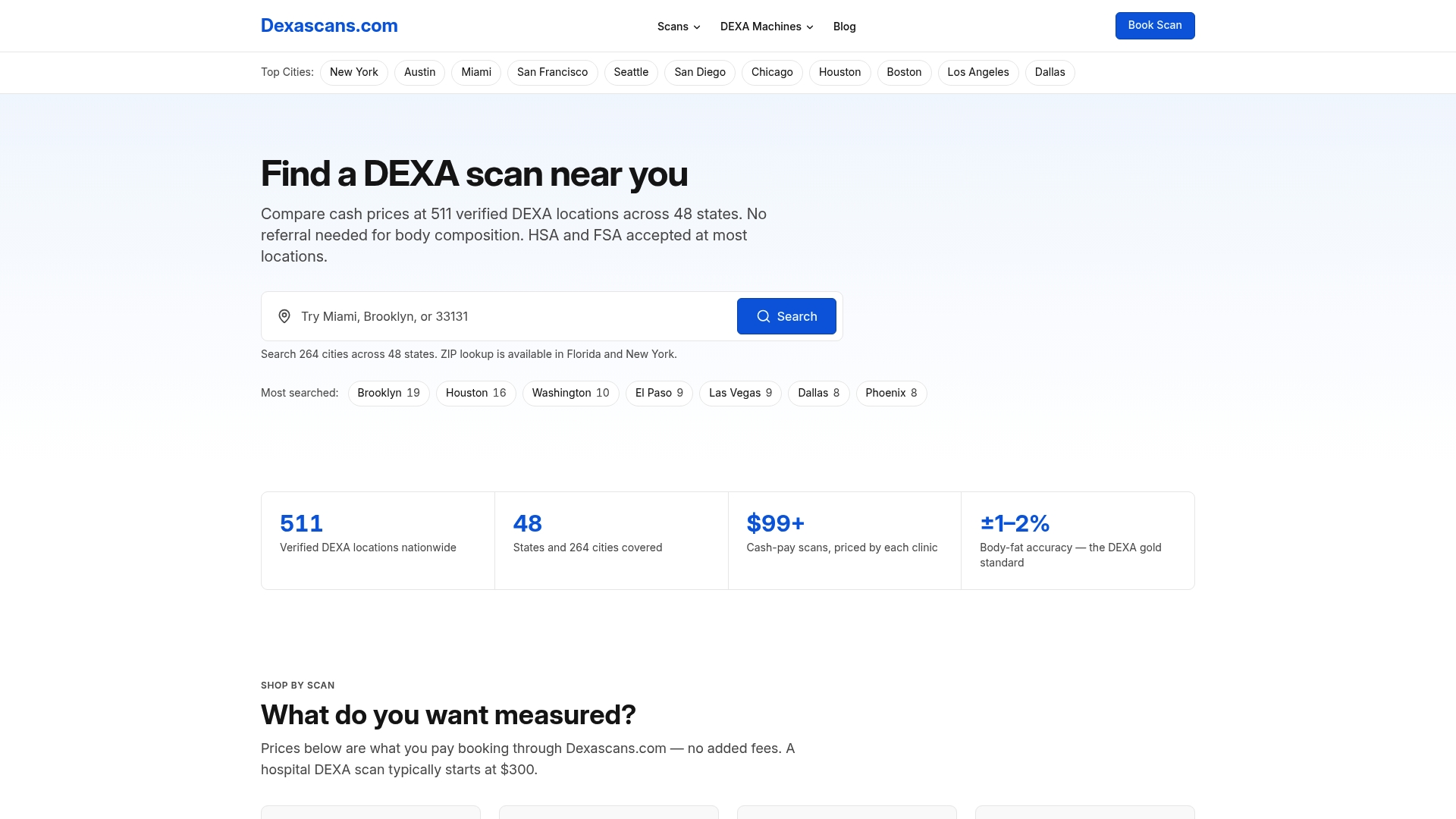
When you book a repeat scan through a listed clinic, ask two things upfront: which sites they measure (hip, spine, or both) and what machine they use, since consistency between scans matters for tracking real change. Bring your prior report so the technologist can match positioning as closely as possible. You can search verified DEXA locations near you and compare cash prices before you book your next scan.
Where to Read More
For deeper background beyond this article, the NIAMS guide to bone mineral density numbers covers the clinical cutoffs directly, the ISCD Official Positions detail reporting standards, and the Postgrad Med J review covers DEXA's diagnostic strengths and limits in more technical depth.
This article is general information, not a substitute for advice from a qualified doctor. Consult a qualified healthcare professional about your own circumstances before acting on anything here.
Sources
- Bone Mineral Density Tests: What the Numbers Mean | NIAMS
- Official Adult Positions - ISCD
- Diagnostic Tests: Bone mineral density: testing for osteoporosis (Postgrad Med J review)
- Bone density test (DXA/DEXA scan) - Mayo Clinic
FAQ
How Do You Interpret DEXA Scan Results?
Check which score applies to you (T-score for postmenopausal women and men 50+, Z-score for younger adults), then compare it to the diagnostic ranges: -1.0 or higher is normal, -1.0 to -2.5 is low bone mass, and -2.5 or below is osteoporosis.
What Is Normal Bone Density for a 70-Year-Old Woman?
The same numeric cutoffs apply regardless of age within the postmenopausal group. A T-score of -1.0 or higher is normal for a 70-year-old woman, though average bone density naturally trends lower with age.
What Can Throw Off a DEXA Scan?
Spinal osteophytes, vertebral compression fractures, metal implants, prior spinal hardware, obesity, and inconsistent positioning between scans can all skew results, along with switching between different machine models over time.
Is a T-Score of -3.5 Bad for Osteoporosis?
Yes. A T-score of -3.5 falls well past the -2.5 osteoporosis threshold and indicates severe bone loss, which typically warrants prompt discussion of treatment options and fracture-prevention strategies with your clinician.