
A DEXA scan billed to insurance generally requires an order from a physician or qualified practitioner, while cash-pay scans booked directly with a clinic often do not. Medicare specifically requires that the treating practitioner order the test and use the results to manage the patient's care. Because clinic policies and insurer rules vary, we list clinics that accept direct cash bookings for readers who want to skip the referral step entirely.
TL;DR:
- When insurance pays, bone density exams generally require a treating clinician’s order, a qualifying diagnosis, the clinician’s NPI, and documentation that results will guide care.
- Medicare generally covers bone mass testing every two years, but documented medical necessity can support earlier retesting for treatment monitoring or other qualifying conditions.
- Routine screening is recommended at age 65 for women; younger postmenopausal women need risk assessment for factors such as low weight, smoking, or family history.
- Many clinics accept direct cash bookings without an order, but fitness body composition scans differ from clinical hip and spine exams.
- Insurers are unlikely to reimburse scans booked without an order, even when results reveal a medical problem, so confirm coverage before paying cash.
Table of Contents
- When is a DEXA order required: clinical testing versus fitness scans
- Medicare and insurer rules on coverage, frequency, and documentation
- How clinicians decide who needs a DXA scan
- How to get an order: practical steps and scripts to use
- Options when you don't have insurance coverage for a DEXA
- Billing, coding, and coverage pitfalls to avoid
- Checklist: questions to ask before you book a DEXA
- How Dexascans helps you find a scan without a referral
- A practical reminder before you book
- Find and book a DEXA scan that fits your situation
- FAQ
- Sources
When is a DEXA order required: clinical testing versus fitness scans
The referral question really comes down to why you're getting scanned. A medically indicated bone density test, often called a bone mass measurement or axial DXA, looks at your hip and spine to diagnose or monitor osteoporosis. This is the version insurance pays for, and it's the version that typically needs an order from your doctor. A body-composition DEXA, on the other hand, measures fat, muscle, and bone across your whole body and is frequently used for fitness tracking or general health monitoring rather than diagnosing disease.
That distinction matters because clinical indications drive whether a clinician writes an order in the first place. Common reasons a doctor orders a DXA include:
- Screening for osteoporosis in someone at elevated risk based on age or health history
- Long-term use of glucocorticoid medications like prednisone, which can weaken bone
- Vertebral abnormalities found on an X-ray or other imaging
- Monitoring how well an osteoporosis treatment is working over time
- Evaluating a condition such as primary hyperparathyroidism that affects bone metabolism
When none of those apply and you simply want a body-composition snapshot for training or weight management, many clinics and testing centers offer that service as a cash transaction with no clinician order involved. You can learn more about how a body composition scan differs from a bone-density exam, since the two use similar equipment but serve very different purposes.
Medicare and insurer rules on coverage, frequency, and documentation
Medicare's coverage rules are the clearest example of why an order matters for insurance billing. Under 42 CFR 410.31, bone mass measurements must be ordered by the treating physician or a qualified nonphysician practitioner, and the result has to be used in managing that patient's specific medical problem. An order by itself doesn't guarantee payment: the documentation and the type of test performed both have to match what the payer considers medically necessary.

Medicare generally covers bone mass measurement roughly every two years, with exceptions allowed when medical necessity supports earlier retesting, according to Medicare's coverage guidance. Beneficiaries who typically qualify include estrogen-deficient women identified as being at clinical risk, people with vertebral abnormalities on imaging, patients on long-term glucocorticoid therapy, those with primary hyperparathyroidism, and patients being monitored for response to an FDA-approved osteoporosis drug. The 24-month standard reflects a screening or monitoring interval rather than a flat rule, and some of these categories allow for more frequent testing when the ordering practitioner documents the clinical reason.
For a claim to actually get paid, a few pieces of documentation need to line up:
- The ordering practitioner's name and National Provider Identifier (NPI) on the claim
- A diagnosis code that supports medical necessity for the specific test performed
- A separate interpretation report, usually from a radiologist, distinct from the technical scan itself
- Evidence that the result will be or was used to manage the patient's treatment, not just collected for informational purposes
CMS billing and coding guidance reinforces that testing facilities and ordering clinicians share responsibility for this paper trail. A claim missing the ordering NPI or lacking a qualifying diagnosis code risks denial even when the scan itself was performed correctly. This is also where frequency rules get confusing for patients: someone with osteoporosis on treatment might be re-scanned sooner than someone receiving a routine screening test, because the "qualifying category" and the medical reason behind the test, not just the calendar, determine how often Medicare will pay. If you're trying to understand how often you might need repeat testing based on your own risk level, our DEXA scan frequency breakdown walks through typical intervals by category.
How clinicians decide who needs a DXA scan
Clinicians don't order a bone density test for every patient who asks, and that's by design rather than reluctance. The U.S. Preventive Services Task Force recommends routine osteoporosis screening for women age 65 and older. For postmenopausal women younger than 65, the recommendation shifts to a risk-assessment-first approach: a clinician evaluates risk factors before deciding whether a DXA is warranted, rather than scanning everyone in that age group automatically.
That risk assessment typically looks at factors such as:
- Low body weight relative to height
- A parent who fractured a hip
- Current smoking
- Heavy alcohol use
- Certain chronic diseases or long-term medications that affect bone density
The CDC echoes this framework, noting that women 50 to 64 with specific risk factors, such as a parent's hip fracture or a relevant chronic condition, may warrant earlier screening even before the routine age-65 threshold applies to everyone else.
This two-step model exists to concentrate testing on people most likely to benefit, rather than scanning broadly and generating results that don't change anyone's treatment. It's a deliberate tradeoff: fewer low-value scans in exchange for more targeted ones.
Pro Tip: If you're under 65 and postmenopausal, bring a written list of your personal and family risk factors to your appointment: it gives your clinician concrete information to document medical necessity if a scan is warranted.
How to get an order: practical steps and scripts to use
Getting a clinician to order a DXA scan is usually a matter of presenting the right information clearly, not a hard sell. Here's a workable approach:
- Gather your history first. Write down any prior fractures, your family history of hip fracture, medications like long-term steroids, and lifestyle factors such as smoking or alcohol use.
- Schedule a visit specifically to discuss bone health. Mentioning it as a side note during an unrelated appointment makes it easier to get deprioritized.
- State your risk factors plainly. A script like "I've been on prednisone 10 mg daily for six months" or "my mother broke her hip at 72" gives your clinician exactly what they need to document medical necessity.
- Ask directly for a risk assessment and, if appropriate, a DXA order. Something as simple as "based on this history, do you think I should be screened for osteoporosis?" opens the conversation without demanding a specific test.
- If your clinician declines, ask for the reasoning in writing. A documented risk assessment explaining why screening isn't indicated yet is useful information, and you're entitled to ask for it.
- Request a second opinion or a referral to an endocrinologist or rheumatologist if you still have concerns after that conversation, particularly if you have a condition known to affect bone density.
This process works because it mirrors exactly what payers look for: a documented clinical reason, tied to your specific history, that justifies the test. Clinicians aren't being difficult when they ask for that context; they're building the record a claim actually needs to get paid.
Options when you don't have insurance coverage for a DEXA
If a clinician doesn't order a scan, or you'd simply rather not go through insurance, cash-pay options exist and are widely available. Many independent clinics and testing centers schedule direct bookings without requiring any clinician order at all, and pricing is often more transparent than what a hospital radiology department quotes.
A few things to know before booking this way:
- Cash prices vary considerably between hospital-based imaging and independent or fitness-oriented clinics, often by a wide margin for the same type of scan
- A body-composition scan booked for fitness purposes is a different service than an axial DXA ordered to evaluate bone health, even though both use DEXA technology
- Research on self-referral programs has shown that offering testing without a clinician gatekeeper increases how many people get scanned, though payer rules still determine whether any of it gets reimbursed
- A scan booked without an order is very unlikely to be reimbursed by insurance after the fact, even if the results turn out to show a medical problem
If your goal is bone health monitoring rather than body composition, our bone density test guide explains typical cash pricing and what a T-score result actually tells you. For a deeper look at how DXA results are interpreted once you have them, this explainer on reading your results is a useful patient-facing resource.
Billing, coding, and coverage pitfalls to avoid
Even with a valid order in hand, a few administrative details determine whether your claim actually gets paid. The ordering clinician's NPI has to appear on the claim, the diagnosis code submitted has to support medical necessity for that specific test, and the radiologist's interpretation is billed as a separate service from the technical scan itself. Missing any one of these pieces is a common reason claims get denied even when the underlying care was appropriate, according to CMS guidance on ordering and documentation.
A few mistakes come up often enough to flag directly:
- Assuming a preventive scan is automatically $0 out of pocket without checking your specific plan design, since HealthCare.gov notes that cost-sharing protections depend on network status and how the service is classified
- Booking a fitness-oriented body-composition scan and expecting your insurer to reimburse it as a medically necessary bone density test
- Going to an out-of-network facility and discovering afterward that your plan won't cover it at the in-network rate
- Showing up without the paperwork your clinician's office was supposed to send, which can delay or derail the claim entirely
Catching these issues before you book saves a surprise bill later. Our guide to avoiding surprise DEXA bills covers the most common insurance pitfalls in more detail.
Checklist: questions to ask before you book a DEXA
Before booking, call the clinic and confirm these details up front:
- Will you bill my insurance, or is this a cash-pay appointment?
- Which test will be performed: an axial DXA of the hip and spine, or a full-body composition scan?
- Do you accept orders from my clinician, and will you need their NPI?
- What's the full price estimate, including any separate radiologist interpretation fee?
- Are you in-network with my insurance plan, or could I face out-of-network billing?
- How and when will results be delivered, and will I get a written report?
Save any written price estimate and keep copies of your clinician's order and the final report. You'll want both if you ever need to file a claim or share results with another provider. Our scan procedure guide covers what to expect once you arrive, from check-in to how long the appointment actually takes.
How Dexascans helps you find a scan without a referral
We list verified DEXA scan locations across many states, with clear labeling of which clinics accept direct cash bookings with no referral needed. Search by ZIP code, compare cash price ranges side by side, and filter by test type, whether you want a full body-composition scan, a bone-density exam, or a combined appointment. Every listing links to the clinic's booking page, so you can see pricing and availability before making a call. Our locations directory makes it straightforward to find a verified option near you.
A practical reminder before you book
My honest advice after researching this topic: be prepared before you walk into any appointment. Write down your risk factors, ask your clinician for a documented evaluation rather than a quick yes or no, and don't assume a cash scan and an insurer-billed scan are interchangeable. Verify your coverage, use the checklist above, and keep your paperwork.
— Erik
Find and book a DEXA scan that fits your situation
Once you know whether you need an insurer-billed bone density exam or a cash body-composition scan, booking is the easy part. We make it simple to search by ZIP code, compare verified clinics and transparent cash prices, and filter results by the exact test type you need.
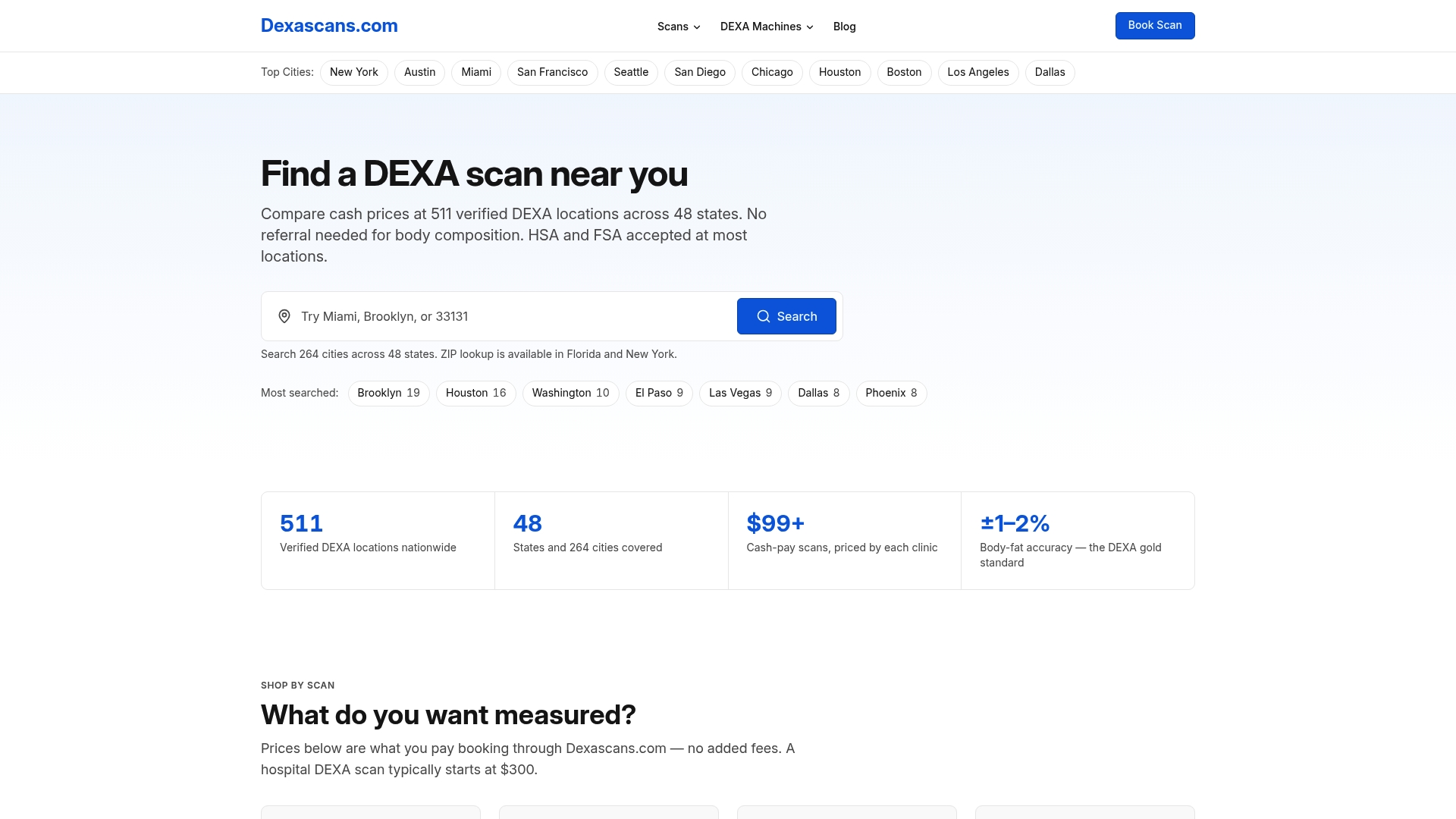
- Search our directory by location to see verified clinics near you
- Compare cash pricing before you commit to an appointment
- Confirm whether you want a clinical bone-density exam or a fitness-focused composition scan
Start with our complete guide to what a DEXA scan involves to make sure you're booking the right test for your goals.
This article is general information, not a substitute for advice from a qualified doctor. Consult a qualified healthcare professional about your own circumstances before acting on anything here.
FAQ
What are the criteria for referral for a DEXA scan?
Clinicians typically order a DXA based on documented risk, including age (routine screening for women 65 and older), low body weight, a parent's hip fracture, smoking, heavy alcohol use, or long-term glucocorticoid use, according to USPSTF and CDC guidance. For Medicare coverage specifically, the test also has to fall into a qualifying category such as monitoring osteoporosis treatment or evaluating vertebral abnormalities.
Can I just request a DEXA scan?
You can ask your clinician for a bone density evaluation, but whether they order it depends on your documented risk factors and age. If you'd rather skip that process entirely, many clinics accept direct cash bookings for body-composition or bone-density scans with no clinician order required.
How to get a DEXA scan covered?
Coverage generally requires an order from your treating physician or qualified practitioner tied to a qualifying medical reason, documented with the correct diagnosis code and the ordering clinician's NPI on the claim, per Medicare's coverage rules. Checking with your insurer beforehand about network status and plan design, as HealthCare.gov recommends, helps confirm your actual out-of-pocket cost.
At what age will insurance pay for a bone density scan?
Medicare and most insurers generally follow USPSTF guidance recommending routine screening for women starting at age 65, with earlier testing covered for younger postmenopausal women or anyone with documented risk factors or a qualifying medical condition. The exact age isn't a strict cutoff: it depends on your individual risk profile and your clinician's assessment.
Sources
- eCFR :: 42 CFR 410.31 -- Bone mass measurement: Conditions for coverage and frequency standards.
- Bone mass measurements
- Screening for osteoporosis to prevent fractures: USPSTF recommendation summary
- DEXA scan facts and guidance — CDC