

A DEXA scan in Boston typically runs from about $166 to $495 at hospitals for a bone density test, based on Massachusetts cash-price data, while independent fitness clinics usually charge less for body composition scans. The fastest way to avoid overpaying is to check verified cash prices before you call, and to ask every provider for the exact CPT billing code.
TL;DR:
- Massachusetts hospital cash prices for central DXA (CPT 77080) range from about $166 to $1,182, with a median near $495; compare published rates before calling.
- Confirm whether you need central DXA (77080), peripheral DXA (77081), or a fitness body composition scan, since test type affects price, diagnosis, and coverage.
- Medicare Part B covers qualifying bone density tests every 24 months at no cost when providers accept assignment; fitness scans are generally cash pay.
- Before booking, get the CPT code and cash price in writing, then confirm whether radiologist interpretation is included and whether a formal report suits your needs.
Table of Contents
- Boston cash price snapshot: hospitals vs. independent clinics
- When insurance or Medicare covers a DEXA and what you still pay
- Clinical DXA vs. body composition DEXA: why the test matters for cost
- How to find and book a verified, affordable DEXA scan in Boston
- Appointment prep and what your results will tell you
- Is a DEXA scan actually worth the cost?
- Compare verified Boston DEXA options with Dexascans
- FAQ
- Sources
Boston cash price snapshot: hospitals vs. independent clinics
Prices for the same scan can differ by hundreds of dollars depending on where you go in the Boston area, and the gap usually comes down to whether you are booking at a hospital or an independent studio.
For a central DXA bone density scan (CPT 77080), Massachusetts hospitals report cash prices ranging from about $166 to $1,182, with a median near $495, according to SelfPayRates. That spread alone can justify a few phone calls before booking. At Beth Israel Deaconess Medical Center in Boston, the published cash-pay price for a DXA bone density scan is reported in the hospital's machine-readable price file and listed on Itemized. Hospitals are required to publish these files under the federal price transparency rule, which makes them one of the more reliable ways to check a real number before you ever pick up the phone.

Independent and mobile DEXA providers that focus on body composition scans tend to price differently than hospitals, often landing in a lower range because they skip the overhead of a full radiology department. Our national pricing breakdown shows cash prices for body composition scans varying by ZIP code, which is worth checking even if you already have a Boston number in mind.
A few factors drive the difference between a $200 hospital bill and a $100 studio scan:
- Setting: hospital outpatient imaging departments carry higher overhead than independent fitness-focused clinics.
- Interpretation: a hospital price often includes a radiologist's read; a fitness studio price usually does not, because the scan is not meant for diagnosis.
- Scan site: central scans (hip and spine) are billed differently than peripheral scans (wrist or heel), which affects the quoted price.
- Bundling: some clinics fold the scan into a consult fee or membership, while others bill it as a standalone line item.
Massachusetts hospital cash prices for central DXA span from roughly $166 to $1,182, according to SelfPayRates, meaning the cheapest published rate in the state can be several times lower than the most expensive. That range is the single best argument for calling more than one facility. When you call, ask for the price tied to your exact CPT code rather than a general "DEXA scan" quote, since two different tests can share the same casual name but carry very different prices.
When insurance or Medicare covers a DEXA and what you still pay
Whether a DEXA scan costs you anything out of pocket depends almost entirely on why you are getting it and which billing code applies.
Medicare Part B covers bone mass measurements, including DXA, once every 24 months when a qualifying medical indication is present, such as a history of fracture, long-term steroid use, or other risk factors defined by Medicare. If your provider accepts assignment, Medicare states you pay nothing for the covered test. That coverage, though, is specific to medically indicated bone density testing, not to body composition scans booked for fitness tracking.
Elective body composition scans booked through a fitness studio are almost always cash pay, regardless of your insurance plan, because there is no diagnosis code attached to the visit. Private insurance generally follows a similar logic to Medicare: coverage depends on the CPT code billed and whether a physician documented medical necessity, not on the test's brand name. Our guide to Medicare rules and insurance nuances walks through how this plays out across different carriers.
Before you book, a short phone script can save you a surprise bill:
- Ask which CPT code will be billed for your appointment.
- Ask whether the facility accepts Medicare assignment, if that applies to you.
- Ask whether the quoted price is cash pay or submitted to your insurer.
- Ask whether a radiologist interpretation is included in that price.
Pro Tip: Get the CPT code and cash-pay status in writing, even a text or email, before your appointment, since verbal quotes are where most billing surprises start.
Clinical DXA vs. body composition DEXA: why the test matters for cost
Not every scan called a "DEXA" is the same test, and the difference affects both price and whether insurance will touch it at all.
A central DXA scans the hip and lumbar spine and is the test used to diagnose osteoporosis, billed under CPT 77080. A peripheral DXA, billed under CPT 77081, scans a smaller site like the wrist or heel and is used less often for full diagnostic purposes. A body composition DEXA, the kind most fitness studios offer, scans the whole body to estimate fat mass, lean mass, and bone mineral content region by region, and it typically does not carry a diagnostic CPT code at all, which is part of why it is usually cash only.
The USPSTF's osteoporosis screening recommendation names central DXA as the standard method for bone mineral density screening in defined risk groups, which is the test your doctor means if they refer you for osteoporosis screening. That is a different appointment than a fitness-focused body composition scan, even though both use similar equipment.
Before booking, confirm:
- Whether you are requesting a central DXA (77080), peripheral DXA (77081), or a body composition scan.
- Whether a radiologist interpretation is included, which matters for clinical scans but not for most fitness scans.
- Whether the facility can issue a formal report your physician can use, if that is your goal.
Our pages on the body composition scan and the bone density test break down what each report actually includes, which is worth a look before you decide which one to book.
How to find and book a verified, affordable DEXA scan in Boston
Finding a fair price takes a few extra minutes of research, but it is straightforward once you know where to look.
- Check hospital machine-readable files through Itemized or the hospital's own price transparency page to see a real published cash number before calling.
- Cross-check that number against Massachusetts-wide ranges to see where a specific hospital's price falls relative to the state median.
- Compare independent and mobile clinic prices in the Boston and Cambridge area, which often run lower than hospital rates for body composition scans.
- Call your shortlist and confirm the exact CPT code, cash price, and whether a radiologist read is included.
- Book directly, preferably with a provider that does not require a physician referral for a fitness-focused scan.
Before you commit to an appointment, run through this checklist on the phone:
- Confirm the CPT code for the specific scan you want.
- Confirm whether the quoted price is cash pay or billed to insurance.
- Confirm whether a radiologist interpretation is part of the price.
- Confirm whether the provider accepts Medicare assignment, if relevant to you.
- Ask about prep instructions so you are not surprised the day of your appointment.
A common trap: a receptionist says "we accept insurance," which sounds reassuring but tells you nothing about whether your specific scan is covered. Insurance acceptance and coverage are two different things, and only the CPT code and documented medical necessity determine what you owe.
Our listing page for DEXA scans in Cambridge, MA shows a real example of how this looks in practice, with verified cash prices and no-referral booking for the Boston area.
Appointment prep and what your results will tell you
A DEXA scan appointment is quick, usually under 30 minutes, and does not require fasting. You will be asked to remove metal objects like jewelry, belts, or underwire bras, and to wear loose clothing without zippers or metal buttons. If you have had a recent contrast imaging study, such as a barium exam, mention it, since that can interfere with results for a short window afterward.
Your report will look different depending on the test:
- A clinical bone density scan produces a T-score and Z-score, used to assess fracture risk and diagnose osteoporosis or osteopenia.
- A body composition scan produces a body-fat percentage, lean mass figure, and regional breakdown by limb and trunk.
- Some reports include a radiologist's written interpretation, while fitness-focused scans typically hand you the raw numbers only.
Pro Tip: If your T-score comes back in the osteopenia or osteoporosis range, bring the report to a doctor rather than trying to interpret it alone, since follow-up testing or treatment decisions depend on your full medical history.
Our prep checklist covers appointment-day details in more depth if you want a fuller walkthrough before you go.
Is a DEXA scan actually worth the cost?
For most people chasing fitness or weight goals, an occasional cash-pay body composition scan is one of the more precise ways to track real changes in fat and lean mass, since the technology measures within about one to two percentage points of accuracy. That precision is wasted, though, if you book one scan and never check back in. The value comes from comparing two scans months apart, not from a single snapshot.
For bone health, the calculation is different. The USPSTF recommends central DXA screening for defined risk groups, and that decision should follow medical guidance and Medicare's coverage rules, not personal curiosity about a number. If a scan comes back showing low bone density, the next step is to have a conversation with a doctor, not another scan.
Either way, shopping cash prices before you book keeps the cost reasonable without cutting corners on the test itself.
— Erik
Compare verified Boston DEXA options with Dexascans
You can find many DEXA clinics listed online across multiple states, including the Boston and Cambridge area, allowing you to compare cash prices before booking instead of guessing from a hospital's front desk. Listings typically show cash pricing and often do not require a referral, enabling direct booking of body composition or bone density scans once you identify a suitable price.
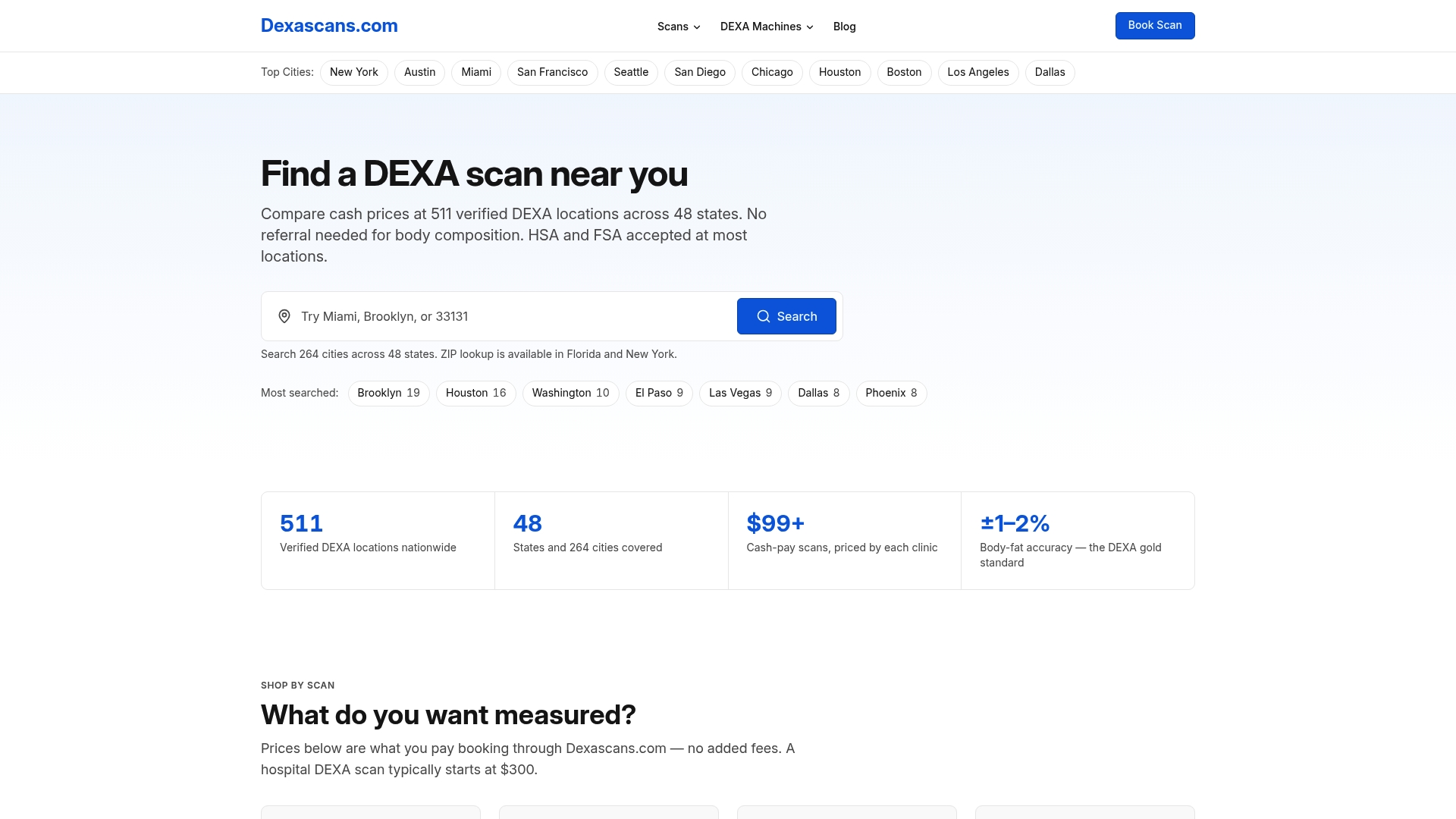
To use it: search Boston or Cambridge, filter by the scan type you want, and check whether the listing notes a radiologist interpretation if you need a clinical-grade report. Our Cambridge, MA listing is a good example of what a verified local option looks like, with sample pricing already attached. Still confirm the cash price and CPT code directly with the clinic before your appointment, since prices can shift. Start by checking DEXA scan locations near you to see what is available in your area today.
This article is general information, not a substitute for advice from a qualified doctor. Consult a qualified healthcare professional about your own circumstances before acting on anything here.
FAQ
Is a DEXA scan worth the money?
For fitness tracking, a body composition DEXA offers precise, repeatable measurements that are useful when compared across multiple scans over time. For bone health, value depends on whether you meet the risk criteria in the USPSTF screening recommendation, in which case a doctor-ordered scan is medically justified rather than optional.
How much does a DEXA scan cost in the US?
Published hospital cash prices for a central bone density DXA in Massachusetts range from about $166 to $1,182, with a median near $495, according to SelfPayRates. Prices vary by state and facility, so checking local hospital price files or a verified clinic listing gives a more accurate number for your area.
How much does a DEXA scan cost privately?
A private, cash-pay DEXA at a Boston hospital can run close to $291, as shown in Beth Israel Deaconess Medical Center's published price file, while independent body composition clinics often charge less since they skip radiologist interpretation fees. The exact price depends on whether you are booking a clinical bone density scan or a fitness-focused body composition scan.
Will insurance pay for a DEXA scan?
Insurance and Medicare typically cover a bone density DXA only when a qualifying medical indication is documented and the correct CPT code is billed, and Medicare Part B specifically covers this once every 24 months with no cost to the beneficiary if the provider accepts assignment. Elective body composition scans booked for fitness purposes are almost always cash pay regardless of your coverage.
How does a DEXA scan cost compare with or without insurance?
Without insurance, you are quoted a facility's published cash price, which for Massachusetts bone density scans has a median near $495 at hospitals, according to SelfPayRates. One partner resource on DEXA scan costs with or without insurance walks through how billed versus cash pricing typically compares for this test.
Sources
- Bone mass measurements (Medicare coverage)
- DEXA bone density scan cost in Massachusetts without insurance: from $166, median $495 | SelfPayRates
- Itemized
- Osteoporosis screening — USPSTF recommendation