
Expect to pay in the range typical for sports performance labs, higher prices at major-metro fitness or university centers, and more at hospital clinical CPETs. Insurance typically only steps in for the hospital version, and only when a physician orders it for a diagnostic reason. If you're a serious athlete or want precise training zones, a fitness lab test is the better value.
TL;DR:
- VO2 max testing at university labs typically costs $150 to $250, making them the most affordable option with shorter report and consultation times.
- Higher-priced testing at hospitals or premium centers can exceed $400 due to advanced equipment, physician oversight, and detailed reports.
- Tests administered by certified exercise physiologists or using well-maintained equipment provide more accurate results worth a higher price.
- Insurance covers clinical tests ordered for medical reasons but generally excludes elective fitness testing, which is usually paid out-of-pocket.
- Retesting at the same lab with identical protocols helps ensure reliable progress measurements, considering natural 3% to 5% variability.
Table of Contents
- How Much Is a VO2 Max Test? Price by Setting
- What Makes One VO2 Max Test Cost More Than Another?
- Where Can You Find and Book a VO2 Max Test Near You?
- What Happens During a VO2 Max Test?
- Does Insurance Cover a VO2 Max Test?
- Is a VO2 Max Test Worth the Money?
- Why Dexascans Tracks VO2 Testing Pricing Nationwide
- Compare VO2 and DEXA Pricing Before You Book
- Sources
How Much Is a VO2 Max Test? Price by Setting
The price you pay depends almost entirely on where you walk in the door. Community and university-affiliated performance labs sit at the low end, hospital-based clinical labs sit at the high end, and everything in between reflects staffing, equipment, and how much reporting comes with the result.
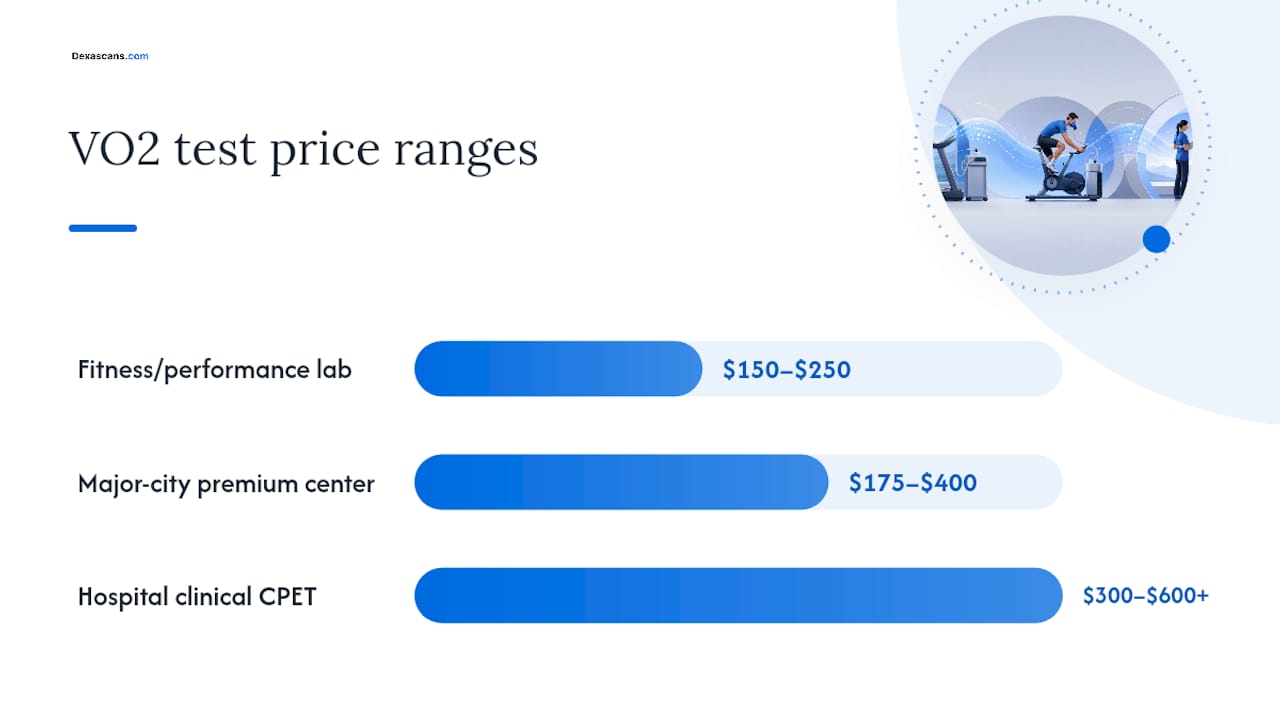
A performance package at a university exercise lab typically runs $150 to $250 and covers the graded exercise test, breath-by-breath gas analysis, and a written summary. Major-metro private testing centers, where rent and specialized staff cost more, land at $175 to $400. Hospital clinical CPETs, ordered through a cardiology or pulmonology department, run $300 to $600 or more once facility fees and physician oversight get added to the bill.
Here's how the three tiers typically break down:
- Fitness/performance lab ($150–$250): graded treadmill or bike test, mask and metabolic cart, printed or digital report, brief consult.
- Major-city premium center ($175–$400): longer consult, ventilatory threshold breakdown, sometimes a follow-up coaching call or training-zone plan.
- Hospital clinical CPET ($300–$600+): physician-supervised, ECG monitoring, diagnostic interpretation, billed through the hospital's standard fee schedule.
Bundles change the math. Pairing VO2 testing with a resting metabolic rate (RMR) test or a DEXA scan for body composition often shaves a modest amount off the combined price compared to booking each separately, since labs like to move you through one appointment instead of two.
What Makes One VO2 Max Test Cost More Than Another?
Two labs can advertise the same "VO2 max test" and hand you very different experiences for very different prices. The gap usually comes down to five things: the equipment, who's running the session, how deep the report goes, the building you're standing in, and whatever else gets bundled in.
Metabolic carts vary widely in calibration frequency and mask design, and older or poorly maintained equipment introduces more error into your number. Staffing matters just as much. A test administered by a certified exercise physiologist or clinician, rather than a student technician, tends to cost more, and exercise medicine labs staffed this way are generally considered the more accurate setting for the test. A university-affiliated or hospital-connected lab also carries facility overhead that a strip-mall fitness studio doesn't have.
- Metabolic cart model and calibration schedule
- Technician credentials (student vs. exercise physiologist vs. physician)
- Depth of the post-test report and whether coaching time is included
- Facility type: independent studio vs. university or hospital lab
- Add-ons like RMR, lactate threshold, or a DEXA bundle
Pro Tip: A higher price often buys a more useful report, not just a fancier machine. A test that includes your ventilatory thresholds and a coached walkthrough of what your heart-rate zones actually mean for training is worth more than a bare VO2 number on a printout.
Where Can You Find and Book a VO2 Max Test Near You?
Legitimate testing happens in a handful of predictable places: university exercise physiology cores, private sports performance centers, hospital-based exercise labs, and dedicated fitness testing clinics. Each type serves a slightly different customer, but the booking process should look similar everywhere.
Before you hand over a card number, check a few things on the provider's booking page:
- Is the price posted, or do you have to call and ask?
- Who actually runs the test, and what's their credential?
- Is a consultation or written report included, or is that an extra fee?
- Can they show a sample report so you know what you're paying for?
Dexascans is built for exactly this kind of comparison shopping. Search by city or ZIP code and you can see cash pricing across verified local providers, including whether a location bundles VO2 testing with RMR or DEXA body composition scans. Before booking anywhere, ask directly whether the quoted price includes the consult, whether retesting comes at a discount, and whether they'll email you the full data (not just a summary sheet) so you can compare it against a future test.
What Happens During a VO2 Max Test?
The appointment follows a standard graded exercise protocol: you run or cycle at increasing intensity while wearing a mask connected to a metabolic cart, with a heart-rate monitor strapped on the whole time. The technician bumps up the resistance or speed every minute or two until you can't sustain it anymore.
- Check-in and equipment setup, including mask fitting and calibration.
- Warm-up at an easy pace for a few minutes.
- Graded test with escalating intensity until voluntary exhaustion, usually lasting 8 to 15 minutes.
- Cool-down and immediate recovery monitoring.
- Results review and, at many labs, a short consultation on training zones.
Plan on about an hour total including setup, calibration, and post-test discussion, even though the intense effort portion is relatively brief. Show up rested, avoid a heavy meal for a few hours beforehand, skip caffeine if requested, and wear appropriate workout clothes and shoes.
Your results will typically show VO2 max in milliliters per kilogram per minute, your ventilatory thresholds, and heart-rate training zones calculated from those thresholds. One thing worth knowing before you retest in six months: published research puts test-to-test variability at roughly 3% to 5%, even under good conditions. That's not the test being unreliable. It's a reminder to use the same lab, same protocol, and ideally the same technician next time, so you're comparing apples to apples rather than chasing noise.
Does Insurance Cover a VO2 Max Test?
Coverage hinges on one distinction: who ordered the test and why. A clinical CPET ordered by a physician to investigate unexplained shortness of breath, evaluate heart failure, or clear someone for surgery gets billed through the medical system and may be covered depending on your plan and the diagnostic indication. An elective fitness VO2 test, the kind an athlete books to nail down training zones, is booked outside that system entirely and is almost always cash-pay.
That distinction changes your out-of-pocket math substantially. If insurance applies, you're looking at a copay or coinsurance rather than the full $300 to $600 hospital rate. If it doesn't, you're paying the sticker price the lab quotes you, full stop.
- Ask upfront whether the provider bills insurance or operates strictly cash-pay.
- If you think a medical indication exists, talk to your doctor about a referral before booking a fitness-lab version.
- Request a receipt with billing codes if you plan to submit for reimbursement through an HSA or FSA.
- Check with your insurer about pre-authorization requirements if a physician does order the test.
Is a VO2 Max Test Worth the Money?
It depends entirely on what you're trying to answer. If you're training for a marathon, racing competitively, or working with a coach who needs precise heart-rate zones, a lab test earns its price by replacing guesswork with a real number. If you're a diagnostic case, your doctor's referral to a clinical CPET matters more than cost.
If you're just curious how fit you are or want to track general trends over time, you probably don't need to spend $200 on a lab appointment. Consumer wearables and field tests can estimate VO2 max reasonably well for trend-watching, even though they're less precise than breath-by-breath lab analysis.
- Wearable estimate: free with most fitness watches; good for spotting trends, not exact numbers.
- Cooper 12-minute run test: free, requires just a track and a stopwatch; rough VO2 max estimate.
- 1-mile walk test: free, low-effort option for beginners or those returning from injury.
- Lab CPET: $150–$600+; the only option precise enough to set real training zones.
Pro Tip: If you do spring for a lab test, book your retest at the same facility with the same protocol. Given the natural 3–5% variability between sessions, switching labs between tests can make real fitness gains look flat, or make no progress look like a breakthrough.
Why Dexascans Tracks VO2 Testing Pricing Nationwide
We built Dexascans to fix a problem we kept running into ourselves: fitness testing prices are all over the map, and almost nobody posts them clearly. Our listings cover verified locations across 48 states, and we push providers toward transparent cash pricing instead of the "call for a quote" runaround that's standard in this industry.
VO2 max testing shows up on our platform the same way DEXA scans do, as an add-on you can compare side by side with body composition and bone density options at the same clinic. That matters if you're the type who wants your training zones and your body fat percentage from a single trip instead of three separate appointments. We're not the lab running your test. We're the tool that helps you figure out which lab deserves your money before you show up.
— Erik
Compare VO2 and DEXA Pricing Before You Book
If you're already weighing a VO2 max test, there's a good chance a body composition scan is on your list too, since a lot of performance labs bundle the two. Dexascans lets you search by city or ZIP and see real cash prices from verified clinics, not vague "starting at" ranges.
When you search a location, you'll see whether that provider offers VO2 max testing, RMR, or DEXA body composition scanning as standalone or bundled services, along with the price for each. No referral is needed for the DEXA side of things, and you can confirm exactly what's included before you ever pick up the phone. Head to Dexascans' location finder and search your ZIP code to compare providers near you and see which one gives you the most for what you're spending.
Sources
- Performance package — University of Utah (movement & fitness testing)
- Study on VO2 max measurement variability — PMC
- Performance evaluations — UCSF
- 7 things patients should know about VO2 max — American Medical Association