
Most consumer scales use a Tanita-style 1–59 rating where 1–12 counts as healthy. Imaging studies commonly use visceral fat area cutoffs near 100–130 cm² to flag metabolic risk, and DXA reports visceral fat as a mass or volume figure tied to sex- and age-specific reference curves. None of these numbers translate directly into each other. Before you panic over a score, confirm which method produced it, and lean on DXA or imaging if you need a precise answer.
TL;DR:
- Different methods measuring visceral fat, like BIA, VFA from imaging, and DXA, each use distinct units and thresholds, making direct comparisons unreliable.
- A BIA score above 12 indicates elevated visceral fat risk, while VFA near 130 cm² is linked to metabolic syndrome, and DXA estimates provide age- and sex-specific reference ranges for better context.
- Consistent testing conditions and using the same method over time are crucial for accurately tracking visceral fat changes, with imaging and DXA offering more reliable benchmarks than home scales.
- Visceral fat tends to respond faster to dietary changes, with significant reductions observable within 8 to 12 weeks through a caloric deficit, adequate protein, and combined aerobic and resistance exercise.
- Always interpret visceral fat scores alongside waist circumference and bloodwork, and consult a healthcare professional before making health decisions based solely on these numbers.
Table of Contents
- What Visceral Fat Is and Why the Range on Your Report Matters
- Tanita, VFA, and DXA: The Three Scales You'll Actually Encounter
- How to Read Your Own Score Without Guessing
- BIA vs. DXA vs. CT/MRI: Which Number Should You Trust?
- Lowering Visceral Fat: What Actually Moves the Number
- Getting a Reliable DXA Baseline for Visceral Fat
- A Single Number Doesn't Tell the Whole Story
- Book a DXA Scan to Track Visceral Fat With Real Precision
- Sources
- FAQ
What Visceral Fat Is and Why the Range on Your Report Matters
Visceral fat is the fat packed around your liver, pancreas, and intestines, deep inside the abdominal cavity. It's a different tissue from subcutaneous fat, the layer you can pinch under your skin. You can be lean overall and still carry a concerning amount of visceral fat, which is exactly why a single body weight or BMI number misses so much.
This tissue behaves almost like an organ of its own. It releases inflammatory compounds and free fatty acids directly into the bloodstream feeding the liver, and that traffic pattern is a major reason visceral fat tracks so closely with insulin resistance and cardiovascular risk. Subcutaneous fat, by contrast, mostly just sits there.
That's why a numeric score matters more than a general sense of "belly fat." A range gives you:
- A baseline to compare against population data instead of guesswork
- A way to track whether a diet or training change is actually working
- An earlier warning sign than cholesterol or glucose numbers sometimes provide
The number itself isn't the diagnosis. It's the tool that lets you catch a trend before it becomes a lab result.
Tanita, VFA, and DXA: The Three Scales You'll Actually Encounter
Three systems dominate real-world visceral fat reporting, and they don't share a unit or a scale, so mixing them up is the single most common source of confusion.
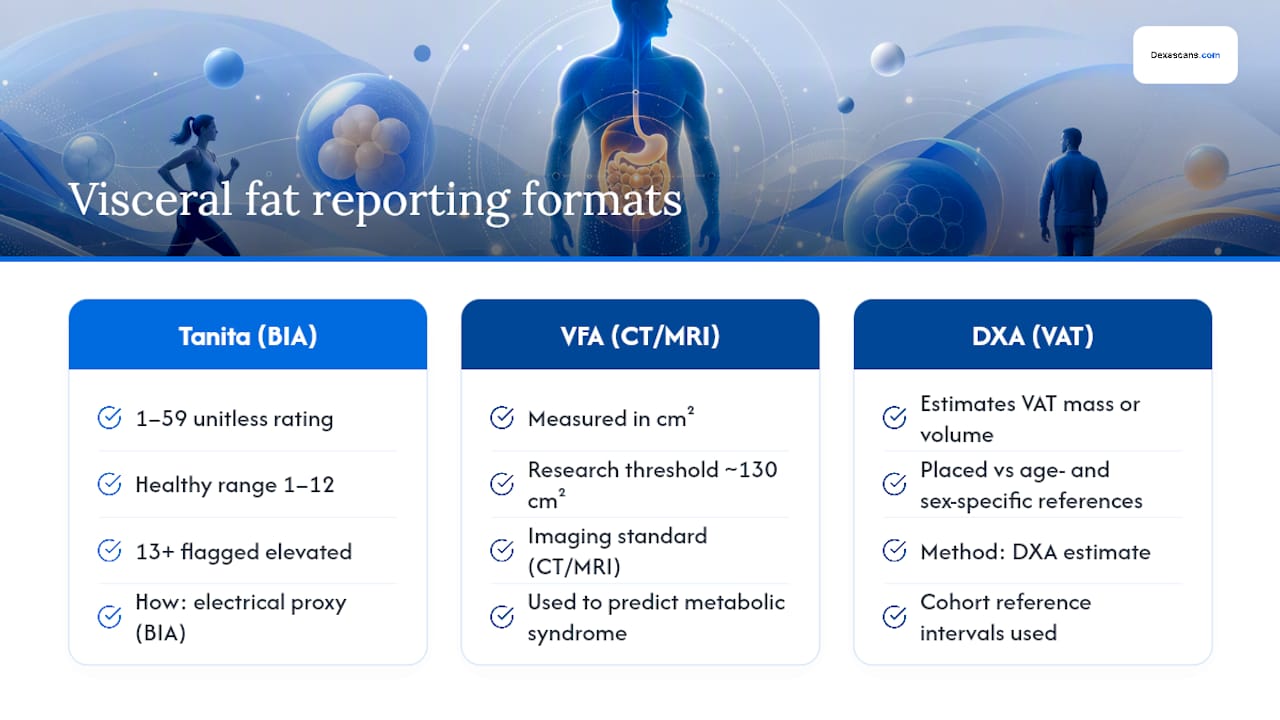
Tanita and other bioelectrical impedance (BIA) scales report a unitless rating from 1 to 59. Manufacturer guidance and clinical summaries widely cite 1 through 12 as the healthy range, with 13 and above flagged as elevated. This number is a proxy calculated from how electrical current moves through your body, not a direct measurement of fat tissue.
Visceral fat area (VFA), measured in square centimeters via CT or MRI, is the clinical research standard for imaging. Cutoffs vary by population and study design, but several studies use thresholds in the 130 cm² range to predict metabolic syndrome, with sex-specific differences showing up consistently.
DXA VAT mass or volume is a third format entirely. DXA doesn't hand you a 1 to 59 score or a raw cm² area. It estimates the actual mass or volume of visceral fat in your abdomen, and researchers have built age- and sex-specific reference intervals from large cohort data so your number can be placed against people who share your demographic profile.
The takeaway: a "12" on a bathroom scale and a "130" from a CT scan aren't measuring on the same yardstick. Know your method before you judge your number.
How to Read Your Own Score Without Guessing
Turning a visceral fat number into a decision takes a few deliberate steps, not a gut reaction to whatever digit shows up on a screen.
- Identify the method and unit. Is this a BIA rating (1–59), a VFA in cm², or a DXA mass/volume figure? Each has a different scale entirely.
- Match your number to that method's published thresholds. For BIA, treat anything above 12 as a signal worth watching. For imaging, values creeping toward 130 cm² align with higher metabolic syndrome risk in several studies.
- Account for confounders before drawing conclusions. Hydration status, time since your last meal, and even where you are in a menstrual cycle can shift a BIA reading meaningfully. Device firmware and algorithm differences between brands add another layer of variability.
- Decide your next move. A single elevated BIA reading isn't an emergency. A pattern across multiple readings, especially alongside a wide waist circumference or abnormal labs, is worth a conversation with a clinician or a more precise scan.
Pro Tip: If you're tracking progress over months, use the exact same device and testing conditions each time, ideally fasted and before your morning workout. Comparing a hydrated afternoon BIA reading to a fasted morning one will make a stable score look like it's swinging wildly.
BIA vs. DXA vs. CT/MRI: Which Number Should You Trust?
Not all visceral fat numbers carry equal weight, and knowing where each method sits on the accuracy spectrum changes how much stock you should put in a single reading.
- BIA (consumer scales) wins on accessibility. It's cheap, fast, and available at home. Its weakness is consistency: BIA visceral fat level correlates only modestly with CT-derived measurements, and sensitivity and specificity for flagging true visceral obesity vary by study.
- DXA is a validated body-composition technique with reported precision near ±1 to 2 percent, making it far more repeatable than BIA for tracking change over time.
- CT and MRI remain the imaging gold standard for measuring visceral fat area or volume directly, which is why most clinical cutoff studies are built on CT or MRI data in the first place.
The practical rule is simple: pick one method and stick with it for tracking. If you need a genuinely precise baseline, especially before starting a new training or nutrition program, imaging or DXA beats a bathroom scale every time.
Lowering Visceral Fat: What Actually Moves the Number
Diet does the heaviest lifting. A sustained caloric deficit, built around adequate protein and lower refined carbohydrate and added sugar intake, consistently reduces visceral fat faster than it reduces subcutaneous fat, according to clinical reviews on abdominal fat. That's actually good news: visceral fat tends to respond early, often before you notice changes elsewhere.
Exercise adds a second lever. A mix of moderate aerobic training and resistance work outperforms either alone, and some evidence points to high-intensity interval training as particularly effective for visceral fat specifically, likely because of its outsized effect on insulin sensitivity.
Sleep and hormones round out the picture:
- Poor sleep raises cortisol and disrupts appetite hormones, both of which favor visceral fat storage.
- During menopause, hormone therapy can shift where fat is distributed, but it is not a weight-loss treatment on its own; any benefit is likely indirect, through better sleep.
Pro Tip: Give any consistent program 8 to 12 weeks before expecting a measurable shift on a rescan. Visceral fat moves faster than subcutaneous fat, but it still needs weeks, not days, to show up in a follow-up scan.
Getting a Reliable DXA Baseline for Visceral Fat
A BIA scale is fine for rough trend-spotting, but if you want a number you can actually trust, DXA is the more repeatable option, with precision reported near ±1 to 2 percent. Before booking, ask a few direct questions:
- Does the scan specifically report VAT, or only general body composition?
- What prep is required (fasting window, hydration, clothing)?
- What machine model and protocol does the clinic use, since output can vary between DXA systems?
- Is pricing transparent up front, and is a physician referral required?
Verified locations with published cash pricing make it far easier to get the same protocol twice, which is the whole point when you're tracking a trend instead of a single snapshot.
A Single Number Doesn't Tell the Whole Story
Treat your visceral fat score as one data point, not a verdict. Pair it with waist circumference and routine bloodwork like fasting glucose and lipids before drawing conclusions about your risk. Retest with the same method each time. Small, sustained habits beat any quick fix, and no single number should override a fuller clinical picture.
— Erik
Book a DXA Scan to Track Visceral Fat With Real Precision
If you've been relying on a bathroom scale's BIA estimate and want a number you can actually trust over time, Dexascans gives you a straight path to it: a searchable directory of verified DXA locations with transparent cash pricing, no physician referral required.
That matters because tracking visceral fat only works if your baseline is solid and your method stays consistent. A DXA body composition scan reports VAT with precision far tighter than a home scale, and because pricing is published up front, there's no billing surprise waiting at checkout. If you're newer to the technology, the DXA scan primer walks through what the scan measures and how to prep. When you're ready, search DXA locations near you and book a scan directly.
This article is general information, not a substitute for advice from a qualified doctor. Consult a qualified healthcare professional about your own circumstances before acting on anything here.
Sources
- What Is Visceral Fat & How To Get Rid of It — Cleveland Clinic
- Optimal cutoff values for visceral fat volume to predict metabolic syndrome (PMC8428730)
- Comparison of BIA visceral fat level with CT-derived VAT measures (PMC8506854)
FAQ
Is a Visceral Fat Score of 7.0 Bad?
No. On the common Tanita-style 1–59 scale, 1 through 12 is widely classified as healthy. Keep in mind this reading is a BIA proxy, so hydration and timing can shift it a point or two between tests.
How Do I Lower My Visceral Fat Level?
A sustained caloric deficit paired with higher protein intake and less refined sugar drives the biggest changes, backed up by a mix of aerobic and resistance training. Visceral fat often responds within 8 to 12 weeks of consistent effort, frequently faster than subcutaneous fat does.
What Burns the Most Visceral Fat?
No single exercise is a silver bullet, but combining moderate aerobic training with resistance work, and adding high-intensity intervals where appropriate, tends to outperform either approach alone for visceral fat specifically. Diet quality, particularly cutting added sugar and refined carbs, plays an equally large role.
When Losing Weight, Does Visceral Fat Go First?
Visceral fat commonly decreases earlier in a weight-loss program than subcutaneous fat does, which is one reason waist circumference and DXA rescans sometimes show change before the scale moves much. That pattern isn't universal, so pairing a DXA scan with routine measurements gives a clearer picture than weight alone.