
Smart scales measure weight accurately but estimate body composition only approximately, with individual errors against DEXA frequently exceeding 3 to 4 percentage points of body fat and several kilograms of lean mass. They work well for tracking your own trend over weeks and months. When you need clinical precision or a regional breakdown of fat and bone, a DEXA scan is the better tool.
TL;DR:
- Smart scales provide reliable weight measurements but can inaccurately estimate body fat and lean mass, often with errors exceeding 3 to 4 percentage points of body fat.
- Day-to-day fluctuations in hydration, recent exercise, and electrode contact can cause significant variations in body composition readings, making single measurements unreliable.
- Population-level error margins are acceptable for trend tracking, but individual results may misrepresent actual body composition changes, especially at the extremes of body types.
- For precise assessments, especially for health conditions or athletic baselines, DEXA scans offer regional fat and bone density measurements with about ±1 to 2% accuracy.
- Consistent measurement conditions, such as same time, floor surface, and avoiding immediate post-exercise readings, improve the reliability of smart scale trend data.
Table of Contents
- How smart scales estimate fat, lean mass, and water
- What the research shows when smart scales are tested against DEXA
- What changes your smart-scale reading from day to day
- A step-by-step protocol to get more reliable readings
- When a DEXA scan makes more sense than a smart scale
- Getting DEXA-level accuracy without the guesswork
- Calibration needs and procedures for smart scales
- How floor surface and placement affect your reading
- A pragmatic way to use both tools together
- Ready for a precise baseline? Here's how to book one
- FAQ
- Sources
How smart scales estimate fat, lean mass, and water
Smart scales send a weak electrical current through your body and measure the resistance, a method called bioelectrical impedance analysis (BIA). Fat tissue resists current more than muscle, which holds more water and electrolytes, so the device infers composition from how easily the signal travels. That means hydration and ion content drive the raw signal just as much as actual tissue amounts do.
Consumer devices differ a lot in how they collect that signal:
- Foot-to-foot single-frequency scales send current through your legs only and miss your upper body entirely, relying on statistical assumptions to fill the gap.
- Multi-frequency devices use several current frequencies to separate intracellular from extracellular water, giving a slightly fuller picture.
- Bioimpedance spectroscopy (BIS) units, mostly used in clinical settings, scan across a wide frequency range for more detailed segmental readings.
Every device then runs its raw impedance reading through a proprietary equation built from a reference population. If your age, body shape, or ethnicity differs from that reference group, the output shifts in ways the device never flags. That is also why a scale can be remarkably consistent on back-to-back mornings yet still biased when checked against a DEXA scan: test-retest reliability and accuracy against a gold standard are two different things.
What the research shows when smart scales are tested against DEXA
Peer-reviewed comparisons consistently find that consumer BIA scales track weight well but diverge from DEXA on body composition, sometimes by a meaningful margin.
A review of BIA versus DXA studies found fat-free mass overestimated by 0.43 kg to 3.15 kg and body fat underestimated by 0.32 to 4.0 percentage points, depending on the device and population tested. That range matters: a 4-point body-fat miss can shift someone from "athletic" to "average" on paper, even though nothing in their body actually changed.

A separate cross-sectional study of three commercial smart scales found weight accurate to within about a kilogram, but fat-mass estimates typically showed errors of multiple kilograms depending on the device. Muscle-mass errors varied by device, and no single scale showed consistent proximity to DEXA in all measures.
A few patterns show up across this research:
- Fat mass tends to be underestimated while lean mass is often overestimated, a systematic bias rather than random noise.
- Device-to-device variability is large, so a reading from one brand of scale is not directly comparable to another.
- Training-population mismatch matters, meaning a scale calibrated mostly on younger, average-build adults will misjudge older adults, very muscular people, or those at the extremes of body size.
For population-level screening, a few percentage points of error washes out across large groups. For an individual deciding whether a diet or training block worked, a 3 to 4 percentage point swing can mean the difference between "it worked" and "it didn't," even when the real change was much smaller.
What changes your smart-scale reading from day to day
A single smart-scale reading is a snapshot of your hydration and circulation as much as your tissue composition, which is why the number can jump around without your body actually changing.
- Hydration shifts move the signal fast. Controlled hydration and dehydration trials found that single-frequency BIA sometimes failed to detect expected total body water changes and produced significant body-fat differences across repeated measures on the same people.
- Exercise and skin temperature alter limb impedance. Segmental impedance in the arms, legs, and trunk can respond in opposite directions after a workout or a hot shower, which is why a scale reading right after exercise can look better or worse than reality in a way that feels backward.
- Body type affects accuracy. Very muscular people, those at extremes of body size, and anyone whose shape differs from the device's reference population tend to see larger errors because the underlying equation was never built with them in mind.
- Firmware updates and sensor contact matter. A dirty or dry electrode plate, or a silent algorithm update from the manufacturer, can shift your baseline without any real change in your body.
Pro Tip: Treat any single smart-scale reading as noisy data, and judge your progress only by the direction of a multi-day average.
A step-by-step protocol to get more reliable readings
Consistency in how you measure matters more than the scale's absolute accuracy, since most of the value comes from the trend line rather than any one number.
- Weigh yourself at the same time each day, ideally first thing in the morning after using the bathroom and before eating or drinking.
- Skip measurements right after intense exercise, a sauna, or a large meal, since fluid shifts from any of these can distort the impedance reading.
- Wear the same amount of clothing (or none) and stand on the same hard, flat surface each time.
- Take readings daily for a week or more and compare short moving averages rather than single days.
A few habits make the data more useful once you are collecting it:
- Log context like sleep quality, recent workouts, and, for people who menstruate, cycle phase, since all three shift fluid balance.
- Ignore any single-day outlier that jumps far from your recent average.
- Expect week-to-week trend changes, not day-to-day drama, to be the signal worth acting on.
When a DEXA scan makes more sense than a smart scale
Some situations call for more precision than any BIA device can offer. Clinical decision-making, osteoporosis screening, establishing a precise athletic baseline, or research-grade body composition monitoring all benefit from imaging rather than impedance.
DEXA measures regional fat distribution, gives a proxy for visceral fat, and quantifies bone mineral content, all with precision around ±1 to 2%. The exam itself is quick, typically around 20 minutes, and prep is simple: stay hydrated, avoid heavy meals beforehand, and skip metal clothing or jewelry.
A practical middle path many people land on:
- Get a DEXA scan for an initial baseline, especially before starting a new training or weight-management phase.
- Use a smart scale for weekly or daily trend tracking between scans.
- Repeat DEXA periodically (such as annually, or sooner around a major body-composition goal) to recalibrate your sense of where the trend data actually stands.
Getting DEXA-level accuracy without the guesswork
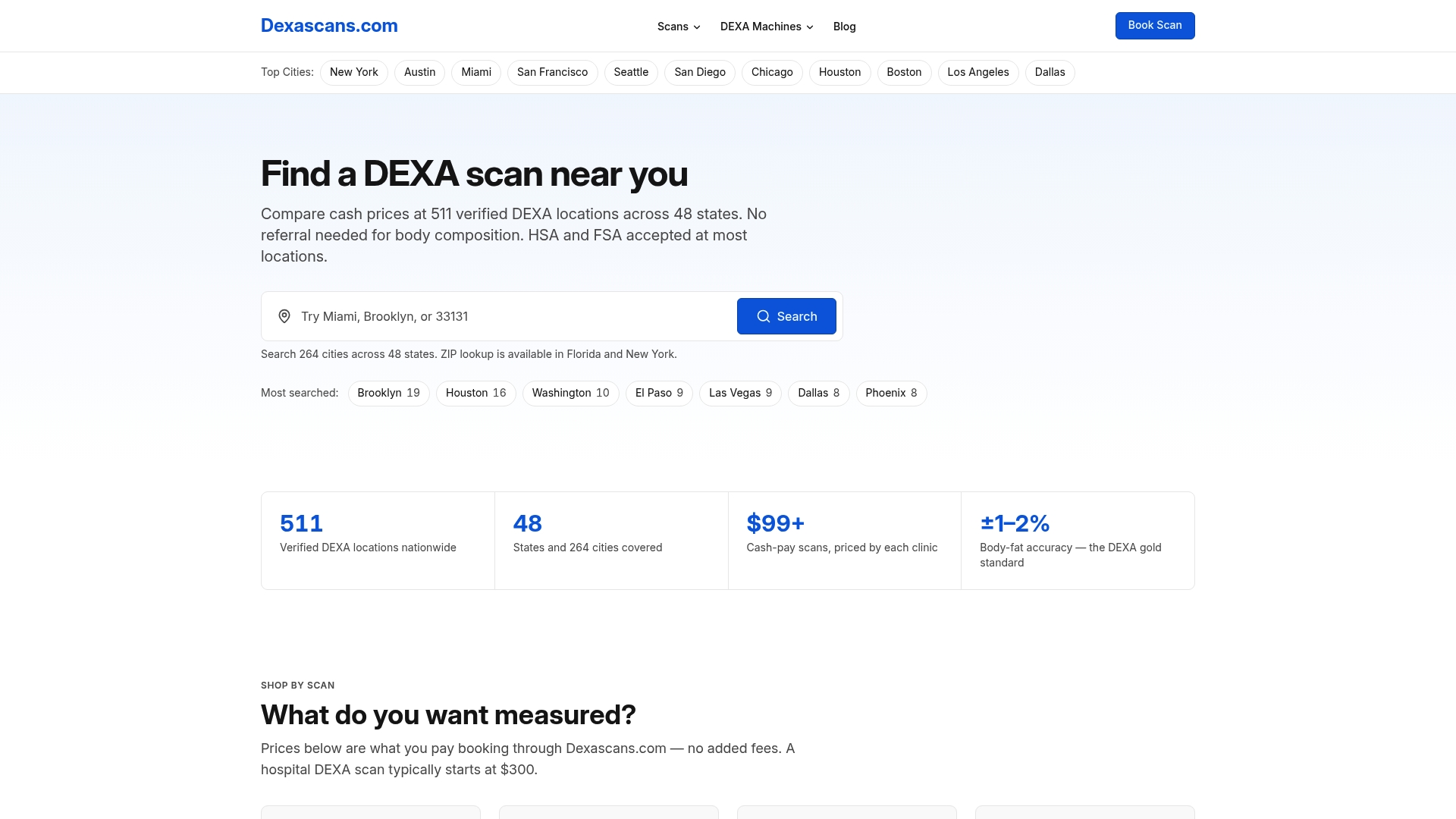
Finding a DEXA provider used to mean calling around to hospitals or sports-performance labs with little sense of price or availability. Dexascans lists over 511 verified DEXA locations across 48 states, with transparent cash pricing shown upfront instead of buried in a quote request.
Readers who want to compare clinics, confirm what a scan includes, and see prep instructions before showing up can check the body composition scan guide or search DEXA locations near them directly.
Calibration needs and procedures for smart scales
Most consumer smart scales ship pre-calibrated and are not designed for the kind of periodic recalibration that clinical BIA or DEXA equipment undergoes. Still, a few maintenance habits keep readings consistent over time.
Check that the scale sits on a hard, level surface every time you weigh in, since even a slight tilt can throw off the load cells that measure weight and, by extension, the impedance reading tied to it. Clean the metal foot or hand electrodes regularly: sweat residue, lotion, or dust changes how well they conduct current and can shift readings without any real change in your body.
Many manufacturers push firmware updates through a companion app that can silently adjust the underlying algorithm. If you notice a sudden jump in your body-fat trend with no corresponding change in weight or appearance, check whether an update happened around the same time before assuming your body actually changed.
Replace batteries as soon as the scale signals low power, since a weak current can distort the impedance measurement before the scale fails outright. If you drop or move the scale to a new location, take a few throwaway readings before trusting the numbers again, since recalibration against your own baseline (not the manufacturer's factory settings) is what actually matters for trend tracking.
None of this closes the gap with DEXA's imaging-based precision, but it does reduce the noise that makes week-to-week comparisons unreliable.
How floor surface and placement affect your reading
Where you place a smart scale changes what it measures almost as much as your actual body composition does. Hard, flat surfaces like tile or hardwood give load cells and foot electrodes a stable, even contact. Carpet, uneven tile, or a slightly warped floorboard can tilt the scale just enough to produce an inconsistent weight reading, and an inconsistent weight reading cascades into an inconsistent body-fat estimate since the two calculations are linked.

Room temperature plays a role too. A cold bathroom floor can constrict blood vessels near your feet, changing local impedance in a way that has nothing to do with your actual fat or muscle. Stepping onto the scale with damp feet after a shower, or right after walking on a hot surface, introduces the same kind of distortion from the opposite direction.
Consistency is the fix. Pick one spot, ideally the same patch of hard flooring, and weigh in there every time rather than moving the scale between the bathroom and bedroom. If you travel, expect your readings at a hotel or a different home to be less comparable to your usual baseline, not because your body changed overnight but because the floor, temperature, and electrode contact all changed at once.
A pragmatic way to use both tools together
I rely on a smart scale for weekly trends and book a DEXA scan about once a year for a real baseline. The trend line matters more than any single reading, and any decision that actually needs clinical precision belongs to a DEXA scan or a clinician, not a bathroom scale.
— Erik
Ready for a precise baseline? Here's how to book one
A smart scale tells you the direction you are heading. When you need to know exactly where you stand, Dexascans lists verified DEXA clinics with transparent cash pricing and no referral required.
This is worth booking now if any of the following applies to you:
- You are monitoring a medical condition or working with a clinician who needs precise body-composition data.
- You want a true baseline before a serious training block, so your smart-scale trends mean something.
- You are due for a bone-density check, especially around osteoporosis risk.
Search DEXA scan locations near you or read the body composition scan guide to see pricing and what to expect before your appointment. Readers who want a clinician's perspective on what the numbers mean can also check this DEXA scan accuracy explainer from a bone-health clinic.
This article is general information, not a substitute for advice from a qualified doctor. Consult a qualified healthcare professional about your own circumstances before acting on anything here.
FAQ
Is 30% body fat considered high?
Rather than fixating on one cutoff, track your own trend over time and use a DEXA scan if you need a precise, clinically interpretable number.
Are Renpho smart scales accurate for body fat?
Renpho scales, like other consumer BIA devices, measure weight reliably but estimate body fat with the same systematic bias seen across the category, often underestimating fat mass and overestimating lean mass compared with DEXA. Treat the body-fat number as a trend indicator rather than a diagnostic figure.
How accurate are smart scales compared to DEXA overall?
Smart scales track weight within about a kilogram of DEXA but show larger gaps on body composition, with body-fat errors commonly in the several-percentage-point range and fat-mass differences of multiple kilograms in some devices. They work best for monitoring your own trend, not for a one-time precise reading.
Should I trust a single smart-scale reading or look at trends?
A single reading can be thrown off by hydration, recent exercise, or even where the scale sits on your floor, so one data point rarely reflects a real change in your body. Averaging several readings over a week gives a far more reliable picture than any single day.
When should I get a DEXA scan instead of relying on a smart scale?
You can compare verified DEXA locations and pricing before booking.
Sources
- Assessment of Body Composition in Health and Disease Using Bioelectrical Impedance Analysis (BIA) and Dual Energy X-Ray Absorptiometry (DXA): A Critical Overview
- Consumer smart scales vs DEXA cross-sectional comparison (PubMed ID 33929337)
- DXA body composition analysis | Sports Medicine | UC Davis Health
- SMFBIA hydration response study