
RMR and BMR both describe the energy your body burns at rest, but they are measured under different conditions, so RMR usually comes out 5 to 10 percent higher than BMR. For everyday calorie planning, a standard equation is a fine starting point, but a measured RMR or a DEXA-informed estimate of your body composition gives you a far more reliable number when precision actually matters.
TL;DR:
- RMR is about 5 to 10 percent higher than BMR because it includes slight digestion-related activity, making it more practical for daily calorie estimates.
- Most people’s equations for estimating BMR can be off by more than 10 percent, especially for individuals with atypical body composition or medical conditions.
- A measured RMR using indirect calorimetry is more accurate and advisable for athletes, those with unusual muscle mass, or significant weight trend discrepancies.
- Body composition scans like DEXA provide a reliable way to refine estimates by measuring lean mass directly, with a precision of ±1 to 2 percent.
- Adjust calorie targets based on actual weight trends over weeks, not solely on initial estimates, and consider professional measurement if results remain inconsistent.
Table of Contents
- What basal metabolic rate measures and why it matters
- How BMR is measured and the equations people use instead
- What resting metabolic rate is and when it gets used
- How RMR testing works and how to get a reliable result
- The real gap between RMR and BMR, in everyday terms
- Choosing the right number for your calorie target
- When a DEXA scan or measured RMR is worth it
- My take on chasing the perfect number
- Get a measured starting point with Dexascans
- FAQ
- Sources
What basal metabolic rate measures and why it matters
Basal metabolic rate is the energy your body needs to keep running when you are doing absolutely nothing: no digestion, no movement, no stress response. It covers the cost of staying alive.
- Breathing and circulating blood
- Maintaining cell and organ function
- Regulating body temperature
Because BMR is meant to capture the body in its most stripped-down state, the testing protocol is strict: total rest, a long fast, and no recent activity of any kind. That strictness is the whole point. The number is supposed to reflect baseline biology, not the leftover effects of a meal or a walk to the lab. BMR typically accounts for the largest share of total daily energy expenditure, often well over half, which is why even small errors in estimating it can throw off a calorie target by a meaningful margin.
How BMR is measured and the equations people use instead
The gold-standard way to measure BMR is indirect calorimetry: a controlled lab test, done first thing in the morning after an overnight fast, with the person lying still and breathing into a device that tracks oxygen use and carbon dioxide output. Few people actually get this done, so most rely on predictive equations instead.
- Harris-Benedict equation: uses age, sex, height, and weight
- Mifflin-St Jeor equation: uses the same inputs but is generally considered more accurate for modern populations
- Other formulas built for specific groups, like older adults or people with altered muscle mass
Only about half to nearly three-quarters of people fall within ±10 percent of their actual measured rate when equations are used, according to a comparison of predictive equations against measured metabolic rate. That means a sizable share of people get an estimate that is meaningfully off, in either direction.
What resting metabolic rate is and when it gets used
Resting metabolic rate measures the same basic thing as BMR, energy burned at rest, but under less strict conditions. The person does not need an overnight stay or a lab wake-up call. A short rest period before testing is usually enough.
- RMR includes a small amount of energy from digestion and recent activity that BMR excludes
- This is why RMR tends to run somewhat higher than BMR, often around 5 to 10 percent more in reviewed literature comparing the two
- Clinics, gyms, and metabolic testing centers favor RMR because it is far more practical to administer than a true basal test
RMR is the number you will encounter in most real-world settings, from weight-loss clinics to sports performance labs, simply because it does not require the logistics of an overnight fast and a pre-dawn lab visit.
How RMR testing works and how to get a reliable result
RMR testing still uses indirect calorimetry, but the prep is less extreme than a basal test. The person rests quietly for a period before breathing into a mask or hood while gas exchange is measured.
- Fast for 8 to 12 hours before the test
- Skip caffeine and nicotine, which both raise metabolic rate temporarily
- Avoid strenuous exercise for 12 to 24 hours beforehand, since post-exercise calorie burn lingers
Pro Tip: Book your RMR test for early morning and skip your usual coffee, since caffeine alone can skew the reading for hours.
Standard protocols run the test for a testing duration around 10 to 30 minutes and discard the first several minutes of data, since early readings tend to be unstable while the body settles. Research on repeated measurements has also found that averaging several readings, rather than relying on one, improves reliability.

The real gap between RMR and BMR, in everyday terms
Reviewed data show mean BMR around 1,397 kcal per day versus mean RMR around 1,527 kcal per day in the same population, a difference of about 130 kcal per day, or roughly 9 percent. That gap, repeated daily, adds up to close to 900 extra calories a week if you mistake one rate for the other.

Fat-free mass, meaning muscle and organ tissue, is the biggest driver of both numbers. Two people of the same weight can have resting rates hundreds of calories apart depending on how much of that weight is muscle versus fat. Age, sex, thyroid function, and certain medications shift the number further, which is why a single generic formula struggles to fit everyone equally well.
Choosing the right number for your calorie target
Picking the right resting rate, and applying it correctly, matters more than obsessing over which formula is technically more precise.
- Start with a standard equations such as Mifflin-St Jeor if you have no medical reason to need precision and just want a reasonable starting point.
- Multiply your resting rate by an activity factor (roughly 1.2 for sedentary, up to 1.9 for very active) to estimate your total daily energy expenditure.
- Track your weight and intake for two to three weeks, then adjust your calorie target by a percentage, not a flat number, if progress stalls.
- Consider a measured RMR test if you have a medical condition, a performance goal, or if an equation-based estimate produces results that do not match your real-world weight trend, and explore professional Nutrition Counseling & Weight Loss services to get personalized support.
Pro Tip: Adjust your calorie target in small percentage steps, around 5 to 10 percent at a time, rather than guessing at a new flat number every few weeks.
Equations are a reasonable first move. They become unreliable once your body composition, activity history, or medical situation drifts far from the "average" person the formula was built around.
When a DEXA scan or measured RMR is worth it
Equations assume a fairly typical body. If you carry unusually high or low muscle mass, are recovering from an illness, or just got a resting-rate estimate that does not match how your weight is actually trending, that mismatch is a signal to measure rather than guess.
- Unexpected weight gain or loss despite following an estimated calorie target
- Athletes or lifters whose muscle mass differs significantly from population averages
- Medical conditions affecting metabolism, including thyroid disorders
Fat-free mass pulled from a body composition scan can be plugged into equations that use lean mass directly, which tend to outperform formulas based only on height, weight, age, and sex. A platform lists hundreds of verified DEXA locations across many states, with transparent cash pricing and body-fat measurement precision of ±1 to 2 percent, so getting that lean-mass number does not require a hospital referral or an opaque bill.
My take on chasing the perfect number
Spend less time hunting for the one true formula and more time watching what your body actually does over a few weeks. Estimate first, measure if your results do not match the estimate, then adjust based on your own data rather than someone else's average.
Skip the supplements and tricks promising to "boost" your metabolism. Fat-free mass built through resistance training is the one lever backed by consistent evidence, and it beats any short-term hack.
— Erik
Get a measured starting point with Dexascans
A standard equation guesses at your resting rate. A DEXA scan measures your fat-free mass directly, giving you a number that can refine any RMR or BMR estimate instead of leaving it to population averages.
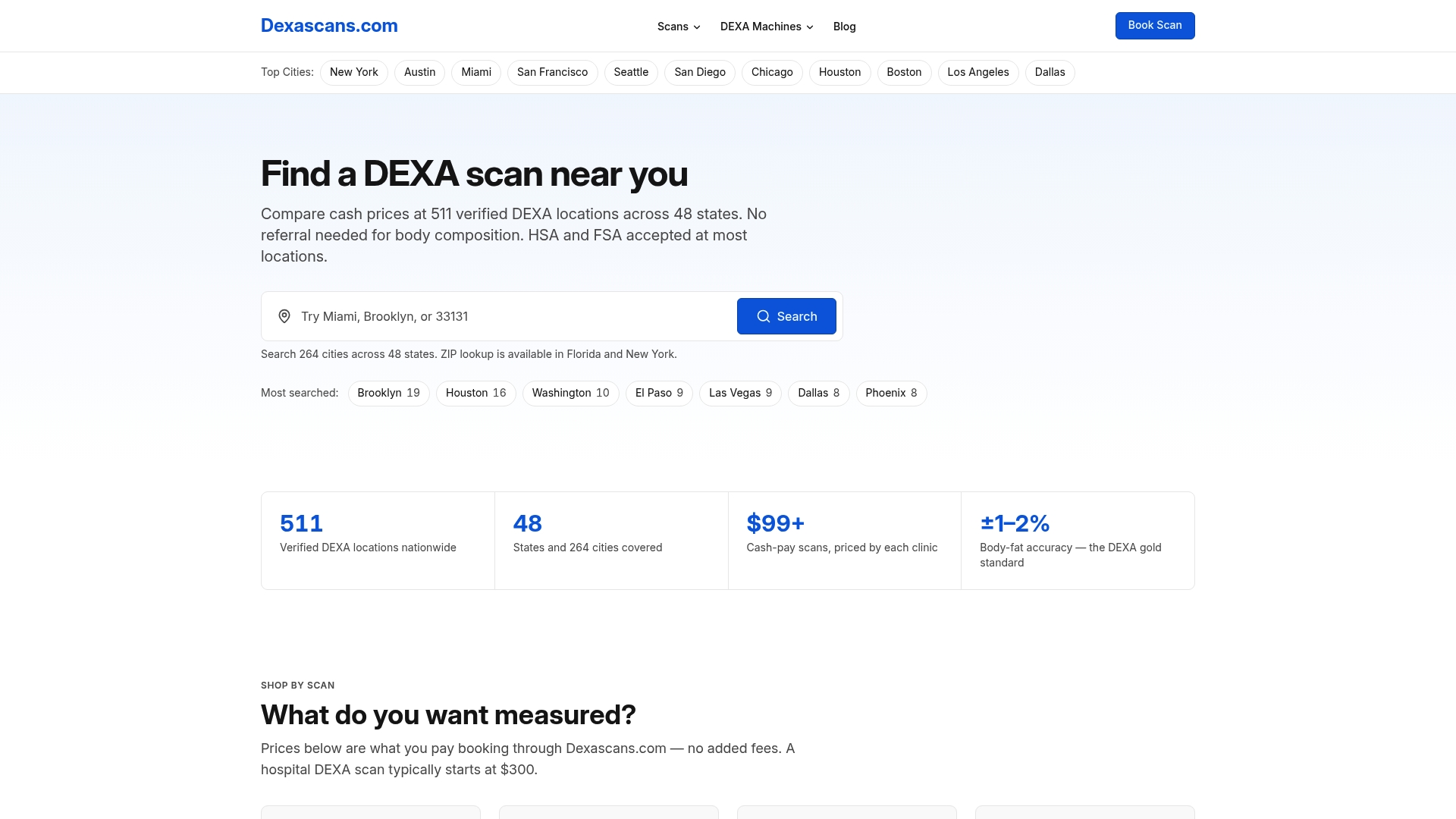
- Compare 511 verified DEXA locations across 48 states with transparent cash pricing
- Get body-fat measurement precision of ±1 to 2 percent, far tighter than a formula built on height and weight alone
- Book directly with a local clinic, no physician referral required
If your calorie targets have stopped working and you suspect your estimate is off, start with what a DEXA scan actually measures and compare clinics near you before booking.
This article is general information, not a substitute for advice from a qualified doctor. Consult a qualified healthcare professional about your own circumstances before acting on anything here.
FAQ
Is BMR or RMR better for weight loss?
Neither is inherently "better" since both estimate resting energy needs, but RMR is more practical because it does not require an overnight lab stay. For weight-loss planning, what matters more is pairing either number with consistent tracking and adjusting your intake based on real results.
Should I use RMR or BMR?
Use RMR for almost all everyday purposes, since it is what most equations, apps, and clinics actually measure or estimate. BMR is mainly useful in clinical or research settings where the stricter basal protocol is necessary.
Is a 1,400 basal metabolic rate good?
Basal metabolic rate varies with age, sex, height, and body composition rather than a fixed benchmark, so a given BMR value is not meaningful on its own. It only becomes meaningful when compared against your actual calorie needs and weight trends over time.
How many calories should I eat if my BMR is 1,500?
Multiply your BMR by an activity factor, roughly 1.2 for a sedentary lifestyle up to around 1.9 for very intense activity, to estimate your total daily calorie needs. From there, adjust in small percentage increments based on how your weight responds over a few weeks rather than treating the first number as final.
Sources
- Resting metabolic rate (RMR) performance-health analysis (protocol summary)
- Trends in measuring BMR and RMR after spinal cord injury: a comprehensive review