
Men age 70 and older should get a bone density test, full stop. Men aged 50 to 69 need one too if they carry risk factors like a prior fragility fracture, low body weight, or long-term steroid use. DEXA, or dual-energy X-ray absorptiometry, is the reference standard both the Endocrine Society and the International Society for Clinical Densitometry recommend for measuring it. The U.S. Preventive Services Task Force stops short of recommending universal male screening, which is why your doctor's judgment on your personal risk factors still carries real weight.
TL;DR:
- Men aged 70 and older should get a bone density test, especially if they have risk factors like prior fractures, low weight, or long-term steroid use.
- Peripheral ultrasound tests are only screening tools, and a low reading warrants a confirmatory DEXA scan, which directly measures bone mineral density.
- The T-score threshold for osteoporosis is -2.5 or lower, but FRAX scores provide a broader fracture risk estimate by combining bone density with other factors.
- Access to testing has improved with verified clinics that offer direct booking without referrals and transparent pricing, which can help identify at-risk men earlier.
- Lifestyle modifications such as adequate calcium and vitamin D, exercise, and quitting smoking are primary steps, with medication reserved for those with fractures or very low T-scores.
Table of Contents
- Clinical Screening Guidelines and Who Faces Higher Risk
- DEXA, Peripheral Tests, and Bone Scans: Not the Same Thing
- What to Expect at Your DEXA Appointment
- Reading Your Results: T-Score, Z-Score, and FRAX
- What Happens After a Low Score
- Why Easier Access to Testing Changes Outcomes for Men
- Find and Book a DEXA Scan Through Dexascans
- Sources
Clinical Screening Guidelines and Who Faces Higher Risk
Guideline groups largely agree on the baseline: test every man 70 and older, and test younger men if risk factors stack up. The Endocrine Society and ISCD both anchor their recommendations at these age and risk thresholds, reasoning that a fracture in an older man carries higher mortality risk than the same fracture in a woman of similar age.
For men aged 50 to 69, testing makes sense when any of these apply:
- A fragility fracture from a fall that shouldn't have broken anything
- Low body weight or a BMI that puts you at the thin end of the scale
- Long-term corticosteroid use, typically defined as three months or more
- Hypogonadism or androgen-deprivation therapy for prostate cancer
- Chronic conditions tied to bone loss, including rheumatoid arthritis or celiac disease
- Heavy smoking or high alcohol intake over a long stretch
The USPSTF's own evidence review found insufficient data to justify screening every man regardless of risk profile. That's not a dismissal of testing. It's an acknowledgment that population-wide screening studies in men lag behind the research base built around women, so clinicians lean on individual risk assessment rather than a blanket rule. If you fall into any category above, that gap in the evidence shouldn't be the reason you skip the conversation with your doctor.
DEXA, Peripheral Tests, and Bone Scans: Not the Same Thing
Central DEXA of the lumbar spine and hip is what almost every guideline points to, because it directly measures the two sites where osteoporotic fractures do the most damage. The machine sends two X-ray beams at different energy levels through bone and soft tissue, then calculates mineral density from how much each beam gets absorbed.
Peripheral tests exist too. Forearm or heel (calcaneal) ultrasound units show up in pharmacies and health fairs because they're portable and cheap to run, but they're screening tools at best, not diagnostic ones. A low reading on a heel scanner should prompt a real DEXA, not a diagnosis on its own.
Where people get confused is mixing up a DEXA scan with a nuclear medicine bone scan (scintigraphy). These are different tests built for different jobs. A bone scan injects a radioactive tracer to detect metastases, infections, or fractures showing active bone turnover. A DEXA scan measures mineral density with no injection at all.
Quick fact: A DEXA scan delivers a radiation dose typically lower than a standard chest X-ray, which is one reason it's considered safe for repeat monitoring over years.
What to Expect at Your DEXA Appointment
Most centers don't require a physician referral, and Dexascans lists clinics you can book directly without one. Preparation is minimal, but a few details matter.
- Skip calcium supplements for about 24 hours before the scan, since they can occasionally interfere with imaging.
- Wear clothing without metal zippers, buttons, or underwire; if your outfit has metal, the clinic will hand you a gown.
- Remove jewelry and empty your pockets before lying on the table.
- Expect to be on the table for 10 to 20 minutes total, most of it lying still while the machine passes over your lower spine and hip.
- The technician may also scan your forearm if your hip or spine can't be read reliably, a situation that comes up more often in men on androgen-deprivation therapy or with certain endocrine disorders.
- Ask about pricing before you book. Cash rates for a bone density scan vary widely between hospital-affiliated imaging centers and independent clinics, and insurance coverage depends on whether your case meets your plan's medical necessity criteria.
Reading Your Results: T-Score, Z-Score, and FRAX
Your report will lead with a T-score, which compares your bone density to a healthy young adult of the same sex. The thresholds are fixed: a T-score of -1.0 or higher is normal, -1.0 to -2.5 signals osteopenia (low bone mass), and -2.5 or lower meets the definition of osteoporosis.
- T-score ≥ -1.0: normal bone density
- T-score -1.0 to -2.5: osteopenia, worth monitoring
- T-score ≤ -2.5: osteoporosis
- Z-score ≤ -2.0 (men under 50): below the expected range for age, which should prompt a search for a secondary cause
If you're under 50, your report should shift to a Z-score, which compares you to other men your age rather than to a young adult baseline. A low Z-score in a younger man often points to a secondary cause, like a hormonal imbalance or long-term medication use, rather than routine age-related loss.
T-scores alone don't tell the whole story. FRAX combines your bone density with age, weight, smoking status, family fracture history, and steroid use to estimate your 10-year probability of a major fracture. A man with osteopenia and a cluster of risk factors can land in a higher FRAX bracket than a man with worse bone density and no other risk factors, which is exactly the scenario FRAX was built to catch.
Pro Tip: Ask your clinic which reference database they use to calculate your T-score. Some facilities apply a female reference range to male patients by default, which can shift your number in ways that matter if you're near a diagnostic threshold.
What Happens After a Low Score
A low T-score or elevated FRAX result doesn't automatically mean medication. It means a conversation about what's driving the number and how urgently to act.
Lifestyle changes come first for most men, regardless of severity:
- Calcium and vitamin D intake at levels your doctor confirms are adequate for your age
- Regular weight-bearing exercise, including resistance training, which stimulates bone remodeling
- Quitting smoking and cutting back on heavy alcohol use
- Reviewing any long-term medications, especially steroids, that might be accelerating bone loss
Medication typically enters the conversation when you've already had a fragility fracture, your T-score is -2.5 or lower, or your FRAX score crosses a treatment threshold even with a less severe T-score. Follow-up DEXA scans are usually spaced one to two years apart to check whether treatment is working, though your clinician may space them differently based on your starting point. If your case involves an unusual Z-score, a suspected hormonal cause, or a fracture that doesn't fit the usual pattern, that's when a referral to an endocrinologist or an osteoporosis specialist makes sense.
Why Easier Access to Testing Changes Outcomes for Men
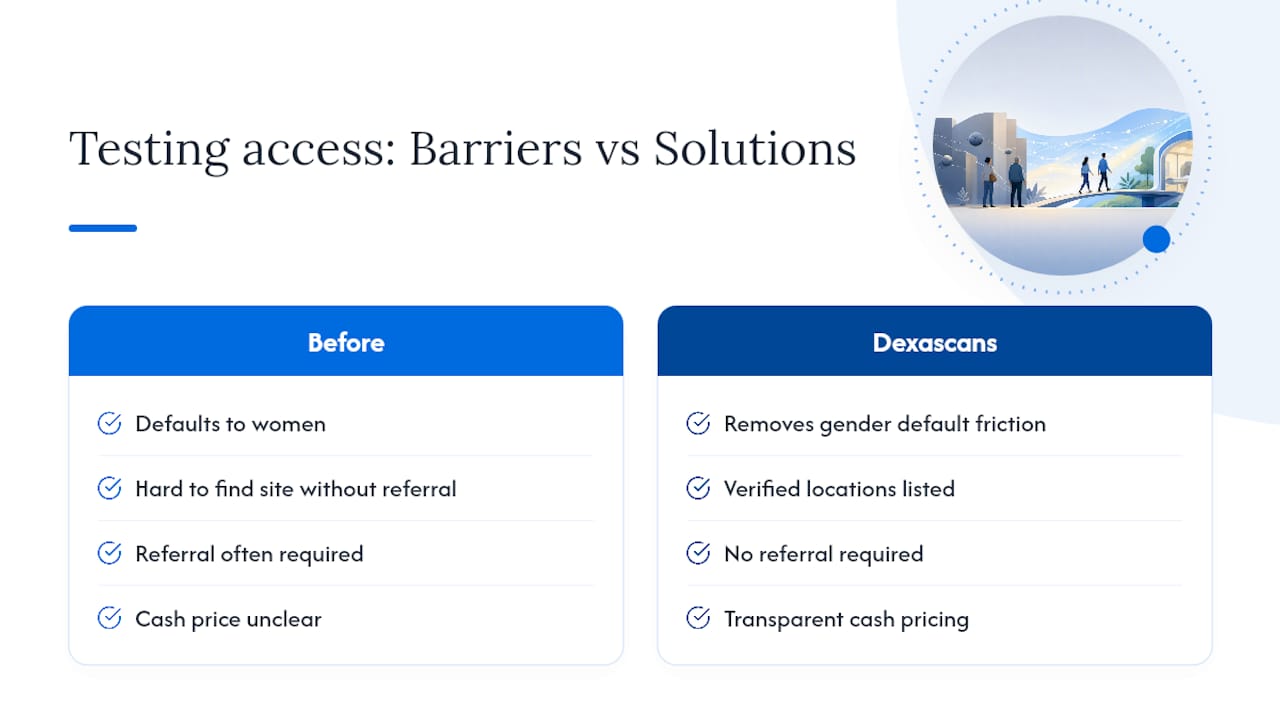
Men get underdiagnosed for osteoporosis partly because screening conversations default to women, and partly because finding a testing site without a referral used to be a hassle. That gap has real consequences: a hip fracture in a man carries a higher mortality risk in the following year than the same fracture in a woman, which is reason enough to close it.
Dexascans built its listing model around removing friction, not around replacing your doctor's judgment. Verified locations, transparent cash pricing, and no referral requirement mean a man who recognizes his own risk factors from a guideline checklist can actually act on that recognition the same week. Lowering the barrier to testing is one of the more overlooked levers in catching male osteoporosis before it becomes a fracture.
— Erik
Find and Book a DEXA Scan Through Dexascans
Once you know you fit the screening criteria, the next question is where to actually get scanned without waiting weeks for a referral. Dexascans lists more than 500 verified clinics across 48 states, each showing the scan types offered, whether that's bone density alone, full body composition, or a combined appointment, along with transparent cash pricing you can compare before you commit.
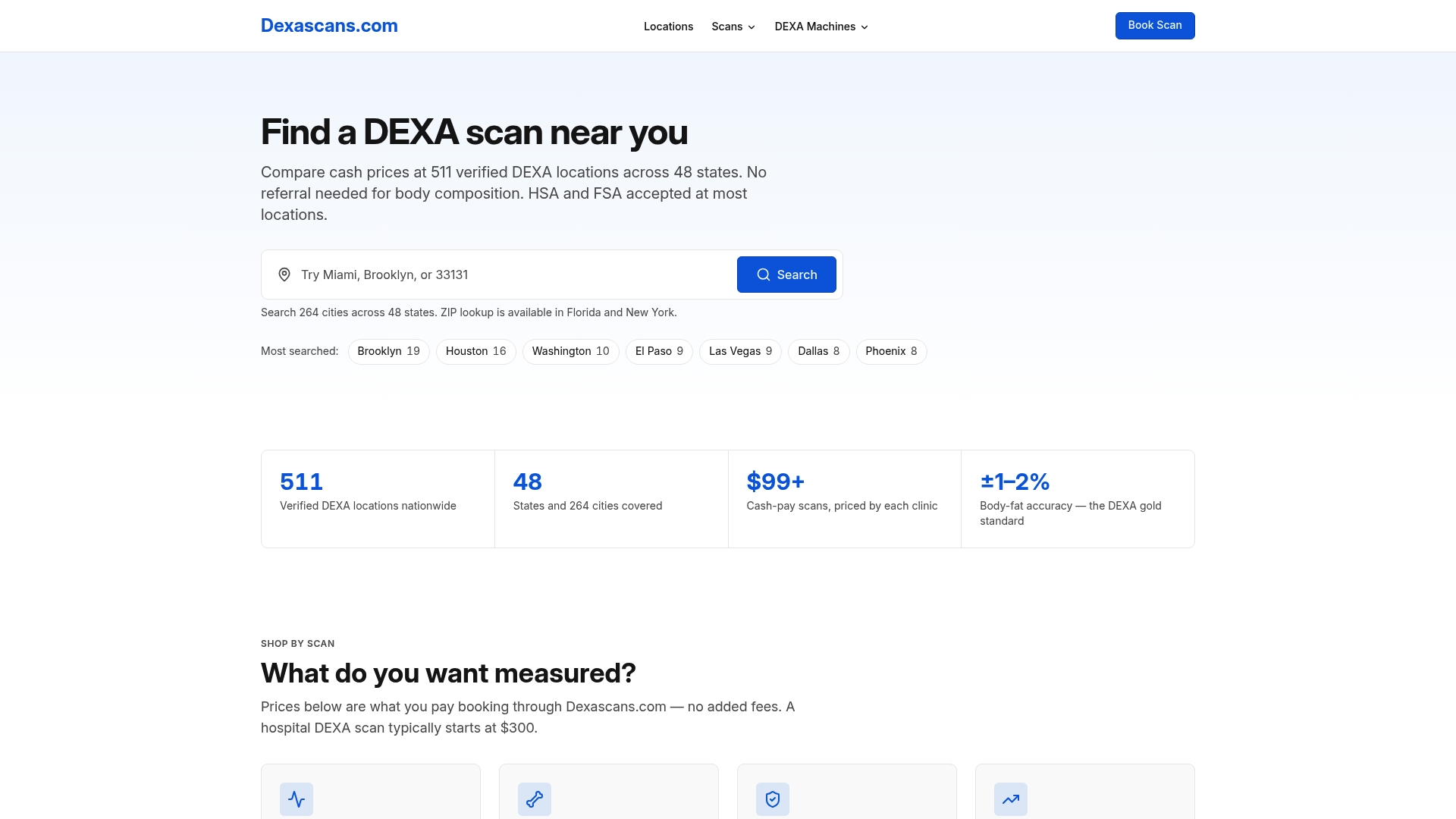
You search by city or ZIP code, compare a handful of nearby clinics on price and scan type, and book directly with the clinic, no physician referral required. Cash pricing on Dexascans tends to run well below typical hospital imaging rates, which matters if your insurance plan doesn't consider your case medically necessary yet. Search DEXA scan locations near you to see what's available in your area, and bring your results back to your doctor or an endocrinologist to decide on next steps together.
This article is general information, not a substitute for advice from a qualified doctor. Consult a qualified healthcare professional about your own circumstances before acting on anything here.
Sources
- Bone density test (DXA/DEXA scan) - Mayo Clinic
- Bone Density Scan - MedlinePlus
- Should I get a bone density test? - Harvard Health
- USPSTF / screening evidence summary (PubMed entry)