
VO2 max is the body's oxygen ceiling, the maximum rate at which you can use oxygen during hard exercise. Lactate threshold is the fraction of that ceiling you can sustain before fatigue accumulates fast. For most endurance races, from a 10K to a marathon, lactate threshold predicts performance more directly than VO2 max does, and it responds better to focused training. VO2 max still matters for setting your aerobic ceiling and for shorter, faster efforts, so the right focus depends on your event and where you are in the season.
TL;DR:
- VO2 max is primarily a ceiling measure of oxygen delivery, with lab tests offering the most accurate assessment, while wearables provide acceptable trend estimates for recreational athletes.
- Lactate threshold better predicts race performance in distances longer than 10K, as it reflects sustainable effort levels and responds more to training than VO2 max.
- Training for endurance events should focus on threshold and economy work, with VO2 max intervals limited to short, maximum efforts, especially when aiming for races longer than 10K.
- Body composition changes, such as fat loss, can affect relative VO2 max measurements without actual fitness improvements, which can be clarified through DEXA scans.
- Regular testing, combining lab, wearable, and field assessments, helps track progress and adjust training priorities without over-relying on infrequent lab visits.
Table of Contents
- What VO2 max measures and how it's tested
- What lactate threshold is and how it's measured
- Ceiling versus usable power: what actually predicts your race time
- Deciding between a lab test and a wearable estimate
- Training sessions that raise LT versus VO2 max
- Building a simple testing and tracking routine
- How body composition data adds context to VO2 and LT tracking
- The physiology behind the two numbers
- Reading the numbers across different athletes and sports
- Clearing up the common mix-ups
- How these metrics entered exercise science
- Where I'd put your training focus
- Adding body composition context with a DEXA scan
- Sources
- FAQ
What VO2 max measures and how it's tested
VO2 max is the maximum volume of oxygen your muscles can use per minute during maximal exertion, expressed relative to body weight (mL per kg per minute). It reflects the combined capacity of your heart, lungs, blood, and muscles to deliver and use oxygen, and it sets the upper limit on your aerobic engine.
The reference method is a graded exercise test with open-circuit spirometry: you breathe into a mask while running or cycling at increasing intensity until exhaustion, and a metabolic cart measures oxygen consumption and carbon dioxide output directly. This is precise because it captures gas exchange in real time rather than estimating it from a proxy like heart rate.
Wearables and watch-based algorithms estimate VO2 max from pace, heart rate, and sometimes heart rate variability during runs. A systematic review of wearable accuracy found these devices can give acceptable estimates for many recreational athletes, though validity depends on the device, the algorithm, and the population tested.
- Lab testing with spirometry is the most accurate method available and the standard researchers used to validate everything else.
- Wearable estimates work reasonably well for tracking trends in typical athletes, but elite-level precision still mostly requires a lab.
- Common error sources include poor GPS pace data, irregular heart rate readings, and algorithms tuned to general populations rather than trained athletes.
What lactate threshold is and how it's measured
Lactate threshold is the exercise intensity at which lactate starts accumulating in the blood faster than your body can clear it. Below this point, your muscles produce energy aerobically with lactate as a byproduct that gets recycled efficiently. Push past it, and lactate piles up, hydrogen ions disrupt muscle contraction, and pace becomes unsustainable within minutes rather than hours.
The reference method is an incremental lab test with blood sampling, typically a finger or earlobe prick every few minutes during a graded protocol, plotting lactate concentration against speed or power to find the inflection point. Because it measures the actual metabolic event, it's considered the benchmark against which other methods are judged.
Practical proxies substitute for the finger prick. Ventilatory threshold testing uses breathing patterns and gas exchange ratios from the same spirometry setup as a VO2 max test. Field-based estimates rely on pace or heart rate during sustained efforts, and wearables now attempt to estimate LT continuously during training.
- Ventilatory thresholds correlate closely with lactate thresholds and can be measured in the same lab session as VO2 max.
- Pace or heart rate at a sustained tempo effort gives a rough, repeatable field marker of LT without blood draws.
- Wearable LT estimates are improving but remain more variable and less validated than VO2 max estimates from the same devices.
Ceiling versus usable power: what actually predicts your race time
VO2 max sets the size of your aerobic engine, but lactate threshold determines how much of that engine you can actually run on for an hour, two hours, or four.
Research on factors influencing threshold running velocity supports this: lactate threshold and running economy explain much of the variation in distance performance, and LT improvements often happen without any corresponding rise in VO2 max. A separate review of physiological predictors of running performance confirms that VO2 max, economy, velocity at VO2 max, and lactate response all contribute, with their relative weight shifting by race distance.
- For marathons and half-marathons, lactate threshold and economy tend to matter more than absolute VO2 max.
- For 5K and shorter races, velocity at VO2 max and raw aerobic ceiling carry more weight.
- Middle-distance events sit between the two, rewarding a high ceiling combined with the economy to use it efficiently.
If you're training for anything longer than 10K, threshold work usually deserves more of your attention than max-effort intervals.
Deciding between a lab test and a wearable estimate
The right test depends on what decision you're trying to make and how precise you need the answer.
- Choose a lab test for a true baseline, for clinical screening, or when programming for competitive athletes where small errors in prescribed paces compound over a season.
- Rely on wearables for week-to-week monitoring if you're a recreational or sub-elite athlete tracking general trends rather than exact zones.
- Combine both: verify your numbers in a lab once or twice a year, and let a wearable track the trend between those checkpoints.
ACSM guidance on estimating cardiorespiratory fitness points out that submaximal and heart-rate-based estimates carry real limitations, and careful protocol choice and RPE use can tighten their accuracy. If you're near a testing center, a VO2 max test gives you a real anchor point to calibrate your watch against. Recreational athletes can usually skip the lab and trust a well-calibrated wearable trend.
Training sessions that raise LT versus VO2 max
The two metrics respond to different kinds of stress, so your weekly structure should reflect what you're trying to move.

VO2 max workouts use short, hard intervals near your maximal aerobic speed, typically 3 to 5 minutes at an intensity you could hold for about 6 to 8 minutes, with recovery periods nearly as long as the work interval. These sessions stress your heart's stroke volume and your muscles' oxygen extraction, and they're taxing enough that two per week is usually the ceiling.
Lactate threshold workouts look different: sustained tempo runs of 20 to 40 minutes at threshold pace, or longer intervals like 4 x 8 minutes with short recoveries, spend more total time at the intensity where lactate starts to climb. Research on threshold-based training suggests that spending meaningful time in the zone between metabolic and ventilatory thresholds can produce solid LT gains even when VO2 max barely moves, which matters once your aerobic ceiling is already well developed.
- VO2 max sessions: short, near-maximal intervals with generous recovery, capped at one or two per week.
- LT sessions: sustained tempo efforts or longer cruise intervals that accumulate meaningful time near threshold.
- Recovery matters more for VO2 max work since the neuromuscular and cardiovascular strain is higher per minute.
Pro Tip: Run the same 20-minute time trial or tempo workout every four to six weeks on the same course to track threshold progress without booking another lab test.
Building a simple testing and tracking routine
A workable plan does not require constant lab visits. It needs a rhythm you'll actually follow.
- Test at the start of a training cycle, again after your biggest training block, and once more in the taper before a goal race.
- Between formal tests, run a monthly field check, a tempo effort or time trial at a fixed course, and log pace, heart rate, and perceived effort.
- Track your wearable's VO2 max trend alongside race times and periodic body composition snapshots to see the full picture, not just one number.
- If threshold pace stalls for several weeks, shift emphasis toward tempo and cruise-interval work; if your ceiling feels flat, add a short VO2 max block instead.
- When both numbers plateau together, treat it as a signal to deload rather than push harder.
How body composition data adds context to VO2 and LT tracking
Relative VO2 max is expressed per kilogram of body weight, so a change in body composition shifts the number even when your aerobic engine hasn't changed at all. Losing fat mass while holding muscle can lift your relative VO2 max on paper without a single extra interval session, and the reverse is just as true.
Because the network lists many verified locations across multiple states with transparent cash pricing, athletes can book a periodic scan without a referral and pair the result with their wearable and lab data. Runners often check body composition once or twice a year, right alongside their VO2 max and threshold retests, to know whether a shift in relative numbers reflects fitness or physique change.
The physiology behind the two numbers
VO2 max and lactate threshold draw on different links in the same energy chain, which is why they don't always move together.

VO2 max reflects the ceiling of your oxygen delivery and uptake system: how much blood your heart can pump per beat, how many capillaries feed your muscle fibers, and how efficiently your mitochondria consume oxygen once it arrives. It's largely a cardiovascular and central story, and it caps how much aerobic energy you can produce at any given moment.
Lactate threshold reflects a different bottleneck: the balance between lactate production in fast-twitch and slow-twitch fibers and your body's ability to shuttle and clear that lactate through the liver, heart, and oxidative muscle fibers. This is more of a peripheral, muscular story, tied to mitochondrial density, capillarization, and the proportion of slow-twitch fibers actively recruited at a given pace. Fatigue near threshold isn't about running out of oxygen supply; it's about your clearance systems losing the race against production.
That distinction explains why an athlete can raise lactate threshold substantially through consistent training while VO2 max plateaus early. The oxygen delivery ceiling was already built years ago; what's still adapting is how efficiently the muscle uses and clears the byproducts of working near that ceiling. Training that targets one system doesn't automatically move the other.
Reading the numbers across different athletes and sports
A VO2 max or lactate threshold number means little without context for the person and sport behind it. ACSM's cardiorespiratory fitness update treats VO2 max as a clinical vital sign because of its strong link to long-term health outcomes, which is a very different use case from ranking marathoners.
For endurance runners and cyclists, both numbers get interpreted relative to sustainable race pace: a high VO2 max paired with a low threshold percentage often signals untapped potential, while a high threshold percentage on a modest VO2 max points to an athlete who has maximized their engine through years of aerobic work. Team-sport athletes, by contrast, care more about repeated-sprint capacity and recovery between efforts, so a single VO2 max number tells a smaller part of the story. Swimmers and rowers show different absolute values than runners because the muscle mass involved and the mechanical efficiency of the sport shift both numbers independently of aerobic fitness.
Recreational athletes should expect more week-to-week noise in both metrics, since sleep, hydration, and training load swing the numbers more than they do for highly trained competitors with stable routines. Comparing your number to a generic population average, rather than to your own trend over time, is usually the less useful exercise.
Clearing up the common mix-ups
The most persistent misconception is that a higher VO2 max always means a faster race time. It doesn't, because lactate threshold and running economy determine how much of that ceiling you can actually spend during a race, and plenty of athletes with modest VO2 max scores outrun higher-ceiling competitors by sustaining a larger share of theirs.
Another common mix-up treats lactate as a pure fatigue toxin to be avoided at all costs. In reality, lactate is a fuel source that working muscles and the heart use continuously, and the threshold marks a shift in the balance between production and clearance rather than the sudden appearance of a harmful substance.
Some athletes also assume wearable VO2 max and lactate threshold numbers are interchangeable with lab results. They're estimates built from pace and heart rate patterns, useful for tracking trends but not a substitute for a spirometry-based test when precision matters.
Finally, there's a tendency to chase VO2 max improvements indefinitely, even after a season or two of hard interval work has pushed the number close to its genetic ceiling. At that point, threshold and economy work typically offer more room for performance gains than another round of maximal intervals.
How these metrics entered exercise science
VO2 max as a concept traces back to early 20th-century physiology labs studying oxygen consumption during exercise, with the framework we still use today largely formalized by mid-century researchers measuring gas exchange in trained and untrained subjects. It became the standard proxy for aerobic fitness because it was measurable, repeatable, and clearly tied to endurance capacity.
Lactate threshold entered the picture later, as researchers studying blood chemistry during graded exercise noticed that lactate didn't rise steadily with intensity but instead showed a distinct inflection point. That observation reframed how coaches thought about pacing, since it offered a physiological marker for sustainable intensity rather than relying on perceived effort alone.
Today, both metrics sit inside frameworks like the FRIEND registry, which compiles reference VO2 max values across populations, and newer tools like muscle near-infrared spectroscopy are being explored for detecting ventilatory and lactate thresholds noninvasively. A 2026 ACSM hot-topic review found mNIRS-derived threshold detection showed higher reliability for the second ventilatory or lactate threshold, suggesting the field is still refining how these thresholds get measured outside a traditional blood-draw protocol.
Where I'd put your training focus
If you're racing anything longer than 10K, threshold and economy work earns more of your training time than another round of VO2 max intervals. Use VO2 max testing to know your ceiling and to guide short, hard interval sessions, but let threshold pace and repeatable field tests drive your week-to-week decisions. Testing without matching sleep, fueling, and recovery just produces noisy numbers you can't act on.
— Erik
Adding body composition context with a DEXA scan
Tracking VO2 max and lactate threshold tells you how your engine and fuel system are performing, but it doesn't explain whether a shift in relative VO2 max came from fitness gains or from a change in body composition. A DEXA scan fills that gap with fat mass and lean mass numbers precise enough to separate the two.
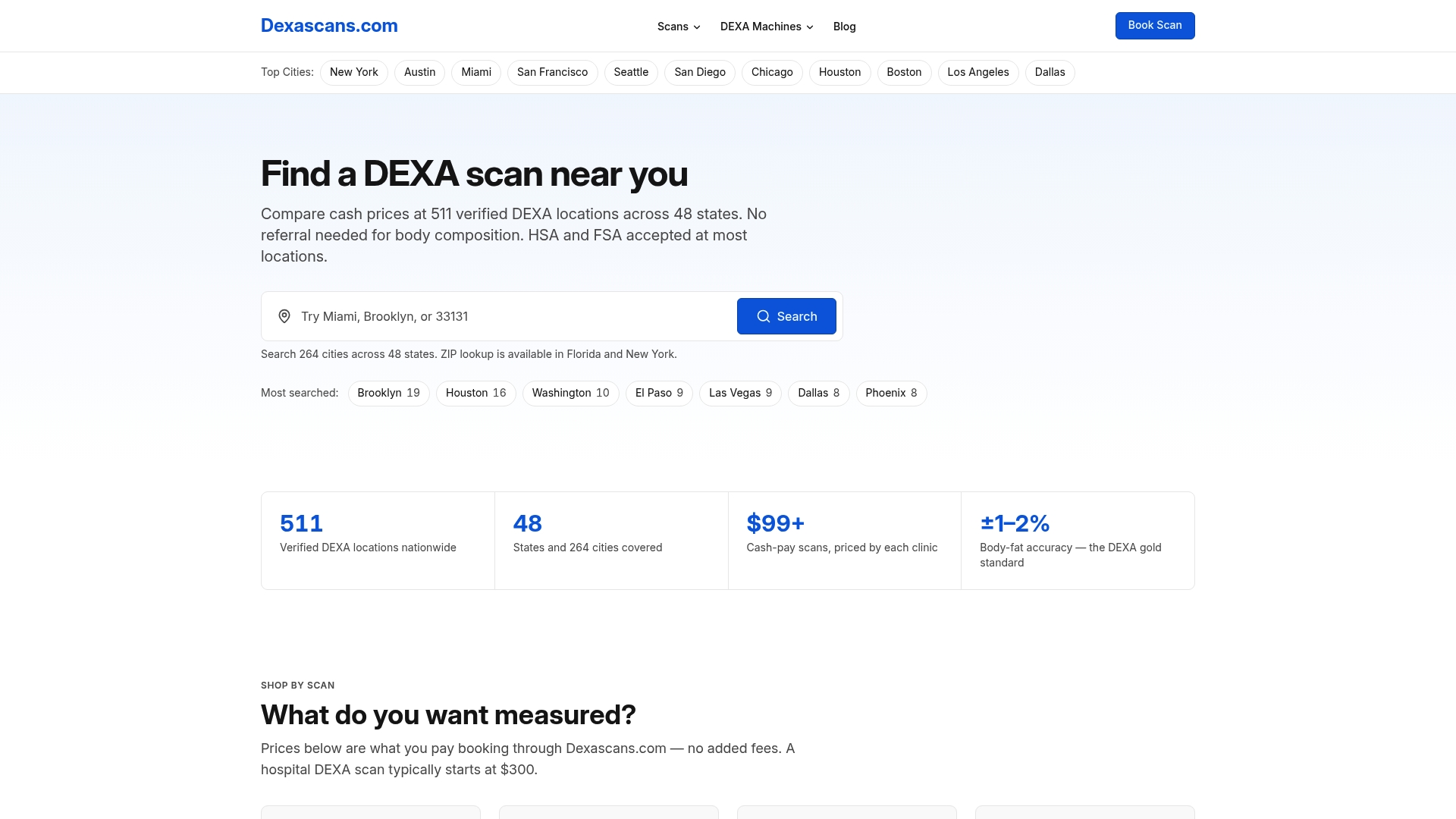
The site lists verified DEXA providers with transparent cash pricing so you can book a body composition scan without a referral and without guessing at hospital rates. Pair a scan with your next lab test or wearable check to see the fuller picture, then find a location near you through the DEXA scan locations directory.
Sources
- Accuracy of wearables for determining the maximal oxygen uptake and lactate threshold: a qualitative systematic review
- We can and should do better when estimating cardiorespiratory fitness
FAQ
Is lactate threshold or VO2 max more important for marathon training?
Lactate threshold and running economy generally matter more than raw VO2 max for marathon performance, since they determine how much of your aerobic ceiling you can sustain over hours rather than minutes. Research on threshold running velocity supports prioritizing threshold work for distance events.
Can you improve VO2 max and lactate threshold at the same time?
Yes, but they respond to different training stimuli, so most plans blend short, hard intervals for VO2 max with sustained tempo work for threshold rather than expecting one workout type to raise both equally. LT tends to keep improving even after VO2 max plateaus.
How accurate are wearable VO2 max and lactate threshold estimates?
Wearables can give acceptable VO2 max estimates for many recreational athletes, though accuracy depends on the device and algorithm. Lactate threshold estimates from the same devices remain more variable and less validated, so lab testing is still the more reliable reference for precise numbers.
Does body composition affect my VO2 max number?
Yes, since relative VO2 max is measured per kilogram of body weight, a change in fat mass or lean mass shifts the number even without any change in aerobic fitness. A DEXA scan can clarify whether an improved VO2 max reading reflects fitness gains or a body composition change.
How often should I retest lactate threshold and VO2 max?
A common approach is testing at the start of a training cycle, after a major training block, and again before a goal race, with monthly field checks like a tempo time trial in between. This keeps you from over-relying on infrequent lab visits while still catching real changes in fitness.