
A DEXA scan in Minneapolis typically runs between $100 and $300 in cash, though some listed prices go as low as $40 and others top $300 depending on the facility. Medicare Part B may cover bone density screening at no cost if you qualify and your provider accepts assignment. Your best first move is comparing verified local cash prices on Dexascans before you book anywhere.
TL;DR:
- Cash prices for a DEXA scan in Minneapolis generally range from $40 to over $313, with a median around $158.40, making price shopping essential.
- Medicare covers bone density screening every 24 months for eligible individuals, potentially resulting in no out-of-pocket cost if the provider accepts Medicare assignment.
- Facility type influences pricing significantly, with hospital outpatient departments charging higher fees due to separate technical, facility, and interpretation costs, unlike bundled wellness-center prices.
- Informed booking requires asking whether the quoted price includes radiologist interpretation, and verifying if the device used is a clinical standard central DXA machine.
- Many clinics allow direct booking without a physician referral, but it is crucial to confirm if the price is all-inclusive and covers necessary professional reports for medical use.
Table of Contents
- Minneapolis price landscape: sourced cash rates, medians, and example ranges
- What changes the price: insurance, facility type, CPT codes, and billing components
- How to find and book an affordable, verified DEXA scan in Minneapolis
- Questions to ask and how to prepare before your appointment
- Why transparent cash pricing and verified listings matter for Minneapolis patients
- Compare verified Minneapolis DEXA prices before you book
- FAQ
- Sources
Minneapolis price landscape: sourced cash rates, medians, and example ranges
Pricing for a DEXA scan in Minneapolis varies more than most people expect for what is a routine, low-radiation imaging test. Local listings tracked by SelfPayRates show a cash-price range for the standard bone density DEXA code (CPT 77080) running from roughly $40 to over $313 across Minneapolis-area facilities, with a median near $158.40. That spread alone explains why calling ahead for a price pays off.

The gap between the low and high ends usually comes down to where you book. Freestanding imaging centers and fitness or wellness studios tend to post flat, predictable cash fees because they are not billing through a hospital system. Hospital-based departments, by contrast, often list a higher "chargemaster" rate on their machine-readable price files, the public pricing documents hospitals are required to publish, even though the price a cash-pay patient actually negotiates can land much lower once they ask directly.
A separate statewide analysis adds another data point worth knowing before you call anyone.
Medicare pays an average amount for a common DEXA bone density CPT code in Minnesota, which is somewhat higher than the national average, according to state-level pricing data. That figure represents the insurance-negotiated payment, not the cash price a self-pay patient would be quoted, which is why Medicare patients and cash shoppers often see wildly different numbers for the same scan.
A few patterns show up consistently across Minneapolis pricing data:
- Freestanding and wellness-center scans usually post flat cash fees in the low hundreds, with little variation once you see the quoted number.
- Hospital outpatient departments frequently list the widest range, because facility fees and professional interpretation fees are billed separately.
- State Medicare averages sit far below typical cash prices, reflecting negotiated insurance rates rather than what an uninsured patient pays.
- Body composition-only scans (no bone density component) sometimes cost less than a full bone density DEXA, since they skip the hip and spine imaging that requires radiologist interpretation.
None of this means the lowest number you find is automatically the right choice. A $40 quote at a hospital's machine-readable file might reflect a Medicare-negotiated rate you are not eligible for, while a $225 flat fee at a wellness center might include everything with no surprise bill later. The number matters less than what it includes.
What changes the price: insurance, facility type, CPT codes, and billing components
The biggest single cost variable for Minneapolis patients is whether Medicare covers your scan. Medicare Part B covers bone density screening once every 24 months for beneficiaries who meet eligibility criteria, such as being at risk for osteoporosis or already being treated for low bone mass. If your provider accepts Medicare assignment, meaning they agree to the Medicare-approved amount as full payment, you may owe nothing out of pocket for an eligible scan. If the provider does not accept assignment, or if you are scanning more often than the 24-month window allows, you are back to paying cash or facing a bill your insurance partially covers.
Facility type is the second major driver. A hospital-owned imaging department often bills a facility fee on top of the scan itself, plus a separate professional fee for the radiologist who reads the images. A hospital-affiliated outpatient clinic may bill similarly but at a lower facility rate. A freestanding imaging center typically bundles everything into one quoted price, which is part of why their cash rates read lower and more predictable. A fitness or wellness center offering DEXA for body composition tracking usually charges a flat fee with no separate professional interpretation fee at all, since there is no diagnostic report to be read by a radiologist.
CPT codes explain why "a DEXA scan" is not a single product with one price. Code 77080 covers a standard bone density study of the hip and spine. Code 77085 covers an axial bone density study that includes vertebral fracture assessment. RadiologyInfo explains that imaging costs depend heavily on exam type, facility, and whether technical and professional services are billed together or separately. Insurance plans treat these codes differently depending on deductibles already met, whether preauthorization was required, and whether the ordering provider documented medical necessity.
Pro Tip: Ask whether the quoted price covers both the technical fee (the scan itself) and the professional fee (the radiologist's report), since many surprise bills come from assuming one price covered both.

A posted "cash price" rarely applies once insurance gets involved. If you are insured and your plan covers DEXA scans, your actual cost depends on your deductible status and copay structure, not the advertised self-pay rate. If you are paying cash specifically to avoid the insurance billing process, confirm that the quoted number is genuinely all-inclusive before you show up.
How to find and book an affordable, verified DEXA scan in Minneapolis
Shopping for a DEXA scan works best as a short, deliberate process rather than picking the first search result.
- Cross-check hospital price files. If a nearby hospital appears in your search, pull its machine-readable price file or check an aggregator like SelfPayRates to see what it has publicly posted for CPT 77080.
- Request a Good Faith Estimate. Under the No Surprises Act, cash-pay and uninsured patients can request a written estimate before scheduling, which should list every expected charge, not just the headline number.
- Confirm the device type. Ask whether the facility uses a central DXA machine (the clinical standard) or a smaller peripheral device often found in gyms, since this affects whether the results are useful for a diagnostic bone-density conversation with your doctor.
- Verify whether the price includes a radiologist's report. A scan without professional interpretation is fine for casual body composition tracking but not sufficient for an osteoporosis diagnosis.
- Confirm referral requirements. Many cash-pay facilities, including those listed through Dexascans.com, allow booking without a physician referral, which simplifies scheduling but means you are responsible for interpreting results or bringing them to your own doctor.
Filtering matters here. If you want body composition numbers for fitness tracking, body fat percentage, lean mass, visceral fat, you can generally book at a fitness-oriented center with a flat fee and skip the clinical bells and whistles. If you need a T-score for an osteoporosis conversation with your physician, a central DXA with radiologist interpretation is the safer choice, even if it costs more than a wellness-center scan.
Pro Tip: A $100 flat-fee body composition scan at a gym is a reasonable choice for tracking fitness progress, but it is not a substitute for a diagnostic bone density scan if your doctor has flagged osteoporosis risk.
Questions to ask and how to prepare before your appointment
A short round of questions before you book saves you from an unpleasant bill later and makes sure the results are actually useful.
- "Is this price all-inclusive, or will I get a separate bill for radiology interpretation?" This single question catches most surprise charges before they happen.
- "What type of DEXA machine do you use?" Central DXA is the clinical standard; some fitness centers use smaller devices that are fine for trend tracking but not diagnosis.
- "Do you accept Medicare assignment?" If you are on Medicare and eligible for screening, this determines whether you owe anything at all.
- "When will I get my results, and in what format?" A clinical facility should give you a written report; a fitness center may just hand you a printout of numbers.
Preparation is simple. Wear clothing without metal zippers, buttons, or underwire, and remove jewelry before the scan. Tell the technician if you have had a recent barium exam or nuclear medicine scan, since contrast material can interfere with results. If your report includes a T-score, understand that a score of -1.0 or higher is normal, between -1.0 and -2.5 indicates low bone mass, and -2.5 or lower indicates osteoporosis, while a body composition readout instead breaks down fat mass, lean mass, and bone mineral content as percentages.
Requesting a written Good Faith Estimate before your appointment is worth the extra phone call, especially for cash-pay patients, since it forces the facility to itemize charges instead of quoting a single round number that may not hold up once billing happens.
Why transparent cash pricing and verified listings matter for Minneapolis patients
Most of the frustration people run into with DEXA pricing has nothing to do with the scan itself. It comes from not knowing what a quote actually includes until the bill arrives. A $158 median price sounds reasonable until you learn a separate radiologist fee was never mentioned.
That is why verified, itemized pricing matters more than the lowest number on a page. Our listings cover over 500 verified locations in many states, and many allow booking without a physician referral. We built the platform around the measurement standard the scans themselves rely on: body fat precision within ±1 to 2 percent, which only holds up when the facility is using a properly calibrated central DXA device and reporting results honestly.
If you are choosing between two Minneapolis providers, prioritize the one that tells you upfront which device it uses and whether a radiologist reads the results. A lower price that skips the interpretation fee is not actually cheaper if you need that report for a medical decision later.
— Erik
Compare verified Minneapolis DEXA prices before you book
We built Dexascans specifically so you are not stuck guessing what a hospital department or a gym down the street actually charges. Search by Minneapolis or your ZIP code and you will see verified clinics with transparent cash pricing listed side by side, filterable by whether you want a body composition scan, a bone density scan, or both in one appointment.
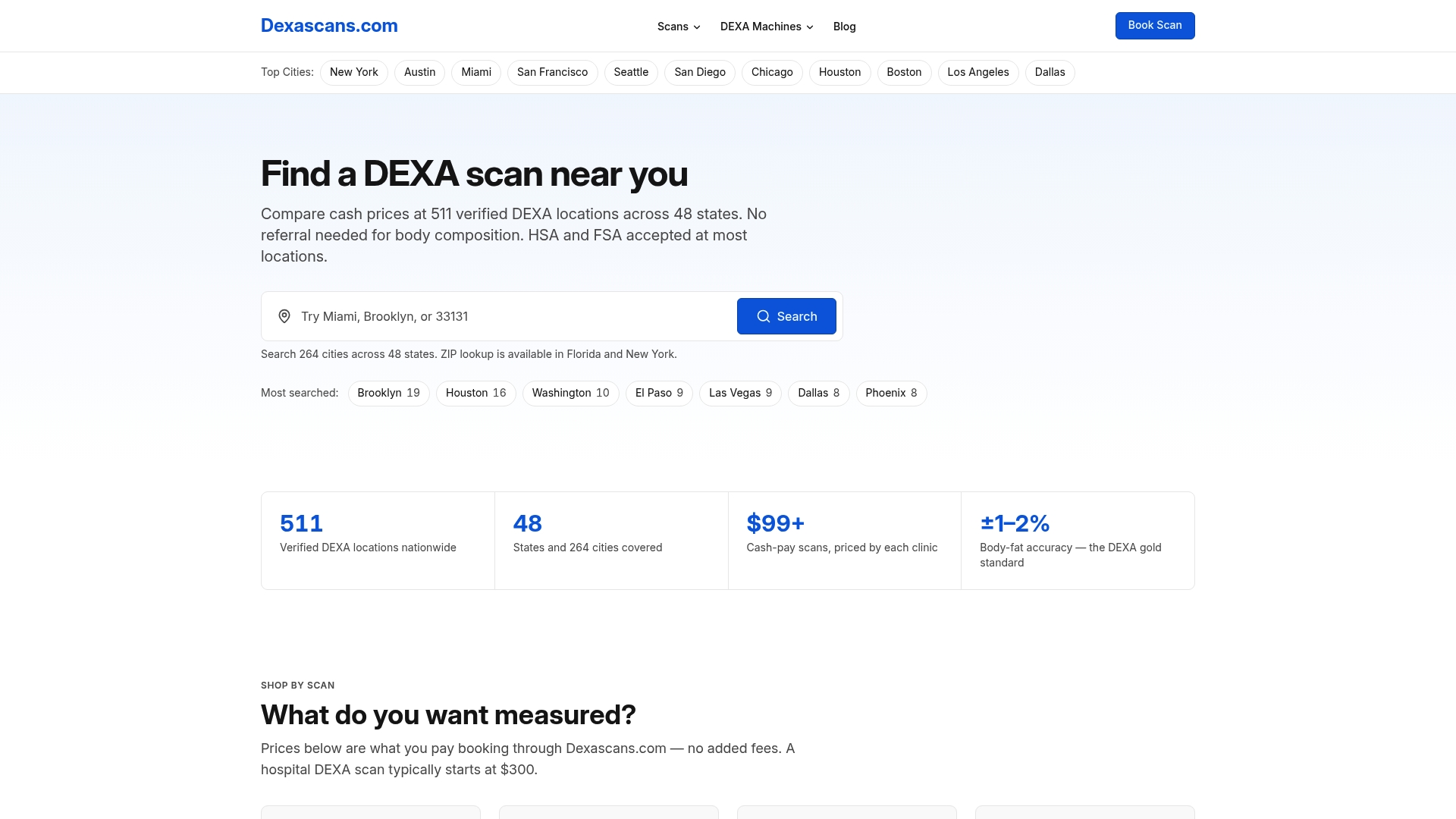
Every location we list has been checked for real pricing and scan availability, and none require a physician referral to book directly. Before you commit anywhere:
- Filter by scan type to avoid booking a body composition appointment when you actually need bone density results for a doctor.
- Check whether pricing is listed as all-inclusive before assuming it covers interpretation.
- Use the location's contact details to confirm current pricing, since cash rates can shift.
Start by searching Dexascans and confirm exactly what is included before you book your scan.
FAQ
How much does a DEXA scan normally cost?
A DEXA scan typically costs between $100 and $300 in cash at most facilities, though Minneapolis-area listings range from roughly $40 to over $313 depending on the facility and CPT code. Fitness and wellness centers tend to charge flat fees toward the lower end, while hospital departments can bill higher due to separate facility and professional fees.
Does Medicare cover a DEXA scan in Minnesota?
Medicare Part B covers bone density screening once every 24 months for eligible beneficiaries, and you may owe nothing if your provider accepts Medicare assignment. Eligibility depends on factors like osteoporosis risk or ongoing treatment for low bone mass, so check with your provider before scheduling.
What is the difference between a bone density scan and a body composition scan?
A bone density scan measures bone mineral density at the hip and spine to screen for osteoporosis, while a body composition scan measures fat mass, lean mass, and bone content for fitness or health tracking. Central DXA devices are the clinical standard for diagnostic bone density results, while smaller devices used at some fitness centers work for general composition tracking.
Do I need a doctor's referral to get a DEXA scan in Minneapolis?
Many cash-pay facilities, including those listed on Dexascans, allow you to book a DEXA scan directly without a physician referral. If you need the results for a specific diagnosis like osteoporosis, it is still worth bringing your report to your doctor for interpretation afterward.
Why do two Minneapolis providers quote such different prices for the same scan?
Price differences usually come from facility type and billing structure rather than the scan itself. Hospitals often separate technical and professional fees, while freestanding centers and wellness studios tend to bundle everything into one flat cash price, which guidance on imaging costs confirms is a common industry pattern.
Sources
- Bone mass measurements
- DEXA bone density scan cost in Minneapolis, MN — inpatient (SelfPayRates)
- Dxa Bone Density Measurement cost in Minnesota (PlainProcedure)