
BMI is a fast, free screening tool that flags population-level risk. It cannot tell muscle from fat, so it fails individuals as often as it helps them. Body fat percentage measures adiposity directly and, in several cohorts, predicts long-term mortality more reliably. Check your BMI categories and waist circumference first; if the picture looks off, a DEXA scan through a network like Dexascans gives you the precise number BMI can't.
TL;DR:
- Body fat percentage predicts long-term mortality more reliably than BMI, especially in younger adults, with a hazard ratio of around 1.78 over 15 years.
- A BMI over 30 can be misleading for muscular individuals like athletes, who may have low body fat, while normal BMI can mask high body fat and metabolic risk.
- DEXA scans provide the most accurate, consistent measurement of body composition, with a margin of error of about 1 to 2 percent, and are accessible without a doctor's referral.
- When BMI and waist circumference conflict, or for athletes, measuring body fat offers better insight into metabolic risk and health than BMI alone.
- Combining BMI, waist circumference, and body fat percentage yields a more complete picture and guides personalized health decisions more effectively.
Table of Contents
- Body Fat vs. BMI: What Each Number Actually Measures
- Where BMI Falls Short and Where Body Fat Percentage Struggles Too
- What the Research Says About Health Risk
- How to Measure Body Fat Percentage: DEXA, BIA, and Skinfolds Compared
- Putting BMI, Body Fat, and Waist Circumference Together
- Why Accurate Measurement Changes What You Decide to Do Next
- Choose the Metric That Answers Your Actual Question
- Getting a Precise Body Fat Reading When BMI Isn't Enough
- Sources
- FAQ
Body Fat vs. BMI: What Each Number Actually Measures
BMI comes from a simple formula: weight in kilograms divided by height in meters squared. That's it. No tape measure, no scan, just a ratio the CDC sorts into four adult categories:
- Below 18.5: underweight
- 18.5 to 24.9: healthy weight
- 25.0 to 29.9: overweight
- 30.0 and above: obesity
Body fat percentage is a different animal entirely. It measures the actual proportion of your body mass that is fat tissue, versus lean mass like muscle, bone, and water. There's no single universal cutoff the way there is with BMI, because healthy ranges shift with sex, age, and the measurement source you trust. As a rough guide, many clinicians consider 10 to 20% is healthy for men and 18 to 28% healthy for women, with athletes often sitting lower and older adults trending higher even at a stable weight.
The core distinction matters more than either number alone: BMI is an index built from two variables you can grab off a bathroom scale and a tape measure. Body fat percentage is a direct composition measurement. One is a proxy. The other is the thing itself.
Where BMI Falls Short and Where Body Fat Percentage Struggles Too
BMI's biggest selling point is also its biggest weakness: it's cheap, instant, and requires no equipment beyond a scale. That makes it genuinely useful for tracking population trends or flagging risk across a large group of patients in a clinic. What it cannot do is distinguish 20 pounds of muscle from 20 pounds of fat. It also drifts with age, sex, and ethnicity in ways a single formula can't correct for.
A statistic worth sitting with: in one cohort of adults aged 20 to 49, body fat percentage predicted 15-year all-cause mortality with an adjusted hazard ratio around 1.78, while BMI showed no comparable predictive strength in that same age group.
Two real-world mismatches show up constantly:
- A competitive linebacker or powerlifter can post a BMI in the "obese" range while carrying a body fat percentage under 15%, because muscle is dense and heavy.
- An older adult with a "normal" BMI can carry 30% body fat, a pattern researchers call normal-weight obesity, where the scale looks fine but metabolic risk is elevated.
Body fat percentage isn't flawless either. Measurement quality varies wildly by method, and getting a precise reading usually costs more than stepping on a scale.
What the Research Says About Health Risk
Cohort data increasingly points the same direction: body composition tells you more about individual risk than a height-to-weight ratio does. Adults with higher body fat percentage in the study above carried meaningfully elevated mortality risk over 15 years, even when their BMI sat in a range clinicians would call unremarkable.
BMI's relationship with mortality is also messier than the four clean categories suggest. Systematic reviews describe a U-shaped or J-shaped curve, where the lowest mortality sometimes shows up in the 25 to 30 range, technically "overweight" by CDC standards. That single finding undercuts the idea that any BMI number works as a clean, universal threshold.
Fitness complicates the picture further. Meta-analytic data spanning nearly 400,000 people found that cardiorespiratory fitness attenuates the mortality risk tied to a higher BMI class, meaning a fit person carrying extra weight often shows no statistically higher mortality risk than a fit person at normal weight.
The practical takeaway: neither BMI nor body fat percentage should stand alone. Waist circumference and fitness level both add context that a single number, whichever one you're using, can't provide by itself.
How to Measure Body Fat Percentage: DEXA, BIA, and Skinfolds Compared
Accuracy varies more than most people assume, and the gap between methods is large enough to change how you should interpret your own results.
- DEXA (dual-energy X-ray absorptiometry): a direct composition scan, typically 3 to 5 minutes, minimal radiation exposure, and accuracy often cited at ±1 to 2%. It's the most precise option widely available outside a research lab.
- Bioelectrical impedance (BIA): convenient and inexpensive, often built into home scales, but accuracy swings with hydration, recent exercise, and even the device brand.
- Skinfold calipers: cheap and portable, but heavily operator-dependent. A skilled technician gets useful trends; an inexperienced one introduces real error.
- CT and MRI: the only practical way to isolate visceral fat specifically, but cost and radiation (for CT) limit them to clinical settings rather than routine tracking.
Indirect methods like skinfolds and BIA carry typical error ranges of 3 to 9%, compared with roughly 2.5% for densitometry-based methods historically treated as the gold standard for validating everything else.
Pro Tip: If you're tracking body composition over months, stick with the same method and, ideally, the same device and operator every time. Switching between a home BIA scale and a clinical DEXA scan will show you a swing in the numbers that has nothing to do with your actual progress.

Putting BMI, Body Fat, and Waist Circumference Together
Treat these three measurements as a decision tree rather than three competing scores.
- Start with BMI and waist circumference. They're free, fast, and adequate for a first pass. Abdominal obesity thresholds sit at waist circumference above 40 inches (102 cm) for men and above 35 inches (88 cm) for women.
- Order a body fat percentage test when the picture is ambiguous, meaning BMI reads normal but waist circumference is elevated, or you're an athlete whose BMI overstates risk because of muscle mass.
- When results disagree, trust body fat percentage and waist circumference over BMI for metabolic risk, then bring the numbers to a clinician rather than trying to self-diagnose from a spreadsheet.
Track trends, not single snapshots. A body fat reading in isolation tells you less than the same measurement repeated every few months on the same equipment.
Why Accurate Measurement Changes What You Decide to Do Next
A DEXA scan doesn't just give you a nicer number. It changes decisions. An athlete with a "obese" BMI but genuinely low body fat can stop worrying about a metric that never applied to them. Someone with normal-weight obesity finally sees the metabolic risk that a bathroom scale hid for years. Older adults screening for sarcopenia get lean mass data no BMI calculation could ever produce.

Dexascans lists verified DEXA locations with transparent cash pricing, and most locations report the same ±1 to 2% accuracy standard for body fat measurement. Scans typically run a few minutes, many locations require no physician referral, and reports often break down fat mass, lean mass, and regional distribution rather than one blended number.
Choose the Metric That Answers Your Actual Question
The right metric depends on what you're trying to learn. Want a fast screen? BMI works fine. Worried about metabolic risk? Pair body fat percentage with waist circumference. Tracking athletic performance? You need body fat and regional lean mass, not a weight-to-height ratio. None of these numbers replace a conversation with your provider, and fitness level shifts your risk regardless of which category you land in.
— Erik
Getting a Precise Body Fat Reading When BMI Isn't Enough
If your BMI and waist circumference don't line up, or you just want a real number instead of an estimate, a DEXA scan is the most direct route available outside a research hospital.
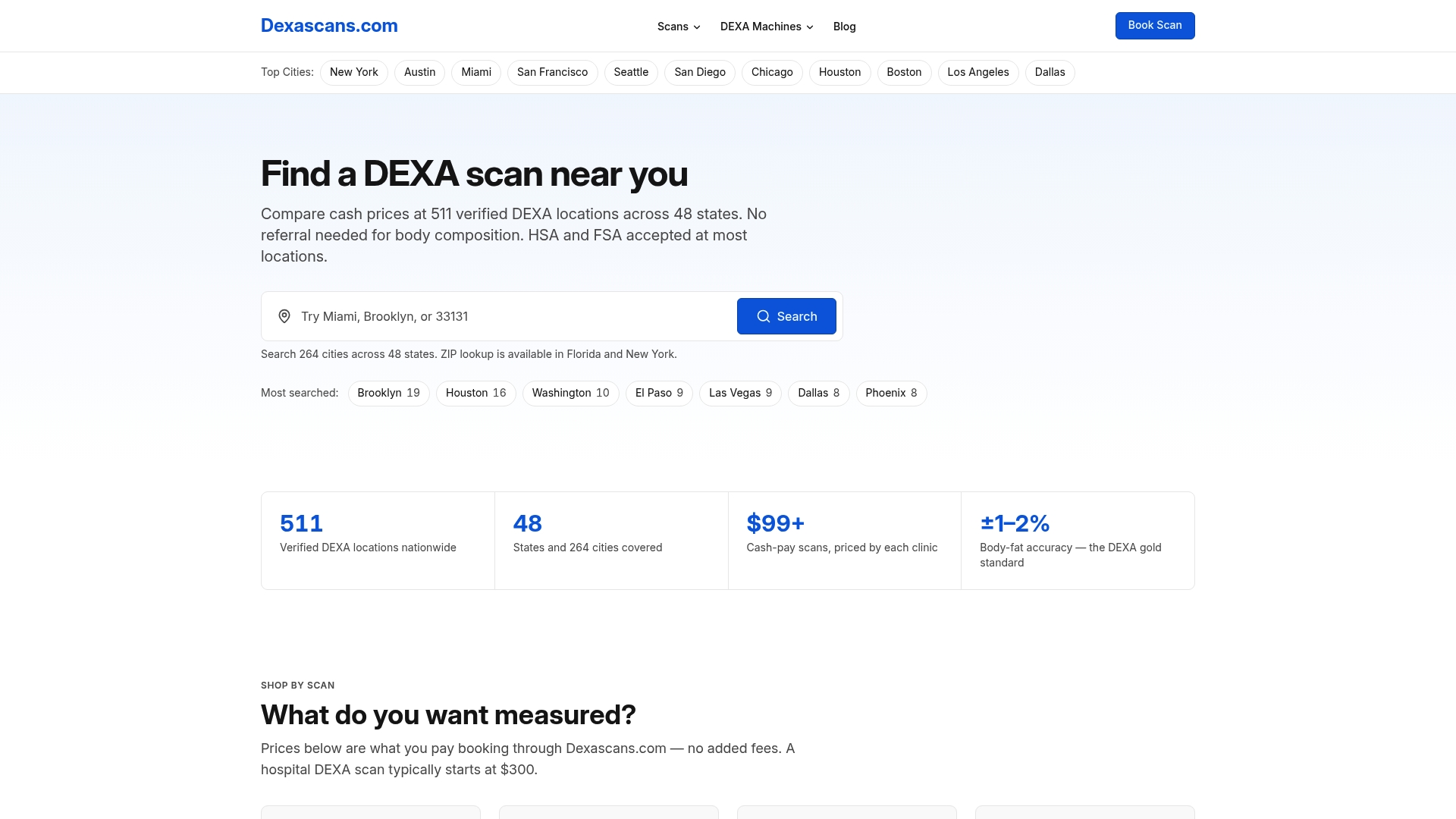
Dexascans compares DEXA scan locations across the country, showing cash pricing upfront so you know the cost before you book, and most clinics listed don't require a referral. That matters most for a specific set of readers: athletes whose BMI overstates risk, people with normal-weight obesity whose scale never reflects their actual fat mass, and anyone monitoring bone density or body composition changes over time who needs consistent, comparable data rather than a rough estimate from a home scale. Search by city or ZIP code, compare a few nearby clinics, and book directly with the one that fits your budget and schedule.
This article is general information, not a substitute for advice from a qualified doctor. Consult a qualified healthcare professional about your own circumstances before acting on anything here.
Sources
FAQ
Is 20% Body Fat Considered High?
For men, 20% body fat sits at the upper edge of the healthy range most clinicians use, while for women it falls comfortably within a healthy range. Context matters: an athlete at 20% might be carrying more muscle than the average adult, so the number alone doesn't tell the whole story without also considering activity level and waist circumference.
Why Is BMI No Longer Considered Sufficient on Its Own?
BMI can't separate fat mass from muscle mass, and it doesn't account for where fat is distributed on the body. Research also shows a U-shaped mortality relationship with BMI, where the lowest mortality sometimes appears in the "overweight" range, undermining the idea of one clean cutoff for everyone.
Can You Convert BMI to Body Fat Percentage?
Not reliably. BMI and body fat percentage measure different things, an index versus a direct composition value, so no formula converts one to the other with clinical accuracy. If you need an actual body fat number, a direct measurement like a DEXA scan is the only way to get one.
Is a BMI of 26 Considered Overweight?
Yes, a BMI of 26 falls into the overweight category under CDC guidelines, which range from 25.0 to 29.9. That said, a BMI of 26 on a muscular frame can reflect a very different body composition than the same number on someone with low muscle mass, which is exactly why pairing it with waist circumference or a body fat measurement gives a clearer picture.